Department of Entomology, Center for Pollinator Research, The Pennsylvania State University, University Park, PA 16802, USA.
USDA-ARS-PWA Pollinating Insect Research Unit, Logan, UT 84322, USA.
Sci Rep. 2017 Jan 16;7:40499. doi: 10.1038/srep40499.
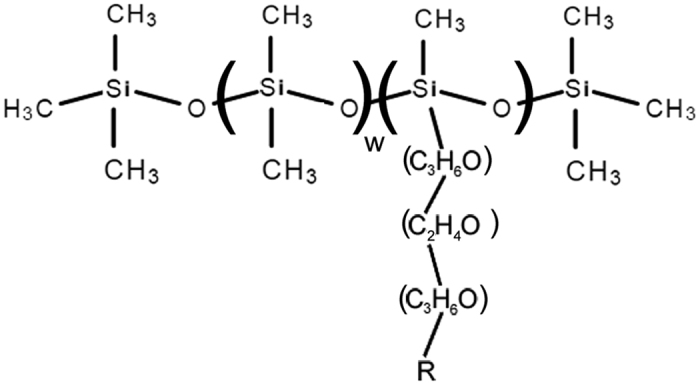
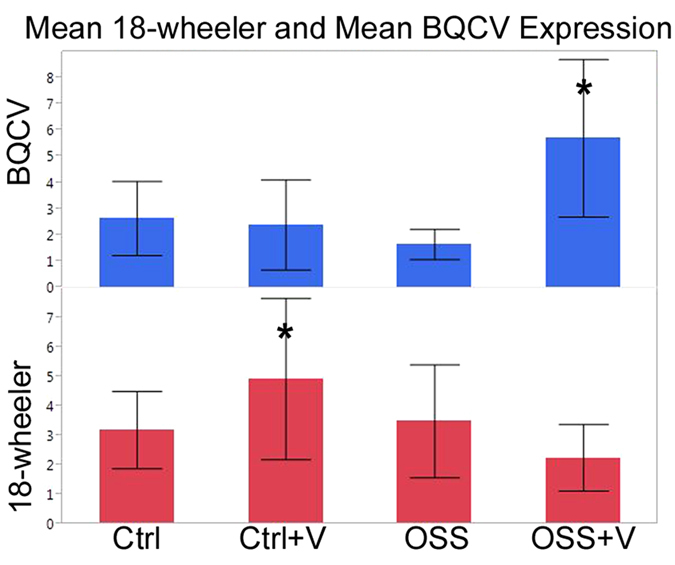
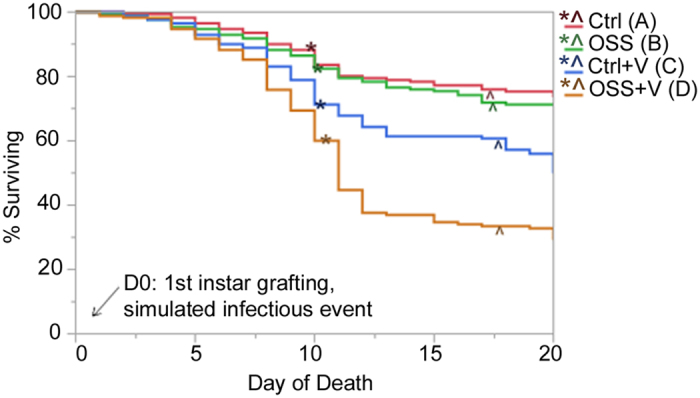
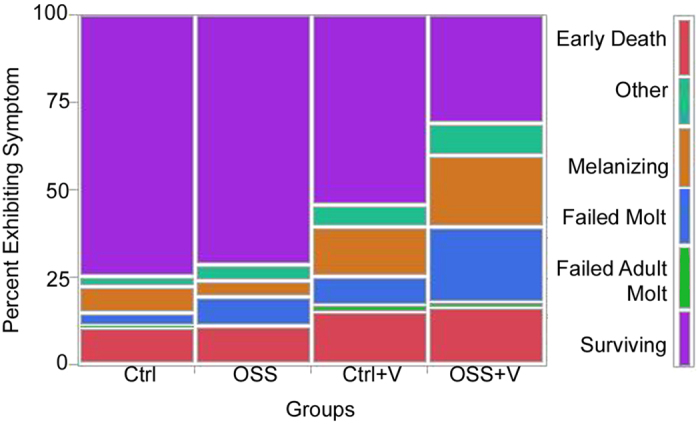
Honey bees are highly valued for their pollination services in agricultural settings, and recent declines in managed populations have caused concern. Colony losses following a major pollination event in the United States, almond pollination, have been characterized by brood mortality with specific symptoms, followed by eventual colony loss weeks later. In this study, we demonstrate that these symptoms can be produced by chronically exposing brood to both an organosilicone surfactant adjuvant (OSS) commonly used on many agricultural crops including wine grapes, tree nuts and tree fruits and exogenous viral pathogens by simulating a horizontal transmission event. Observed synergistic mortality occurred during the larval-pupal molt. Using q-PCR techniques to measure gene expression and viral levels in larvae taken prior to observed mortality at metamorphosis, we found that exposure to OSS and exogenous virus resulted in significantly heightened Black Queen Cell Virus (BQCV) titers and lower expression of a Toll 7-like-receptor associated with autophagic viral defense (Am18w). These results demonstrate that organosilicone spray adjuvants that are considered biologically inert potentiate viral pathogenicity in honey bee larvae, and guidelines for OSS use may be warranted.
蜜蜂在农业环境中的授粉服务受到高度重视,但近年来管理种群数量的下降引起了人们的关注。在美国的一次主要授粉事件(杏仁授粉)之后,蜂群出现了特定症状的幼虫死亡,随后数周后最终蜂群消失。在这项研究中,我们证明,通过模拟水平传播事件,使幼虫长期接触常用于许多农作物(包括酿酒葡萄、坚果树和核果)的有机硅表面活性剂助剂(OSS)和外源性病毒病原体,会产生这些症状。在幼虫-蛹变态期间观察到协同致死作用。使用 q-PCR 技术测量在观察到变态期间的死亡率之前采集的幼虫中的基因表达和病毒水平,我们发现暴露于 OSS 和外源性病毒会导致黑皇后细胞病毒(BQCV)滴度显著升高,并且与自噬性病毒防御相关的 Toll 7 样受体(Am18w)的表达降低。这些结果表明,被认为具有生物惰性的有机硅喷雾助剂会增强蜜蜂幼虫中的病毒致病性,可能需要制定 OSS 使用指南。