Wojdylo Kamila, Karlsson Wilhelm, Baumann Nicola
Institute of Psychology , Polish Academy of Sciences, Warsaw, Poland.
Department of Psychology, University of Trier , Trier, Germany.
J Behav Addict. 2016 Mar;5(1):90-99. doi: 10.1556/2006.5.2016.005.
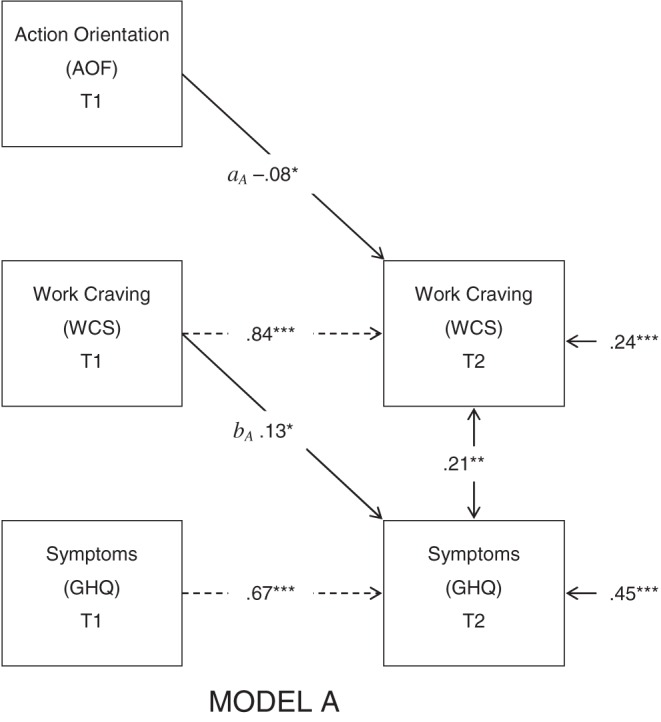
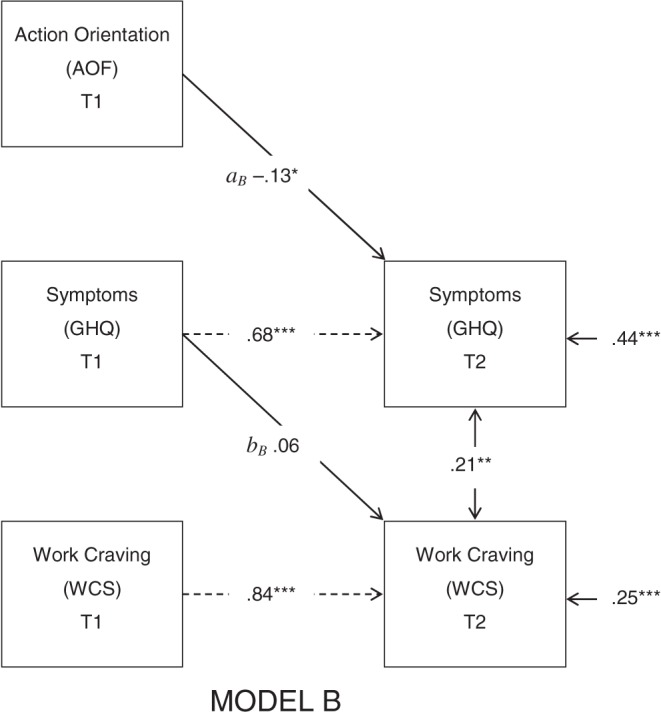
Background The theory of work craving defines workaholism as a pathological work addiction which comprises: (a) obsessive-compulsive desire to work, (b) anticipation of self-worth compensatory incentives from working, (c) anticipation of reduction of negative emotions or withdrawal symptoms from working, and (d) neurotic perfectionism. Research has shown that workaholism is associated with adverse health outcomes. However, the antecedents of workaholism and the causal direction of the relationship with health have been largely neglected. Aims In the present longitudinal study, we expect that work craving is predicted by deficits in emotional self-regulation (i.e., low action orientation) and mediates the relationship between self-regulation deficits and symptoms of psychological distress. We expected work craving to have an effect on later psychological distress symptoms, but not psychological distress symptoms to have an effect on later work craving. Methods In a sample of 170 German employees, a half-longitudinal design using two times of measurement was implemented to specify the paths of two different structural equation models of mediation: (a) action orientation to later work craving and work craving to later psychological distress, and alternatively, (b) the temporal order of action orientation to later distress and distress to later work craving. Results Our data indicated that work craving partially mediated the relationship between self-regulation deficits and psychological distress, but psychological distress symptoms were not found to increase later work craving. Conclusions The presented longitudinal study indicates important mechanisms of work craving, especially by highlighting the influence of self-regulation deficits on work craving and, in turn, psychological distress.
背景 工作渴望理论将工作狂定义为一种病态的工作成瘾,其包括:(a)强迫性的工作欲望,(b)预期从工作中获得自我价值补偿激励,(c)预期通过工作减少负面情绪或戒断症状,以及(d)神经质完美主义。研究表明,工作狂与不良健康结果相关。然而,工作狂的前因以及与健康关系的因果方向在很大程度上被忽视了。目的 在本纵向研究中,我们预期工作渴望由情绪自我调节缺陷(即低行动导向)预测,并介导自我调节缺陷与心理困扰症状之间的关系。我们预期工作渴望会对后期的心理困扰症状产生影响,但心理困扰症状不会对后期的工作渴望产生影响。方法 在170名德国员工的样本中,采用两次测量的半纵向设计来确定两种不同的中介结构方程模型的路径:(a)行动导向对后期工作渴望以及工作渴望对后期心理困扰,或者(b)行动导向对后期困扰以及困扰对后期工作渴望的时间顺序。结果 我们的数据表明,工作渴望部分介导了自我调节缺陷与心理困扰之间的关系,但未发现心理困扰症状会增加后期的工作渴望。结论 所呈现的纵向研究表明了工作渴望的重要机制,特别是通过强调自我调节缺陷对工作渴望进而对心理困扰的影响。