Fikrig Kara, Johnson Brian J, Fish Durland, Ritchie Scott A
Yale School of Public Health, Yale University, 60 College Street, P.O. Box 208034, New Haven, CT, 06520, USA.
College of Public Health, Medical and Veterinary Sciences, James Cook University, PO Box 6811, Cairns, QLD, 4870, Australia.
Parasit Vectors. 2017 Jan 17;10(1):32. doi: 10.1186/s13071-016-1946-y.
The viruses transmitted by Aedes aegypti, including dengue and Zika viruses, are rapidly expanding in geographic range and as a threat to public health. In response, control programs are increasingly turning to the use of sterile insect techniques resulting in a need to trap male Ae. aegypti to monitor the efficacy of the intervention. However, there is a lack of effective and cheap methods for trapping males. Thus, we attempted to exploit the physiological need to obtain energy from sugar feeding in order to passively capture male and female Ae. aegypti (nulliparous and gravid) in free-flight attraction assays. Candidate lures included previously identified floral-based (phenylacetaldehyde, linalool oxide, phenylethyl alcohol, and acetophenone) attractants and an attractive toxic sugar bait-based (ATSB) solution of guava and mango nectars. A free-flight attraction assay assessed the number of mosquitoes attracted to each candidate lure displayed individually. Then, a choice test was performed between the best-performing lure and a water control displayed in Gravid Aedes Traps (GAT).
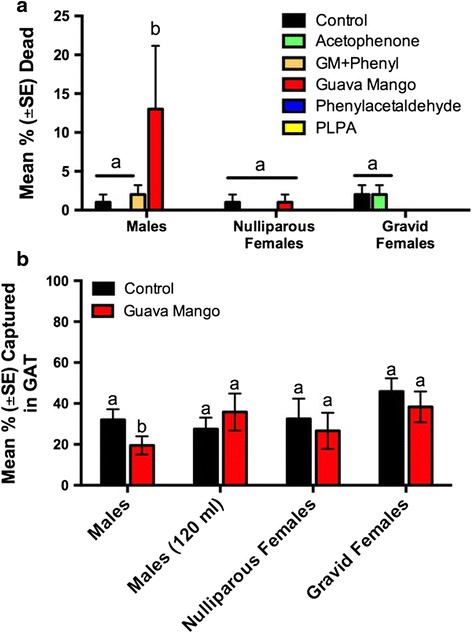
Results from the attraction assays indicated that the ATSB solution of guava and mango nectars was the most promising lure candidate for males; unlike the floral-based attractants tested, it performed significantly better than the water control. Nulliparous and gravid females demonstrated no preference among the lures and water controls indicating a lack of attraction to floral-based attractants and sugar baits in a larger setting. Although the guava-mango ATSB lure was moderately attractive to males when presented directly (i.e. no need to enter a trap or other confinement), it failed to attract significantly more male, nulliparous female, or gravid female Ae. aegypti than water controls when presented inside a Gravid Aedes Trap.
Our findings suggest that the use of volatile floral-based attractants and sugar mixtures that have been identified in the literature is not an effective lure by which to kill Ae. aegypti at ATSB stations nor capture them in the GAT. Future trapping efforts would likely be more successful if focused on more promising methods for capturing male and female Ae. aegypti.
埃及伊蚊传播的病毒,包括登革热病毒和寨卡病毒,正在迅速扩大其地理范围,对公众健康构成威胁。作为应对措施,控制项目越来越多地采用不育昆虫技术,这就需要诱捕雄性埃及伊蚊来监测干预措施的效果。然而,目前缺乏有效且廉价的诱捕雄性埃及伊蚊的方法。因此,我们试图利用埃及伊蚊通过取食糖分获取能量的生理需求,以便在自由飞行吸引试验中被动捕获雄性和雌性埃及伊蚊(未产卵和怀孕的)。候选诱饵包括先前鉴定出的基于花香的(苯乙醛、氧化芳樟醇、苯乙醇和苯乙酮)引诱剂,以及一种基于番石榴和芒果花蜜的有吸引力的有毒糖饵(ATSB)溶液。自由飞行吸引试验评估了单独展示的每种候选诱饵吸引的蚊子数量。然后,在性能最佳的诱饵和置于孕蚊诱捕器(GAT)中的水对照之间进行了选择测试。
吸引试验的结果表明,番石榴和芒果花蜜的ATSB溶液是最有前景的雄性诱饵候选物;与测试的基于花香的引诱剂不同,它的表现明显优于水对照。未产卵和怀孕的雌性在诱饵和水对照之间没有表现出偏好,这表明在更大的环境中,它们对基于花香的引诱剂和糖饵缺乏吸引力。尽管番石榴 - 芒果ATSB诱饵在直接展示时(即无需进入诱捕器或其他封闭空间)对雄性有一定吸引力,但当置于孕蚊诱捕器内时,它吸引的雄性、未产卵雌性或怀孕雌性埃及伊蚊数量并未显著多于水对照。
我们的研究结果表明,使用文献中已鉴定出的挥发性花香引诱剂和糖混合物,无论是在ATSB站点杀死埃及伊蚊还是在GAT中捕获它们,都不是一种有效的诱饵。如果将重点放在更有前景的捕获雄性和雌性埃及伊蚊的方法上,未来的诱捕工作可能会更成功。