Marie Curie Palliative Care Institute Liverpool (MCPCIL), Cancer Research Centre, University of Liverpool, Liverpool, UK.
Clinical Effectiveness and Evaluation Unit, Royal College of Physicians, London, UK.
BMJ Support Palliat Care. 2017 Sep;7(3):316-325. doi: 10.1136/bmjspcare-2014-000810. Epub 2017 Jan 17.
The National Care of the Dying Audit-Hospitals (NCDAH) is used as a method to evaluate care for dying patients in England. An additional component to the 2013/2014 audit was the Local Survey of Bereaved Relatives Views using the 'Care Of the Dying Evaluation' (CODE) questionnaire.
Within the context of the NCDAH audit, to evaluate quality of care provided to dying patients and their families in acute hospitals from the perspective of bereaved relatives.
Postbereavement survey to bereaved relatives.
SETTING/PARTICIPANTS: For acute hospitals wishing to participate, consecutive 'expected' adult deaths occurring between 1 May and 30 June 2013 were identified and the CODE questionnaire was sent to the next-of-kin.
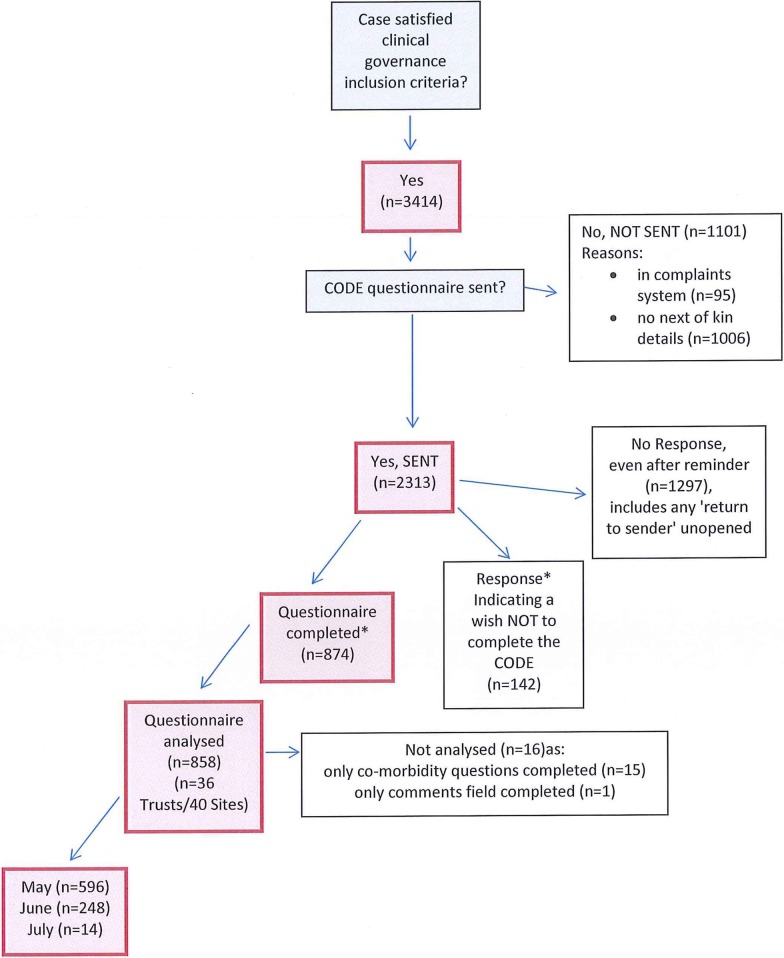
From 3414 eligible next-of-kin, 95 (2.8%) were excluded due to being involved in a complaint procedure and 1006 (29.5%) due to insufficient next-of-kin details. From the remaining 2313 potential participants, 858 returned a completed CODE questionnaire (37.1% response rate). Generally, symptoms were perceived to be well controlled with 769 (91%) participants reporting that either no pain was present or only there 'some of the time'. Unmet information needs, however, was a recognised area for improvement, for example, 230 (29%) reporting having a discussion about hydration would have been beneficial.
Adopting a postbereavement survey to NCDAH appears to be feasible, acceptable and a valuable addition. On the whole, the majority of participants reported good or excellent care. A small but significant minority, however, perceived poor quality of patient care with clear and timely communication urgently needed.
英国全国临终关怀医院审计(NCDAH)被用作评估英格兰临终患者护理的一种方法。2013/2014 年审计的另一个组成部分是使用“临终关怀评估”(CODE)问卷对死者亲属进行的“地方死者亲属意见调查”。
在 NCDAH 审计的背景下,从死者亲属的角度评估急性医院临终患者及其家属所接受的护理质量。
对死者亲属进行死后调查。
地点/参与者:愿意参与的急性医院,确定 2013 年 5 月 1 日至 6 月 30 日期间连续发生的“预期”成年死亡人数,并向近亲发送 CODE 问卷。
在 3414 名符合条件的近亲中,因参与投诉程序而被排除的有 95 人(2.8%),因近亲详细信息不足而被排除的有 1006 人(29.5%)。在剩余的 2313 名潜在参与者中,有 858 人返回了一份填写完整的 CODE 问卷(37.1%的回应率)。一般来说,症状被认为得到了很好的控制,769 名(91%)参与者报告说没有疼痛或只有“有时”有疼痛。然而,未满足的信息需求是一个需要改进的领域,例如,230 名(29%)受访者表示,关于补液的讨论将是有益的。
在 NCDAH 中采用死后调查似乎是可行的、可接受的,也是一个有价值的补充。总的来说,大多数参与者报告说护理质量良好或优秀。然而,一小部分人认为患者护理质量较差,迫切需要进行明确和及时的沟通。