Interdisciplinary Palliative Care Unit, III. Department of Medicine, University Medical Center of the Johannes Gutenberg University of Mainz, Langenbeckstr.1, 55131, Mainz, Germany.
Hannover Medical School, Institute for General Practice, Carl-Neuberg-Straße 1, 30625, Hannover, Germany.
Health Qual Life Outcomes. 2020 Sep 22;18(1):311. doi: 10.1186/s12955-020-01473-2.
International studies indicate deficits in end-of-life care that can lead to distress for patients and their next-of-kin. The aim of the study was to translate and validate the "Care of the Dying Evaluation" (CODE) into German (CODE-GER).
Translation according to EORTC (European Organisation for Research and Treatment of Cancer) guidelines was followed by data collection to evaluate psychometric properties of CODE-GER. Participants were next-of-kin of patients who had died an expected death in two hospitals. They were invited to participate at least eight, but not later than 16 weeks after the patient's death. To calculate construct validity, the Palliative care Outcome Scale (POS) was assessed. Difficulty and perceived strain of answering the questionnaire were assessed by a numeric scale (0-10).
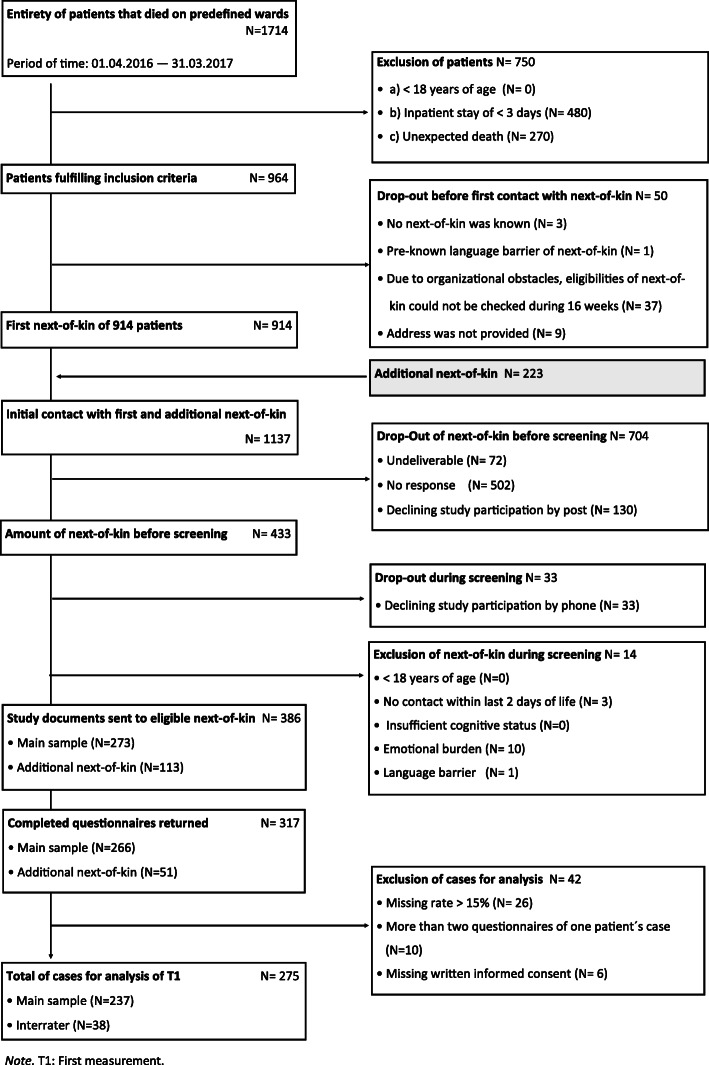
Out of 1137 next-of-kin eligible, 317 completed the questionnaire (response rate: 27.9%). Data from 237 main sample participants, 38 interraters and 55 next-of-kin who participated for repeated measurement were analysed. Overall internal consistency, α = 0.86, interrater reliability, ICC (1) = 0.79, and retest-reliability, ICC (1, 2) = 0.85, were good. Convergent validity between POS and CODE-GER, r = -.46, was satisfactory. A principal component analysis with varimax rotation showed a 7-factor solution. Difficulty, M = 2.2; SD ± 2.4, and perceived strain, M = 4.1; SD ± 3.0, of completing the questionnaire were rather low.
The results from the present study confirm CODE-GER as a reliable and valid instrument to assess the quality of care of the dying person. More over our study adds value to the original questionnaire by proposing a deepened analysis of obtained data. The development of seven subscales increases its potential for further surveys and research.
This study was registered retrospectively on the 25th of January 2018 at the German Clinical Trials Register ( DRKS00013916 ).
国际研究表明,临终关怀存在缺陷,这可能导致患者及其家属痛苦。本研究旨在将“临终关怀评估”(CODE)翻译成德文(CODE-GER)并对其进行验证。
根据欧洲癌症研究与治疗组织(EORTC)的指南进行翻译,然后收集数据以评估 CODE-GER 的心理测量特性。参与者是在两家医院去世的预期死亡患者的家属。他们被邀请在患者去世后至少 8 周,但不迟于 16 周内参加。为了计算结构效度,评估了姑息治疗结局量表(POS)。通过数字量表(0-10)评估回答问卷的难度和感知压力。
在符合条件的 1137 名家属中,有 317 人完成了问卷(应答率:27.9%)。对 237 名主要样本参与者、38 名评分者和 55 名重复测量的家属的数据进行了分析。总体内部一致性,α=0.86,评分者间信度,ICC(1)=0.79,重测信度,ICC(1,2)=0.85,均良好。POS 和 CODE-GER 之间的收敛效度,r=-0.46,令人满意。经过方差最大旋转的主成分分析显示,存在 7 个因子解决方案。完成问卷的难度,M=2.2;SD±2.4,和感知压力,M=4.1;SD±3.0,相对较低。
本研究结果证实 CODE-GER 是一种可靠有效的工具,可评估临终患者的护理质量。此外,我们的研究通过对获得的数据进行深入分析,为原始问卷增加了价值。七个子量表的开发增加了其进一步调查和研究的潜力。
本研究于 2018 年 1 月 25 日在德国临床试验注册处(DRKS00013916)进行了回顾性注册。