Beardmore Robert Eric, Peña-Miller Rafael, Gori Fabio, Iredell Jonathan
Biosciences University of Exeter, Devon, United Kingdom.
Center for Genomic Sciences, Universidad Nacional Autonóma de México, Cuernavaca, Mexico.
Mol Biol Evol. 2017 Apr 1;34(4):802-817. doi: 10.1093/molbev/msw292.
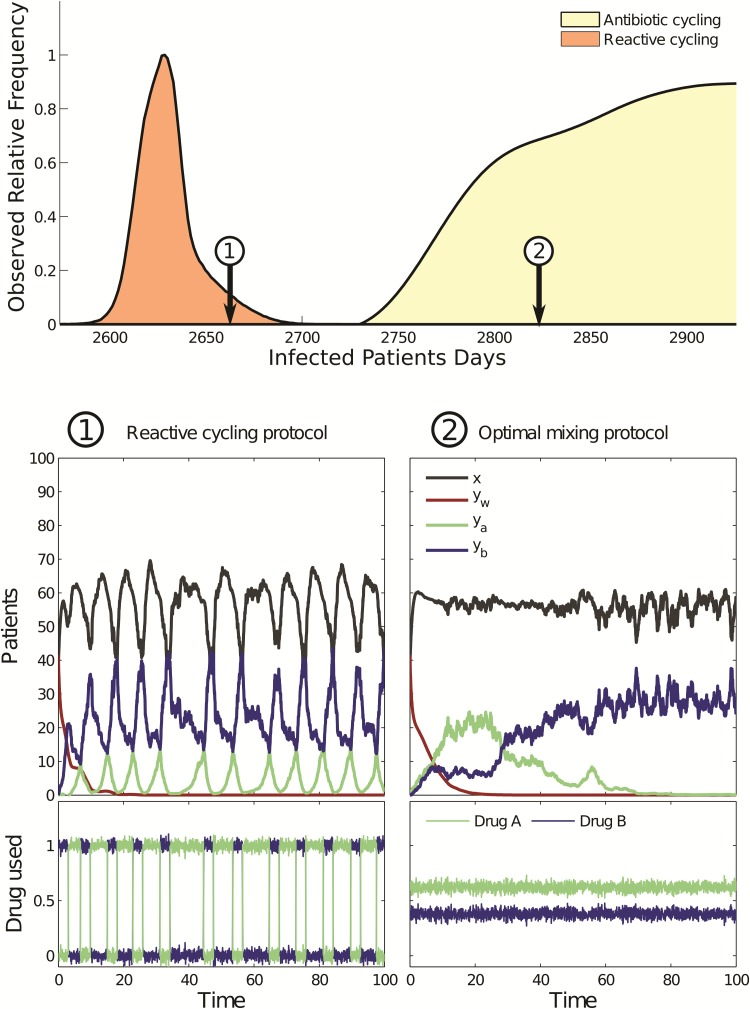
Can we exploit our burgeoning understanding of molecular evolution to slow the progress of drug resistance? One role of an infection clinician is exactly that: to foresee trajectories to resistance during antibiotic treatment and to hinder that evolutionary course. But can this be done at a hospital-wide scale? Clinicians and theoreticians tried to when they proposed two conflicting behavioral strategies that are expected to curb resistance evolution in the clinic, these are known as "antibiotic cycling" and "antibiotic mixing." However, the accumulated data from clinical trials, now approaching 4 million patient days of treatment, is too variable for cycling or mixing to be deemed successful. The former implements the restriction and prioritization of different antibiotics at different times in hospitals in a manner said to "cycle" between them. In antibiotic mixing, appropriate antibiotics are allocated to patients but randomly. Mixing results in no correlation, in time or across patients, in the drugs used for treatment which is why theorists saw this as an optimal behavioral strategy. So while cycling and mixing were proposed as ways of controlling evolution, we show there is good reason why clinical datasets cannot choose between them: by re-examining the theoretical literature we show prior support for the theoretical optimality of mixing was misplaced. Our analysis is consistent with a pattern emerging in data: neither cycling or mixing is a priori better than the other at mitigating selection for antibiotic resistance in the clinic.
: antibiotic cycling, antibiotic mixing, optimal control, stochastic models.
我们能否利用对分子进化不断增长的理解来减缓耐药性的发展?感染科临床医生的一个职责正是如此:预测抗生素治疗期间的耐药轨迹并阻碍这一进化过程。但这能在全院范围内做到吗?临床医生和理论家在提出两种相互冲突的行为策略时曾试图这样做,这两种策略预计能在临床上抑制耐药性进化,它们分别被称为“抗生素循环”和“抗生素混合”。然而,来自临床试验的累积数据(目前已接近400万患者治疗日)变化太大,以至于无法判定循环或混合策略是否成功。前者在医院不同时间对不同抗生素进行限制和排序,以一种在它们之间“循环”的方式进行。在抗生素混合中,合适的抗生素被随机分配给患者。混合导致治疗所用药物在时间上或不同患者之间没有相关性,这就是为什么理论家将其视为一种最优行为策略。所以,虽然循环和混合被提议作为控制进化的方法,但我们表明临床数据集无法在它们之间做出选择是有充分理由的:通过重新审视理论文献,我们发现之前对混合理论最优性的支持是错误的。我们的分析与数据中出现的一种模式一致:在临床上减轻对抗生素耐药性的选择方面,循环和混合都没有先验的优势。
抗生素循环,抗生素混合,最优控制,随机模型