• 文献检索
  • 文档翻译
  • 深度研究
  • 学术资讯
  • Suppr Zotero 插件Zotero 插件
  • 邀请有礼
  • 套餐&价格
  • 历史记录
应用&插件
Suppr Zotero 插件Zotero 插件浏览器插件Mac 客户端Windows 客户端微信小程序
定价
高级版会员购买积分包购买API积分包
服务
文献检索文档翻译深度研究API 文档MCP 服务
关于我们
关于 Suppr公司介绍联系我们用户协议隐私条款
关注我们

Suppr 超能文献

核心技术专利:CN118964589B侵权必究
粤ICP备2023148730 号-1Suppr @ 2026

文献检索

告别复杂PubMed语法,用中文像聊天一样搜索,搜遍4000万医学文献。AI智能推荐,让科研检索更轻松。

立即免费搜索

文件翻译

保留排版,准确专业,支持PDF/Word/PPT等文件格式,支持 12+语言互译。

免费翻译文档

深度研究

AI帮你快速写综述,25分钟生成高质量综述,智能提取关键信息,辅助科研写作。

立即免费体验

实时荧光成像揭示的鞭毛长度依赖性生长。 (注:原文“Length-dependent flagellar growth of revealed by real time fluorescent imaging.”中“of”后面缺少内容,此译文是根据已有内容尽量完善后的结果 )

Length-dependent flagellar growth of revealed by real time fluorescent imaging.

作者信息

Chen Meiting, Zhao Ziyi, Yang Jin, Peng Kai, Baker Matthew Ab, Bai Fan, Lo Chien-Jung

机构信息

Department of Physics and Graduate Institute of Biophysics, National Central University, Jhongli, Taiwan.

Biodynamic Optical Imaging Center (BIOPIC), School of Life Sciences, Peking University, Beijing, China.

出版信息

Elife. 2017 Jan 18;6:e22140. doi: 10.7554/eLife.22140.

DOI:10.7554/eLife.22140
PMID:28098557
原文链接:https://pmc.ncbi.nlm.nih.gov/articles/PMC5300704/
Abstract

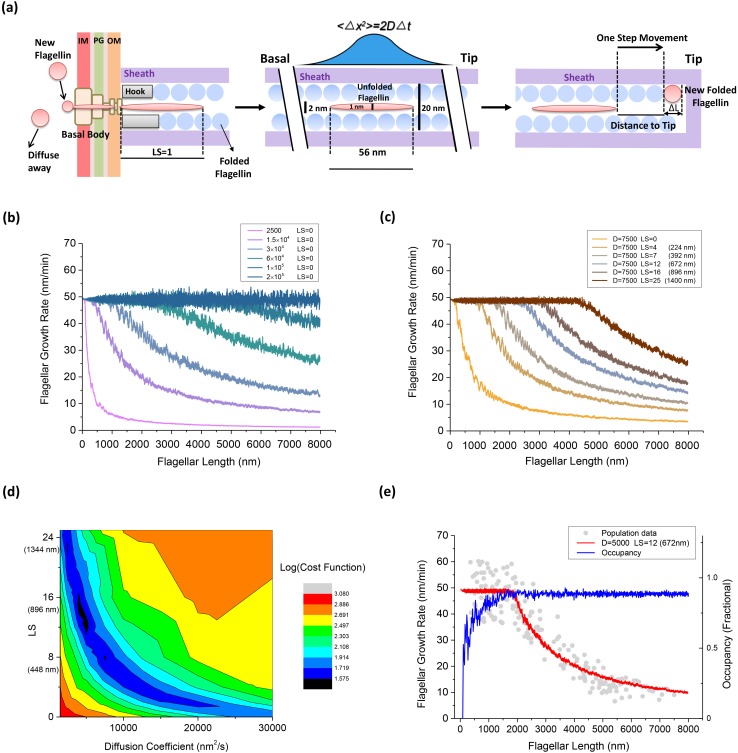
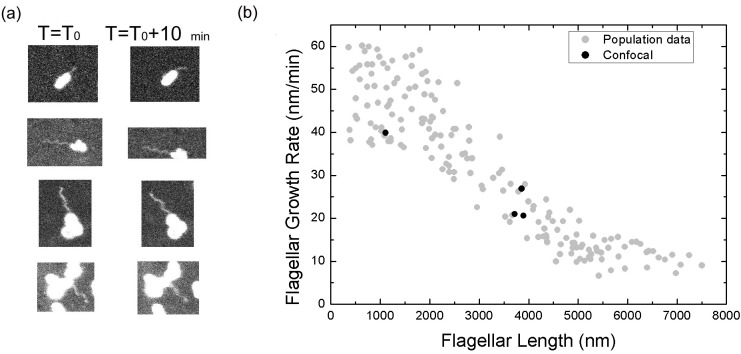
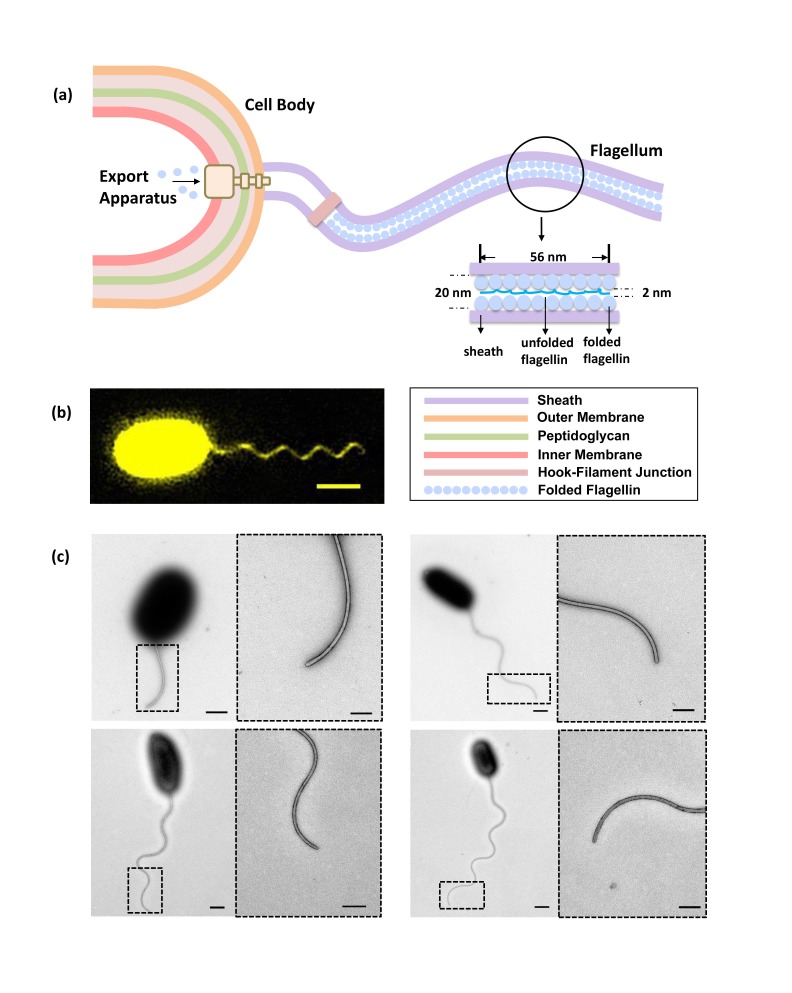
Bacterial flagella are extracellular filaments that drive swimming in bacteria. During motor assembly, flagellins are transported unfolded through the central channel in the flagellum to the growing tip. Here, we applied in vivo fluorescent imaging to monitor in real time the polar flagella growth. The flagellar growth rate is found to be highly length-dependent. Initially, the flagellum grows at a constant rate (50 nm/min) when shorter than 1500 nm. The growth rate decays sharply when the flagellum grows longer, which decreases to ~9 nm/min at 7500 nm. We modeled flagellin transport inside the channel as a one-dimensional diffusive process with an injection force at its base. When the flagellum is short, its growth rate is determined by the loading speed at the base. Only when the flagellum grows longer does diffusion of flagellin become the rate-limiting step, dramatically reducing the growth rate. Our results shed new light on the dynamic building process of this complex extracellular structure.

摘要

细菌鞭毛是驱动细菌游动的细胞外细丝。在鞭毛组装过程中,鞭毛蛋白以未折叠状态通过鞭毛中的中央通道运输到生长顶端。在此,我们应用体内荧光成像技术实时监测极鞭毛的生长。发现鞭毛的生长速率高度依赖于长度。最初,当鞭毛短于1500纳米时,它以恒定速率(50纳米/分钟)生长。当鞭毛变长时,生长速率急剧下降,在7500纳米时降至约9纳米/分钟。我们将通道内鞭毛蛋白的运输建模为一维扩散过程,在其基部有一个注入力。当鞭毛短时,其生长速率由基部的加载速度决定。只有当鞭毛变长时,鞭毛蛋白的扩散才成为限速步骤,显著降低生长速率。我们的结果为这种复杂细胞外结构的动态构建过程提供了新的见解。
https://cdn.ncbi.nlm.nih.gov/pmc/blobs/c8f5/5300704/36e6dbd7e3ba/elife-22140-fig4.jpg
https://cdn.ncbi.nlm.nih.gov/pmc/blobs/c8f5/5300704/9386339f1a5a/elife-22140-fig1.jpg
https://cdn.ncbi.nlm.nih.gov/pmc/blobs/c8f5/5300704/2ee8308a1ab7/elife-22140-fig1-figsupp1.jpg
https://cdn.ncbi.nlm.nih.gov/pmc/blobs/c8f5/5300704/dde99c60c87f/elife-22140-fig1-figsupp2.jpg
https://cdn.ncbi.nlm.nih.gov/pmc/blobs/c8f5/5300704/ba6777545619/elife-22140-fig1-figsupp3.jpg
https://cdn.ncbi.nlm.nih.gov/pmc/blobs/c8f5/5300704/7ed2b0e369e2/elife-22140-fig2.jpg
https://cdn.ncbi.nlm.nih.gov/pmc/blobs/c8f5/5300704/a3276758c01f/elife-22140-fig2-figsupp1.jpg
https://cdn.ncbi.nlm.nih.gov/pmc/blobs/c8f5/5300704/ec5b88905023/elife-22140-fig2-figsupp2.jpg
https://cdn.ncbi.nlm.nih.gov/pmc/blobs/c8f5/5300704/04f690ed46df/elife-22140-fig3.jpg
https://cdn.ncbi.nlm.nih.gov/pmc/blobs/c8f5/5300704/36e6dbd7e3ba/elife-22140-fig4.jpg
https://cdn.ncbi.nlm.nih.gov/pmc/blobs/c8f5/5300704/9386339f1a5a/elife-22140-fig1.jpg
https://cdn.ncbi.nlm.nih.gov/pmc/blobs/c8f5/5300704/2ee8308a1ab7/elife-22140-fig1-figsupp1.jpg
https://cdn.ncbi.nlm.nih.gov/pmc/blobs/c8f5/5300704/dde99c60c87f/elife-22140-fig1-figsupp2.jpg
https://cdn.ncbi.nlm.nih.gov/pmc/blobs/c8f5/5300704/ba6777545619/elife-22140-fig1-figsupp3.jpg
https://cdn.ncbi.nlm.nih.gov/pmc/blobs/c8f5/5300704/7ed2b0e369e2/elife-22140-fig2.jpg
https://cdn.ncbi.nlm.nih.gov/pmc/blobs/c8f5/5300704/a3276758c01f/elife-22140-fig2-figsupp1.jpg
https://cdn.ncbi.nlm.nih.gov/pmc/blobs/c8f5/5300704/ec5b88905023/elife-22140-fig2-figsupp2.jpg
https://cdn.ncbi.nlm.nih.gov/pmc/blobs/c8f5/5300704/04f690ed46df/elife-22140-fig3.jpg
https://cdn.ncbi.nlm.nih.gov/pmc/blobs/c8f5/5300704/36e6dbd7e3ba/elife-22140-fig4.jpg

相似文献

1
Length-dependent flagellar growth of revealed by real time fluorescent imaging.实时荧光成像揭示的鞭毛长度依赖性生长。 (注:原文“Length-dependent flagellar growth of revealed by real time fluorescent imaging.”中“of”后面缺少内容,此译文是根据已有内容尽量完善后的结果 )
Elife. 2017 Jan 18;6:e22140. doi: 10.7554/eLife.22140.
2
Conversion of mono-polar to peritrichous flagellation in Vibrio alginolyticus.在 Algolyticus 弧菌中,由单极到周生鞭毛的转换。
Microbiol Immunol. 2011 Feb;55(2):76-83. doi: 10.1111/j.1348-0421.2010.00290.x.
3
Structure of FliL, a New Stomatin-like Protein That Assists the Bacterial Flagellar Motor Function.FliL 的结构,一种新的质膜旋转酶辅助蛋白,参与细菌鞭毛马达的功能。
mBio. 2019 Mar 19;10(2):e00292-19. doi: 10.1128/mBio.00292-19.
4
Bacterial flagella grow through an injection-diffusion mechanism.细菌鞭毛通过注射扩散机制生长。
Elife. 2017 Mar 6;6:e23136. doi: 10.7554/eLife.23136.
5
Live-cell fluorescence imaging reveals dynamic production and loss of bacterial flagella.活细胞荧光成像揭示了细菌鞭毛的动态产生和损失。
Mol Microbiol. 2020 Aug;114(2):279-291. doi: 10.1111/mmi.14511. Epub 2020 May 2.
6
The bidirectional polar and unidirectional lateral flagellar motors of Vibrio alginolyticus are controlled by a single CheY species.溶藻弧菌的双向极性鞭毛马达和单向侧向鞭毛马达由单一的CheY蛋白调控。
Mol Microbiol. 2007 Apr;64(1):57-67. doi: 10.1111/j.1365-2958.2007.05623.x.
7
HubP, a Polar Landmark Protein, Regulates Flagellar Number by Assisting in the Proper Polar Localization of FlhG in Vibrio alginolyticus.HubP是一种极地标志性蛋白,通过协助FlhG在溶藻弧菌中正确的极位定位来调节鞭毛数量。
J Bacteriol. 2016 Oct 21;198(22):3091-3098. doi: 10.1128/JB.00462-16. Print 2016 Nov 15.
8
Asymmetric swimming pattern of Vibrio alginolyticus cells with single polar flagella.具有单根极鞭毛的溶藻弧菌细胞的不对称游动模式。
FEMS Microbiol Lett. 2005 Jan 15;242(2):221-5. doi: 10.1016/j.femsle.2004.11.007.
9
Localization and domain characterization of the SflA regulator of flagellar formation in Vibrio alginolyticus.溶藻弧菌鞭毛形成的SflA调节因子的定位与结构域特征分析
Genes Cells. 2017 Jul;22(7):619-627. doi: 10.1111/gtc.12501. Epub 2017 May 22.
10
Low flagellar motor torque and high swimming efficiency of Caulobacter crescentus swarmer cells.新月柄杆菌游动细胞的低鞭毛马达扭矩和高游动效率。
Biophys J. 2006 Oct 1;91(7):2726-34. doi: 10.1529/biophysj.106.080697. Epub 2006 Jul 14.

引用本文的文献

1
Risk-reward trade-off during carbon starvation generates dichotomy in motility endurance among marine bacteria.碳饥饿期间的风险-回报权衡导致海洋细菌在运动耐力上出现二分法。
Nat Microbiol. 2025 May 26. doi: 10.1038/s41564-025-01997-7.
2
Bacterial motility depends on a critical flagellum length and energy-optimized assembly.细菌的运动性取决于关键的鞭毛长度和能量优化组装。
Proc Natl Acad Sci U S A. 2025 Mar 18;122(11):e2413488122. doi: 10.1073/pnas.2413488122. Epub 2025 Mar 11.
3
Decoding Bacterial Motility: From Swimming States to Patterns and Chemotactic Strategies.

本文引用的文献

1
Characterization of polar-flagellar-length mutants in ..中极性鞭毛长度突变体的表征
Microbiology (Reading). 1997 May;143(5):1615-1621. doi: 10.1099/00221287-143-5-1615.
2
A Delicate Nanoscale Motor Made by Nature-The Bacterial Flagellar Motor.一种由自然制造的精密纳米级马达——细菌鞭毛马达。
Adv Sci (Weinh). 2015 Jun 25;2(9):1500129. doi: 10.1002/advs.201500129. eCollection 2015 Sep.
3
The Intraflagellar Transport Machinery.鞭毛内运输机制。
解码细菌运动性:从游动状态到模式及趋化策略
Biomolecules. 2025 Jan 23;15(2):170. doi: 10.3390/biom15020170.
4
A conserved cell-pole determinant organizes proper polar flagellum formation.一种保守的细胞极决定因子组织适当的极鞭毛形成。
Elife. 2024 Dec 5;13:RP93004. doi: 10.7554/eLife.93004.
5
FlaG competes with FliS-flagellin complexes for access to FlhA in the flagellar T3SS to control filament length.FlgG 与 FliS-鞭毛蛋白复合物竞争进入鞭毛 T3SS 中的 FlhA,以控制菌毛长度。
Proc Natl Acad Sci U S A. 2024 Oct 29;121(44):e2414393121. doi: 10.1073/pnas.2414393121. Epub 2024 Oct 23.
6
Functional fibrillar interfaces: Biological hair as inspiration across scales.功能性纤维界面:以生物毛发为灵感跨越尺度
Beilstein J Nanotechnol. 2024 Jun 6;15:664-677. doi: 10.3762/bjnano.15.55. eCollection 2024.
7
Live-Cell Imaging of the Assembly and Ejection Processes of the Bacterial Flagella by Fluorescence Microscopy.荧光显微镜活细胞成像研究细菌鞭毛的组装和射出过程。
Methods Mol Biol. 2023;2646:35-42. doi: 10.1007/978-1-0716-3060-0_4.
8
Recent insights into type-3 secretion system injectisome structure and mechanism of human enteric pathogens.近期对 3 型分泌系统注入器结构和人类肠道病原体作用机制的深入了解。
Curr Opin Microbiol. 2023 Feb;71:102232. doi: 10.1016/j.mib.2022.102232. Epub 2022 Nov 9.
9
Insight Into Distinct Functional Roles of the Flagellar ATPase Complex for Flagellar Assembly in .深入了解鞭毛ATP酶复合物在鞭毛组装中的不同功能作用。
Front Microbiol. 2022 May 4;13:864178. doi: 10.3389/fmicb.2022.864178. eCollection 2022.
10
Transitioning to confined spaces impacts bacterial swimming and escape response.进入封闭空间会影响细菌的游动和逃离反应。
Biophys J. 2022 Jul 5;121(13):2653-2662. doi: 10.1016/j.bpj.2022.04.008. Epub 2022 Apr 6.
Cold Spring Harb Perspect Biol. 2016 Oct 3;8(10):a028092. doi: 10.1101/cshperspect.a028092.
4
Internal and external components of the bacterial flagellar motor rotate as a unit.细菌鞭毛马达的内部和外部组件作为一个整体旋转。
Proc Natl Acad Sci U S A. 2016 Apr 26;113(17):4783-7. doi: 10.1073/pnas.1511691113. Epub 2016 Apr 11.
5
Domain-swap polymerization drives the self-assembly of the bacterial flagellar motor.结构域交换聚合驱动细菌鞭毛马达的自组装。
Nat Struct Mol Biol. 2016 Mar;23(3):197-203. doi: 10.1038/nsmb.3172. Epub 2016 Feb 8.
6
Type III secretion systems: the bacterial flagellum and the injectisome.III型分泌系统:细菌鞭毛与注射体。
Philos Trans R Soc Lond B Biol Sci. 2015 Oct 5;370(1679). doi: 10.1098/rstb.2015.0020.
7
Fueling type III secretion.为III型分泌提供动力。
Trends Microbiol. 2015 May;23(5):296-300. doi: 10.1016/j.tim.2015.01.012. Epub 2015 Feb 17.
8
The bacterial flagellar protein export apparatus processively transports flagellar proteins even with extremely infrequent ATP hydrolysis.细菌鞭毛蛋白输出装置即使在ATP水解极其罕见的情况下也能持续运输鞭毛蛋白。
Sci Rep. 2014 Dec 22;4:7579. doi: 10.1038/srep07579.
9
Bacterial type III secretion systems: specialized nanomachines for protein delivery into target cells.细菌III型分泌系统:用于将蛋白质递送至靶细胞的特殊纳米机器。
Annu Rev Microbiol. 2014;68:415-38. doi: 10.1146/annurev-micro-092412-155725. Epub 2014 Jun 18.
10
Structure, gene regulation and environmental response of flagella in Vibrio.弧菌鞭毛的结构、基因调控与环境响应。
Front Microbiol. 2013 Dec 25;4:410. doi: 10.3389/fmicb.2013.00410.