Yang Yu-Wan, Hsieh Teng-Fu, Li Chia-Ing, Liu Chiu-Shong, Lin Wen-Yuan, Chiang Jen-Huai, Li Tsai-Chung, Lin Cheng-Chieh
Department of Neurology, China Medical University Hospital School of Medicine, China Medical University Department of Urology, Taichung Tzu Chi Hospital, Buddhist Tzu Chi Medical Foundation, Taichung School of Medicine, Tzu Chi University, Hualian School of Medicine, College of Medicine, China Medical University Department of Medical Research, China Medical University Hospital Department of Family Medicine, China Medical University Hospital Management Office for Health Data, China Medical University Hospital Research Center for Chinese Medicine and Acupuncture, China Medical University Department of Public Health, College of Public Health, China Medical University Department of Healthcare Administration, College of Medical and Health Science, Asia University, Taichung, Taiwan.
Medicine (Baltimore). 2017 Jan;96(3):e5921. doi: 10.1097/MD.0000000000005921.
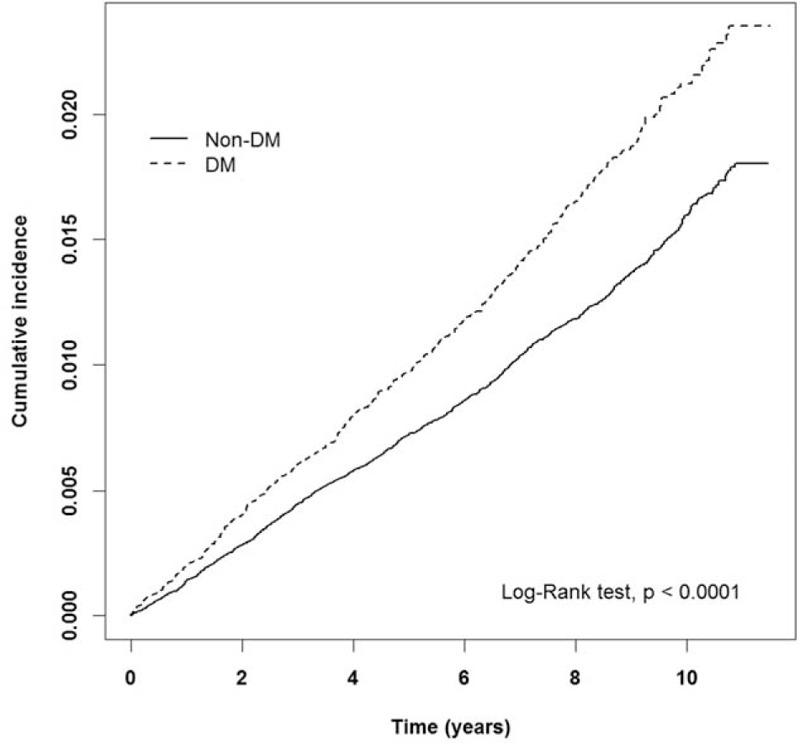
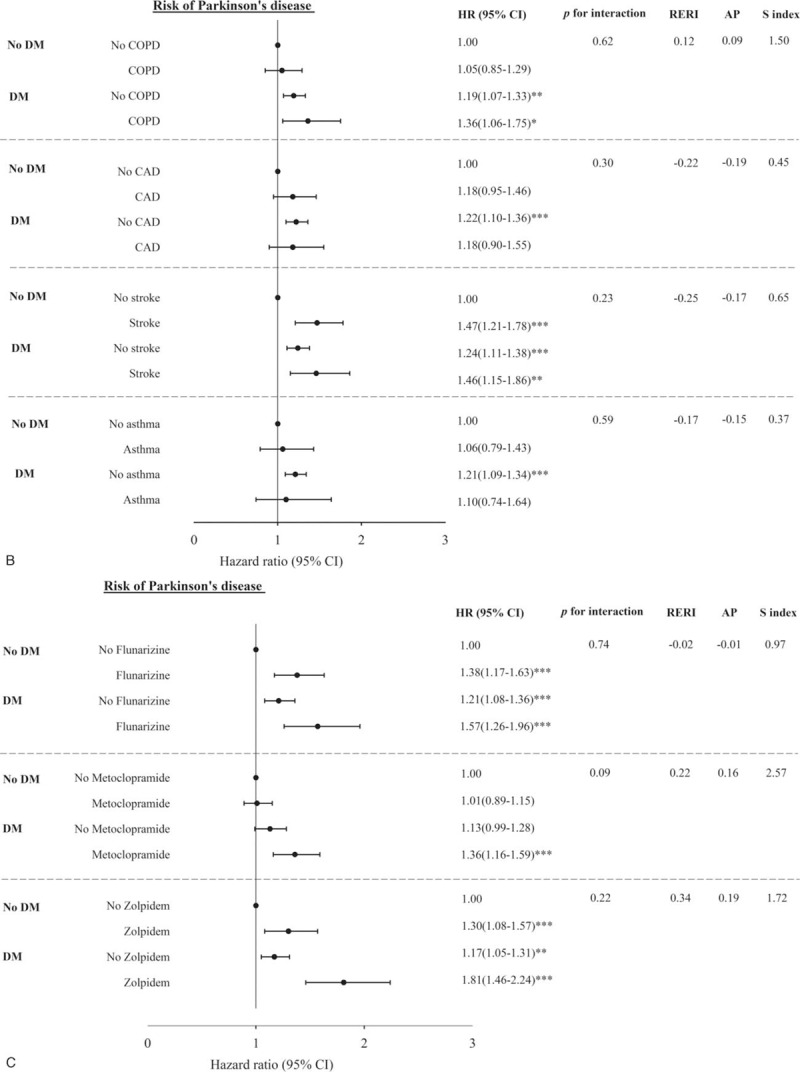
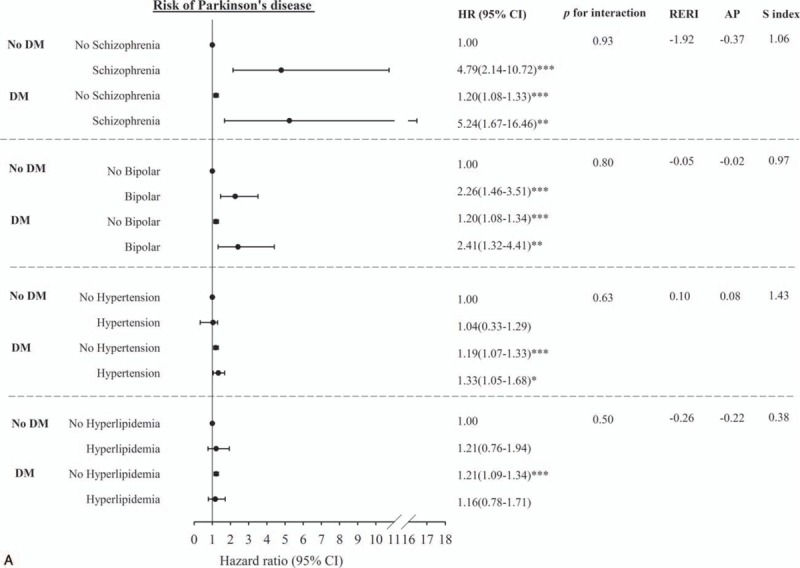
This nationwide population-based study investigated the risk of Parkinson disease (PD) in relation to diabetes mellitus (DM) through the National Health Insurance Research Database in Taiwan.A retrospective study was conducted, consisting of 36,294 patients who were newly diagnosed with DM between January 1, 2000 and December 31, 2006 and 108,882 individuals without DM as healthy controls from insurance claims data from Taiwan's National Health Research Institutes Dataset. The subjects were followed up until December 31, 2011 or until the first manifestation of PD. The hazard ratio (HR) of DM for PD incidence was estimated by Cox proportional hazard regression model.Compared with the non-DM cohort, the incidence density rate of PD was 1.36-fold higher in the DM cohort (1.53 vs 2.08 per 1000 person-years) with an adjusted HR of 1.19 (95% confidence interval = 1.08-1.32) after adjusting for age, sex, comorbidities, and medication use. The adjusted HR of PD for DM with a larger magnitude was observed in females (1.29, 1.12-1.49); individuals age 65 years and older (1.20, 1.06-1.35); those without schizophrenia (1.20, 1.08-1.33), bipolar disorder (1.20, 1.08-1.33), hypertension (1.18, 1.06-1.32), hyperlipidemia (1.21, 1.09-1.34), chronic obstructive pulmonary disease (1.19, 1.06-1.32), coronary artery disease (1.22, 1.09-1.36), stroke (1.23, 1.10-1.37), asthma (1.20, 1.08-1.34), flunarizine use (1.21, 1.08-1.35), zolpidem use (1.16, 1.04-1.30), Charlson comorbidity index score of 0 (1.23, 1.08-1.40), and those using metoclopramide (1.35, 1.14-1.60) and zolpidem (1.46, 1.12-1.90).DM increased the risk of PD during a mean follow-up of 7.3 years. Further mechanistic research on the effect of DM on PD is needed.
这项基于全国人口的研究通过台湾地区国民健康保险研究数据库,调查了糖尿病(DM)与帕金森病(PD)之间的关联风险。开展了一项回顾性研究,研究对象包括2000年1月1日至2006年12月31日期间新诊断为糖尿病的36294例患者,以及来自台湾地区国民健康研究院数据集保险理赔数据中的108882例无糖尿病的个体作为健康对照。对研究对象进行随访至2011年12月31日或直至帕金森病首次出现。采用Cox比例风险回归模型估计糖尿病对帕金森病发病率的风险比(HR)。与非糖尿病队列相比,糖尿病队列中帕金森病的发病密度率高1.36倍(每1000人年分别为1.53例和2.08例),在调整年龄、性别、合并症和用药情况后,调整后的HR为1.19(95%置信区间=1.08-1.32)。在女性(1.29,1.12-1.49);65岁及以上个体(1.20,1.06-1.35);无精神分裂症(1.20,1.08-1.33)、双相情感障碍(1.20,1.08-1.33)、高血压(1.18,1.06-1.32)、高脂血症(1.21,1.09-1.34)、慢性阻塞性肺疾病(1.19,1.06-1.32)、冠状动脉疾病(1.22,1.09-1.36)、中风(1.23,1.10-1.37)、哮喘(1.20,1.08-1.34)、使用氟桂利嗪(1.21,1.08-1.35)、使用唑吡坦(1.16,1.04-1.30)、Charlson合并症指数评分为0(1.23,1.08-1.40),以及使用甲氧氯普胺(1.35,1.14-1.60)和唑吡坦(1.46,1.12-1.90)的人群中,观察到糖尿病对帕金森病的调整后HR幅度更大。在平均7.3年的随访期间,糖尿病增加了帕金森病的风险。需要对糖尿病对帕金森病影响的机制进行进一步研究。