O'Shea Sarah, Liu Yuilin, Liu Chunyu, Frank Samuel A, Shih Ludy C, Au Rhoda
Columbia University Vagelos College of Physicians and Surgeons, New York, NY, USA.
Taub Institute for Research on Alzheimer's Disease and the Aging Brain, New York, NY, USA.
Clin Park Relat Disord. 2024 Dec 3;12:100291. doi: 10.1016/j.prdoa.2024.100291. eCollection 2025.
To determine the role of obesity in the development of Parkinson's disease (PD).
Obesity has been reported to be both a risk factor for PD, as well as potentially protective. The Framingham Heart Study (FHS) is a multigenerational longitudinal cohort study that was started in 1948, which is well-known for its cardiovascular health studies. In this study, we utilized the extensive cardiovascular and neurological data to determine if obesity contributes to the risk of the development of PD.
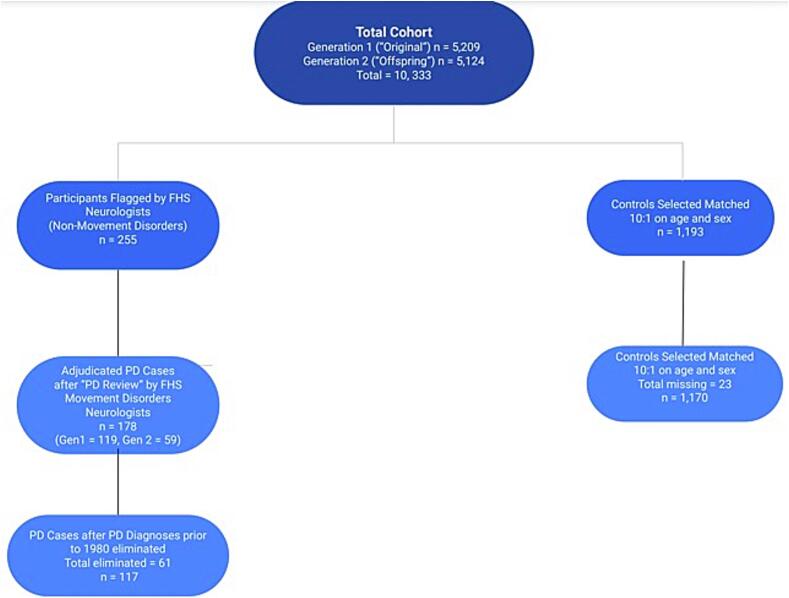
Participants in the FHS Original and Offspring cohorts were included in this study. Controls were selected based on sex and age at baseline examination, 1:10. Cox proportional hazard regression models were used, adjusting for age and sex. PD case status was determined utilizing prior medical and neurological examination data, Framingham Heart Study examinations, and self-report data by a panel of movement disorders neurologists using the UK Brain Bank Criteria (UKBB) and other supporting clinical details after being flagged for review by FHS neurologists. We used p < 0.05 for significance.
Accounting for missing covariate data, this study included 117 participants with PD, with 1170 controls. We found that higher BMI was associated with lower PD risk, with participants with BMI 25 kg/m2 to 30 kg/m2 having HR of 0.66 (CI 0.44-0.98; p = 0.04) and BMI >= 30 kg/m2 having HR 0.47 (CI 0.27-0.84; p = 0.01). When the overweight and obese BMI groups were combined, we noted a more robust association, with combined HR of 0.67 (0.41-0.86; p = 0.01).
Obesity during mid-life potentially reduces the risk of developing PD; however, additional studies are needed to further explore this association.
确定肥胖在帕金森病(PD)发展中的作用。
据报道,肥胖既是PD的一个风险因素,也可能具有保护作用。弗雷明汉心脏研究(FHS)是一项始于1948年的多代纵向队列研究,以其心血管健康研究而闻名。在本研究中,我们利用广泛的心血管和神经学数据来确定肥胖是否会增加PD发病的风险。
FHS原始队列和后代队列的参与者被纳入本研究。根据基线检查时的性别和年龄按1:10选择对照。使用Cox比例风险回归模型,并对年龄和性别进行调整。通过一组运动障碍神经科医生,利用英国脑库标准(UKBB)以及FHS神经科医生标记以供审查后提供的其他支持性临床细节,根据既往医学和神经学检查数据、弗雷明汉心脏研究检查以及自我报告数据来确定PD病例状态。我们将p < 0.05作为显著性水平。
在考虑缺失协变量数据的情况下,本研究纳入了117名PD患者和1170名对照。我们发现较高的体重指数(BMI)与较低的PD风险相关,BMI为25 kg/m²至30 kg/m²的参与者的风险比(HR)为0.66(95%置信区间[CI] 0.44 - 0.98;p = 0.04),BMI >= 30 kg/m²的参与者的HR为0.47(CI 0.27 - 0.84;p = 0.01)。当将超重和肥胖BMI组合并时,我们注意到关联更强,合并后的HR为0.67(0.41 - 0.86;p = 0.01)。
中年时期的肥胖可能会降低患PD的风险;然而,需要进一步的研究来深入探讨这种关联。