Chen Mei, Zhang Ke-Qin, Xu You-Feng, Zhang Sheng-Min, Cao Yong, Sun Wei-Qun
Department of Ultrasonography, Ningbo First Hospital, School of Medicine, Zhejiang University, Ningbo, Zhejiang 315000, P.R. China.
Department of Endocrinology, The Affiliated Hospital of Tongji University, Shanghai 200065, P.R. China.
Mol Clin Oncol. 2016 Dec;5(6):724-730. doi: 10.3892/mco.2016.1053. Epub 2016 Oct 19.
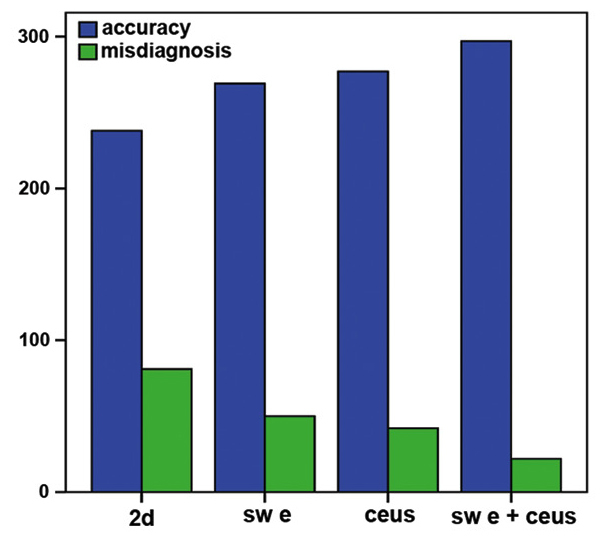
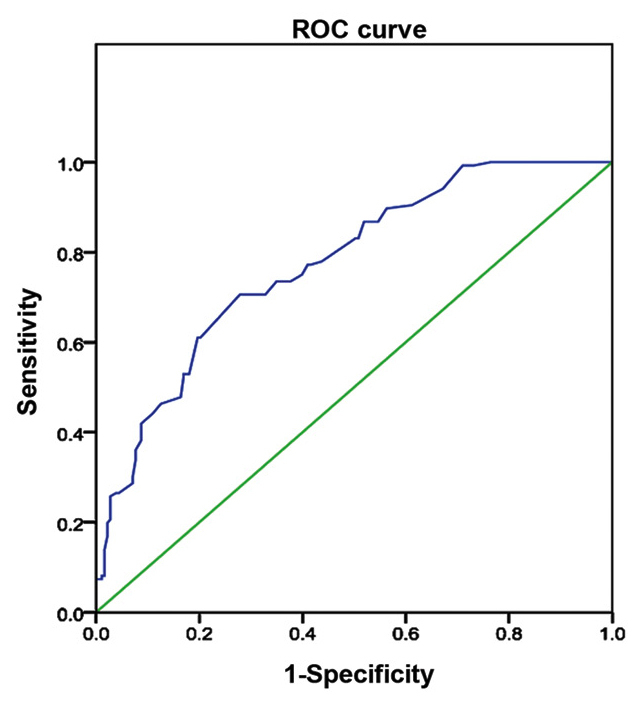
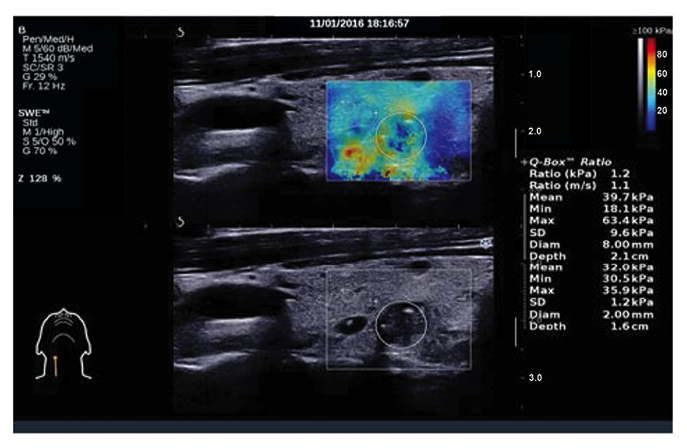
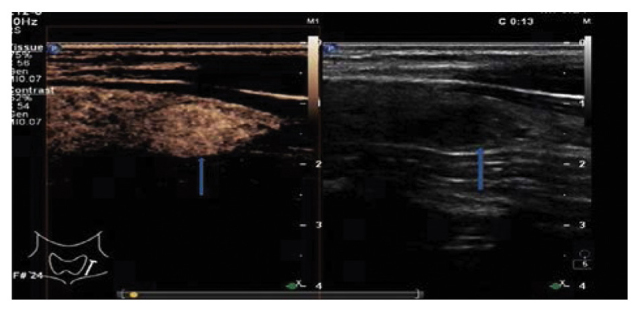
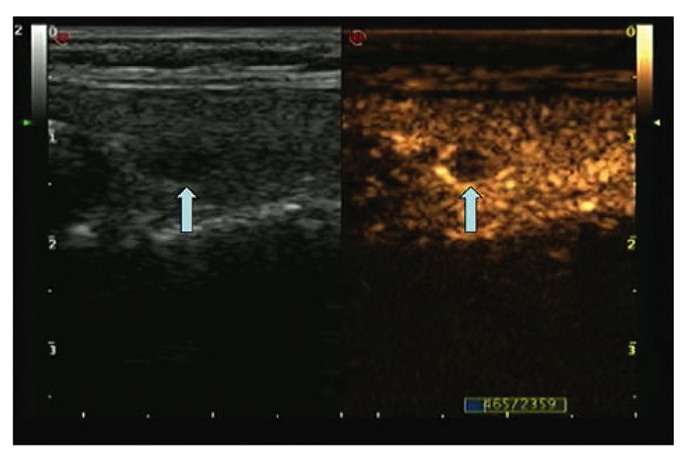
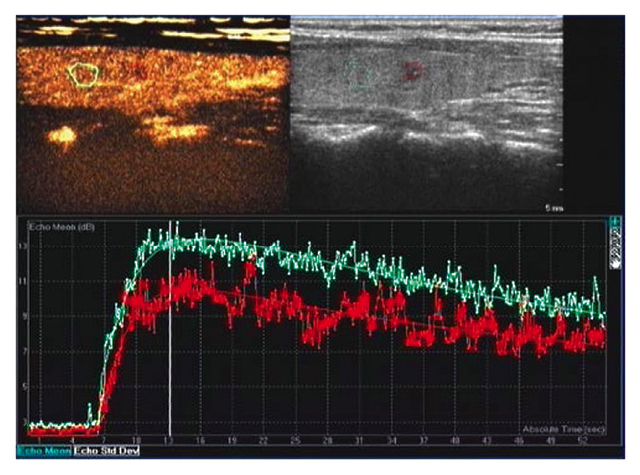
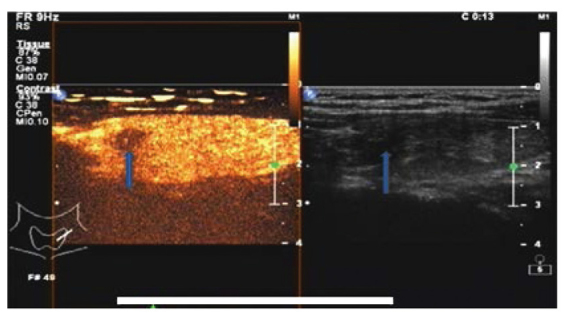
The aim of the present study was to evaluate the value of shear wave elastography (SWE) and contrast-enhanced ultrasonography (CEUS) in the diagnosis of thyroid malignant nodules. A total of 253 patients with 319 thyroid nodules were subjected to two-dimensional ultrasound (2DUS) and CEUS examinations prior to thyroidectomy between March, 2014 and December, 2015. Young's modulus value for each nodule on 2DUS and CEUS images were recorded. The sensitivity, specificity and accuracy of 2DUS, SWE and CEUS in the diagnosis of thyroid malignant nodules were assessed. The results demonstrated that, of the 319 nodules that were pathologically confirmed, 183 were malignant and 136 were benign. The area under the receiver operating characteristic curve as a result of SWE diagnosis was 0.77. When the threshold of the Young's modulus value was ≥27.65 kPa in the diagnosis of malignant thyroid nodules, SWE exhibited a sensitivity of 84.55% (115/136), a specificity of 84.15% (154/183) and an accuracy of 84.32% (269/319). US contrast imaging of malignant thyroid nodules revealed a major tendency for early hypoenhancement and hypoenhancement. CEUS exhibited a sensitivity of 87.5% (119/136), a specificity of 86.33% (158/183) and an accuracy of 86.83% (277/319) in the diagnosis of malignant thyroid nodules. Compared with 2DUS, SWE, CEUS and their combined use exhibited statistically significant differences in the diagnosis of thyroid malignant nodules in terms of sensitivity, specificity and accuracy (χ=9.220,15.310 and 40.296, respectively; P=0.000); SWE or CEUS did not differ significantly in the diagnosis of thyroid malignant nodules in terms of sensitivity, specificity or accuracy (χ=0.737;P=0.542); Compared with the use of SWE or CEUS alone, their combination exhibited statistically significant differences in the diagnosis of malignant thyroid nodules in terms of sensitivity, specificity and accuracy (χ=12.264 and 6.939, respectively; P=0.000,0.005). In conclusion, the high accuracy of the combined use of SWE and CEUS in the diagnosis of malignant thyroid nodules is of great clinical value.
本研究旨在评估剪切波弹性成像(SWE)和超声造影(CEUS)在甲状腺恶性结节诊断中的价值。2014年3月至2015年12月期间,共有253例患有319个甲状腺结节的患者在甲状腺切除术前接受了二维超声(2DUS)和CEUS检查。记录2DUS和CEUS图像上每个结节的杨氏模量值。评估2DUS、SWE和CEUS在甲状腺恶性结节诊断中的敏感性、特异性和准确性。结果表明,在319个经病理证实的结节中,183个为恶性,136个为良性。SWE诊断的受试者操作特征曲线下面积为0.77。在诊断甲状腺恶性结节时,当杨氏模量值阈值≥27.65 kPa时,SWE的敏感性为84.55%(115/136),特异性为84.15%(154/183),准确性为84.32%(269/319)。甲状腺恶性结节的超声造影成像显示早期低增强和低增强的主要趋势。CEUS在甲状腺恶性结节诊断中的敏感性为87.5%(119/136),特异性为86.33%(158/183),准确性为86.83%(277/319)。与2DUS相比,SWE、CEUS及其联合使用在甲状腺恶性结节诊断的敏感性、特异性和准确性方面存在统计学显著差异(χ分别为9.220、15.310和40.296;P = 0.000);SWE或CEUS在甲状腺恶性结节诊断的敏感性、特异性或准确性方面无显著差异(χ = 0.737;P = 0.542);与单独使用SWE或CEUS相比,它们的联合使用在甲状腺恶性结节诊断的敏感性、特异性和准确性方面存在统计学显著差异(χ分别为12.264和6.939;P = 0.000、0.005)。总之,SWE和CEUS联合使用在甲状腺恶性结节诊断中的高准确性具有重要的临床价值。