Omura John D, Carlson Susan A, Paul Prabasaj, Watson Kathleen B, Fulton Janet E
Division of Nutrition, Physical Activity, and Obesity, National Center for Chronic Disease Prevention and Health Promotion, Centers for Disease Control and Prevention, 4770 Buford Highway, NE, Mailstop F-77, Atlanta, GA 30341, United States.
Prev Med Rep. 2016 Oct 28;5:124-126. doi: 10.1016/j.pmedr.2016.10.014. eCollection 2017 Mar.
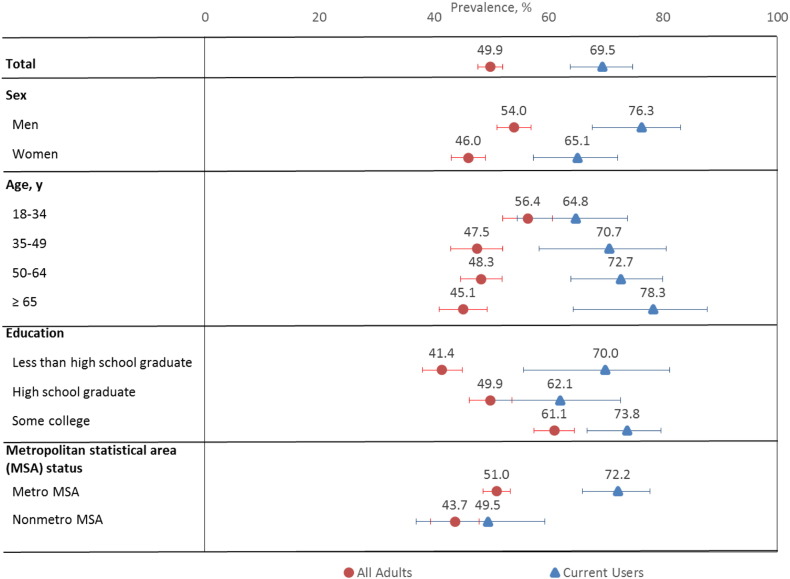
The objective of this study was to assess usage patterns of wearable activity monitors among US adults and how user characteristics might influence physical activity estimates from this type of sample. We analyzed data on 3367 respondents to the 2015 HealthStyles survey, an annual consumer mail panel survey conducted on a nationwide sample. Approximately 1 in 8 respondents (12.5%) reported currently using a wearable activity monitor. Current use varied by sex, age, and education level. Use increased with physical activity level from 4.3% for inactive adults to 17.4% for active adults. Overall, 49.9% of all adults met the aerobic physical activity guideline, while this prevalence was 69.5% among current activity monitor users. Our findings suggest that current users of wearable activity monitors are not representative of the overall US population. Estimates of physical activity levels using data from wearable activity monitors users may be an overestimate and therefore data from users alone may have a limited role in physical activity surveillance.
本研究的目的是评估美国成年人中可穿戴活动监测器的使用模式,以及用户特征如何影响基于这类样本的身体活动估计。我们分析了2015年健康生活方式调查中3367名受访者的数据,这是一项对全国范围内样本进行的年度消费者邮件小组调查。约八分之一的受访者(12.5%)报告目前正在使用可穿戴活动监测器。当前使用率因性别、年龄和教育水平而异。随着身体活动水平的提高,使用率从不活跃成年人的4.3%增至活跃成年人的17.4%。总体而言,49.9%的成年人达到了有氧身体活动指南的要求,而在当前活动监测器使用者中这一比例为69.5%。我们的研究结果表明,可穿戴活动监测器的当前使用者并不代表美国总体人口。使用可穿戴活动监测器使用者的数据对身体活动水平的估计可能偏高,因此仅来自使用者的数据在身体活动监测中可能作用有限。