Mata-Pérez Capilla, Sánchez-Calvo Beatriz, Padilla María N, Begara-Morales Juan C, Valderrama Raquel, Corpas Francisco J, Barroso Juan B
Group of Biochemistry and Cell Signaling in Nitric Oxide, Department of Experimental Biology, Center for Advanced Studies in Olive Grove and Olive Oils, Faculty of Experimental Sciences, Campus Universitario "Las Lagunillas" s/n, University of Jaén, E-23071 Jaén, Spain.
Group of Antioxidants, Free Radicals and Nitric Oxide in Biotechnology, Food and Agriculture, Department of Biochemistry, Cellular and Molecular Biology of Plants, Estación Experimental del Zaidín, Consejo Superior de Investigaciones Científicas, Granada, Spain.
Redox Biol. 2017 Apr;11:554-561. doi: 10.1016/j.redox.2017.01.002. Epub 2017 Jan 10.
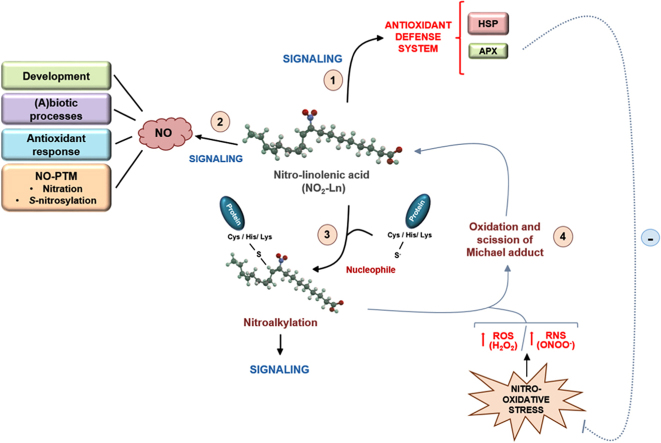
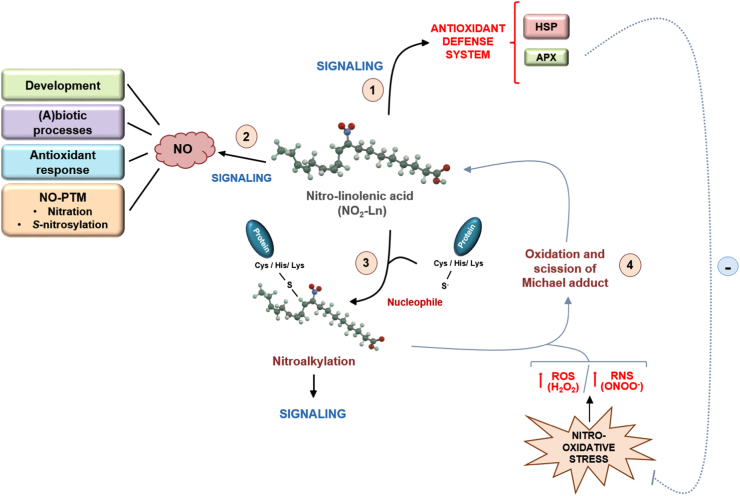
Recent studies in animal systems have shown that NO can interact with fatty acids to generate nitro-fatty acids (NO-FAs). They are the product of the reaction between reactive nitrogen species and unsaturated fatty acids, and are considered novel mediators of cell signaling based mainly on a proven anti-inflammatory response. Although these signaling mediators have been described widely in animal systems, NO-FAs have scarcely been studied in plants. Preliminary data have revealed the endogenous presence of free and protein-adducted NO-FAs in extra-virgin olive oil (EVOO), which appear to be contributing to the cardiovascular benefits associated with the Mediterranean diet. Importantly, new findings have displayed the endogenous occurrence of nitro-linolenic acid (NO-Ln) in the model plant Arabidopsis thaliana and the modulation of NO-Ln levels throughout this plant's development. Furthermore, a transcriptomic analysis by RNA-seq technology established a clear signaling role for this molecule, demonstrating that NO-Ln was involved in plant-defense response against different abiotic-stress conditions, mainly by inducing the chaperone network and supporting a conserved mechanism of action in both animal and plant defense processes. Thus, NO-Ln levels significantly rose under several abiotic-stress conditions, highlighting the strong signaling role of these molecules in the plant-protection mechanism. Finally, the potential of NO-Ln as a NO donor has recently been described both in vitro and in vivo. Jointly, this ability gives NO-Ln the potential to act as a signaling molecule by the direct release of NO, due to its capacity to induce different changes mediated by NO or NO-related molecules such as nitration and S-nitrosylation, or by the electrophilic capacity of these molecules through a nitroalkylation mechanism. Here, we describe the current state of the art regarding the advances performed in the field of NO-FAs in plants and their implication in plant physiology.
近期在动物系统中的研究表明,一氧化氮(NO)可与脂肪酸相互作用生成硝基脂肪酸(NO-FAs)。它们是活性氮物种与不饱和脂肪酸反应的产物,主要基于已证实的抗炎反应,被认为是细胞信号传导的新型介质。尽管这些信号介质在动物系统中已被广泛描述,但在植物中对NO-FAs的研究却很少。初步数据显示,特级初榨橄榄油(EVOO)中存在游离和与蛋白质结合的NO-FAs,它们似乎对地中海饮食相关的心血管益处有贡献。重要的是,新发现显示模式植物拟南芥中存在内源性硝基亚麻酸(NO-Ln),且在该植物的整个发育过程中,NO-Ln水平会发生调节。此外,通过RNA测序技术进行的转录组分析确定了该分子具有明确的信号传导作用,表明NO-Ln主要通过诱导伴侣蛋白网络并支持动植物防御过程中保守的作用机制,参与植物对不同非生物胁迫条件的防御反应。因此,在几种非生物胁迫条件下,NO-Ln水平显著升高,突出了这些分子在植物保护机制中的强大信号传导作用。最后,最近在体外和体内都描述了NO-Ln作为NO供体的潜力。综合来看,由于NO-Ln能够诱导由NO或NO相关分子介导的不同变化,如硝化和S-亚硝基化,或者通过这些分子的亲电能力通过硝基烷基化机制,这种能力使NO-Ln有潜力通过直接释放NO来充当信号分子。在此,我们描述了植物中NO-FAs领域的研究进展及其对植物生理学的影响的当前技术水平。