Shrestha Akina, Sharma Subodh, Gerold Jana, Erismann Séverine, Sagar Sanjay, Koju Rajendra, Schindler Christian, Odermatt Peter, Utzinger Jürg, Cissé Guéladio
Swiss Tropical and Public Health Institute, Department of Epidemiology and Public Health, P.O. Box, CH-4002 Basel, Switzerland.
University of Basel, Petersplatz 1, CH-4001 Basel, Switzerland.
Int J Environ Res Public Health. 2017 Jan 18;14(1):89. doi: 10.3390/ijerph14010089.
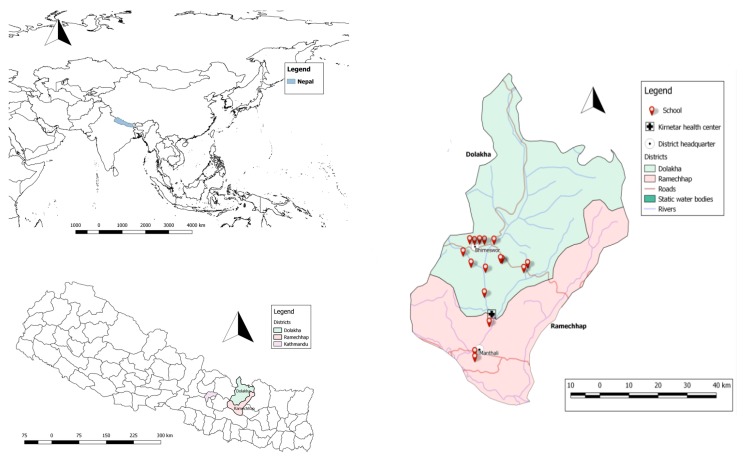
This study assessed drinking water quality, sanitation, and hygiene (WASH) conditions among 708 schoolchildren and 562 households in Dolakha and Ramechhap districts of Nepal. Cross-sectional surveys were carried out in March and June 2015. A Delagua water quality testing kit was employed on 634 water samples obtained from 16 purposively selected schools, 40 community water sources, and 562 households to examine water quality. A flame atomic absorption spectrophotometer was used to test lead and arsenic content of the same samples. Additionally, a questionnaire survey was conducted to obtain WASH predictors. A total of 75% of school drinking water source samples and 76.9% point-of-use samples (water bottles) at schools, 39.5% water source samples in the community, and 27.4% point-of-use samples at household levels were contaminated with thermo-tolerant coliforms. The values of water samples for pH (6.8-7.6), free and total residual chlorine (0.1-0.5 mg/L), mean lead concentration (0.01 mg/L), and mean arsenic concentration (0.05 mg/L) were within national drinking water quality standards. The presence of domestic animals roaming inside schoolchildren's homes was significantly associated with drinking water contamination (adjusted odds ratio: 1.64; 95% confidence interval: 1.08-2.50; = 0.02). Our findings call for an improvement of WASH conditions at the unit of school, households, and communities.
本研究评估了尼泊尔多莱卡和拉梅奇普地区708名学童及562户家庭的饮用水质量、环境卫生和个人卫生(水、环境卫生和个人卫生,WASH)状况。2015年3月和6月进行了横断面调查。使用Delagua水质检测试剂盒对从16所经目的抽样选定的学校、40个社区水源和562户家庭采集的634份水样进行水质检测。使用火焰原子吸收分光光度计检测相同样本中的铅和砷含量。此外,还进行了问卷调查以获取水、环境卫生和个人卫生的预测因素。学校饮用水源样本中75%以及学校内的使用点样本(水瓶)中76.9%、社区水源样本中39.5%以及家庭层面的使用点样本中27.4%均被耐热大肠菌污染。水样的pH值(6.8 - 7.6)、游离和总余氯(0.1 - 0.5毫克/升)、铅平均浓度(0.01毫克/升)以及砷平均浓度(0.05毫克/升)均在国家饮用水质量标准范围内。家畜在学童家中四处走动与饮用水污染显著相关(调整比值比:1.64;95%置信区间:1.08 - 2.50;P = 0.02)。我们的研究结果呼吁改善学校、家庭和社区层面的水、环境卫生和个人卫生状况。