Luo Xin, Ryu Keun Woo, Kim Dae-Seok, Nandu Tulip, Medina Carlos J, Gupte Rebecca, Gibson Bryan A, Soccio Raymond E, Yu Yonghao, Gupta Rana K, Kraus W Lee
Laboratory of Signaling and Gene Regulation, Cecil H. and Ida Green Center for Reproductive Biology Sciences, University of Texas Southwestern Medical Center, Dallas, TX 75390, USA; Division of Basic Research, Department of Obstetrics and Gynecology, University of Texas Southwestern Medical Center, Dallas, TX 75390, USA; Program in Genetics, Development, and Disease, Graduate School of Biomedical Sciences, University of Texas Southwestern Medical Center, Dallas, TX 75390, USA.
Laboratory of Signaling and Gene Regulation, Cecil H. and Ida Green Center for Reproductive Biology Sciences, University of Texas Southwestern Medical Center, Dallas, TX 75390, USA; Division of Basic Research, Department of Obstetrics and Gynecology, University of Texas Southwestern Medical Center, Dallas, TX 75390, USA.
Mol Cell. 2017 Jan 19;65(2):260-271. doi: 10.1016/j.molcel.2016.11.015.
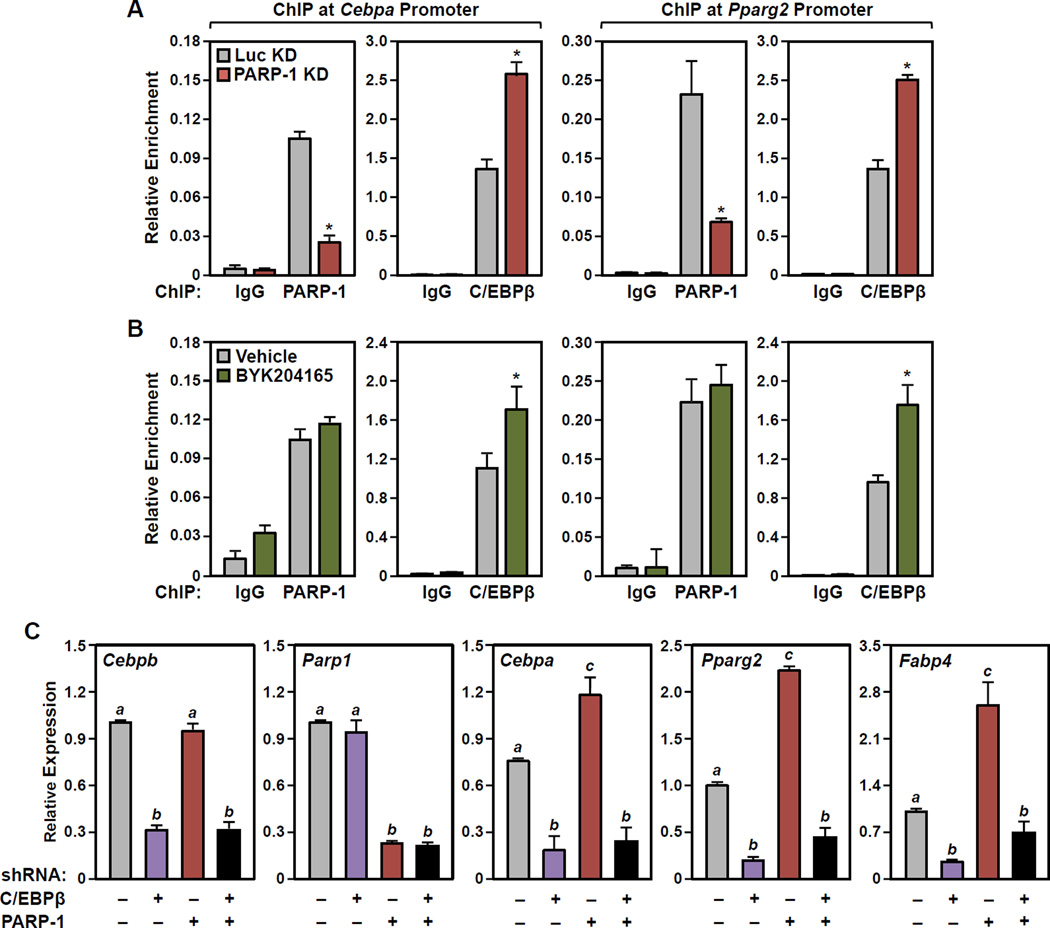
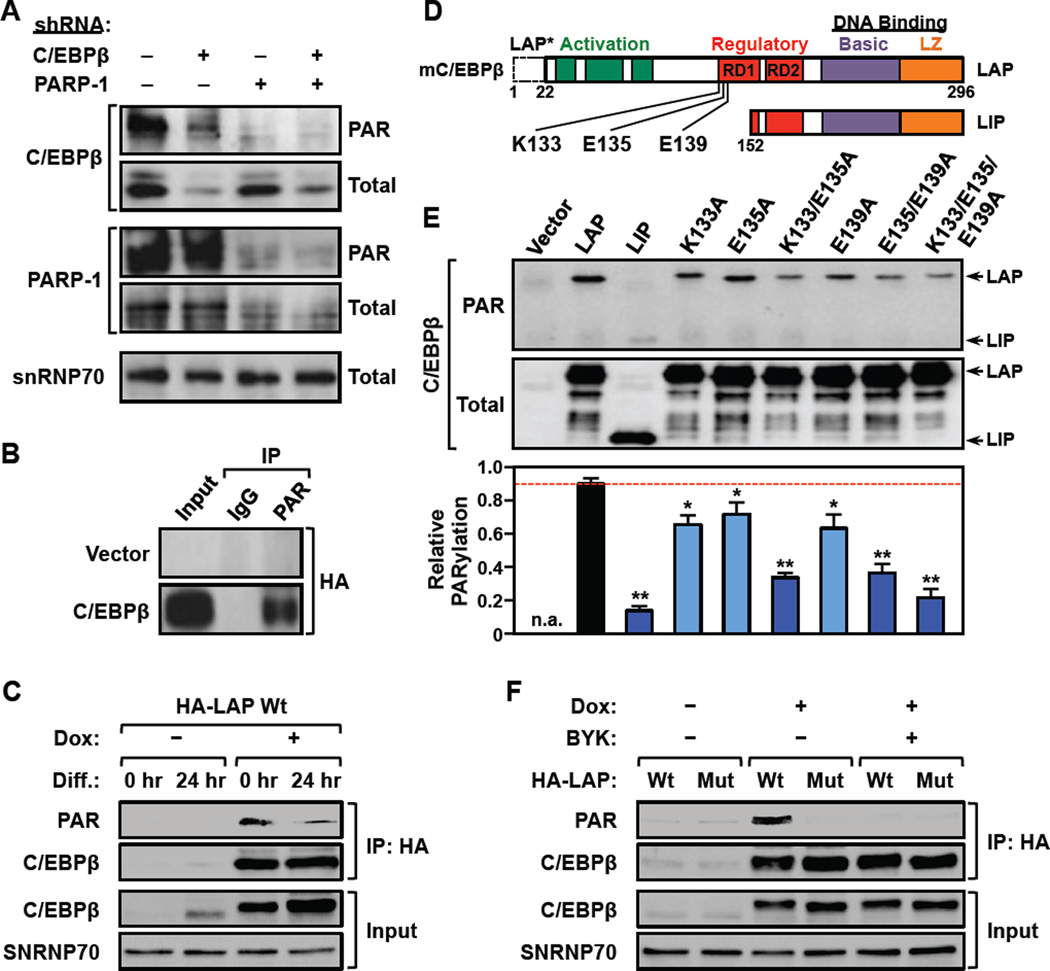
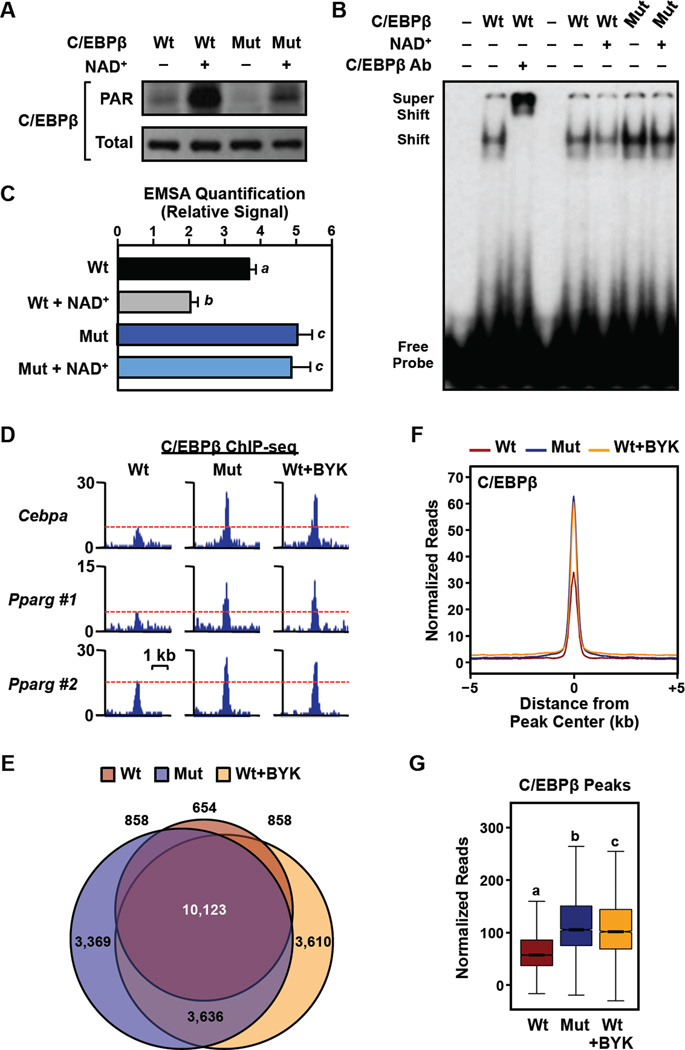
Poly(ADP-ribosyl)ation (PARylation) is a post-translational modification of proteins mediated by PARP family members, such as PARP-1. Although PARylation has been studied extensively, few examples of definitive biological roles for site-specific PARylation have been reported. Here we show that C/EBPβ, a key pro-adipogenic transcription factor, is PARylated by PARP-1 on three amino acids in a conserved regulatory domain. PARylation at these sites inhibits C/EBPβ's DNA binding and transcriptional activities and attenuates adipogenesis in various genetic and cell-based models. Interestingly, PARP-1 catalytic activity drops precipitously during the first 48 hr of differentiation, corresponding to a release of C/EBPβ from PARylation-mediated inhibition. This promotes the binding of C/EBPβ at enhancers controlling the expression of adipogenic target genes and continued differentiation. Depletion or chemical inhibition of PARP-1, or mutation of the PARylation sites on C/EBPβ, enhances these early adipogenic events. Collectively, our results provide a clear example of how site-specific PARylation drives biological outcomes.
聚(ADP-核糖)化(PARylation)是一种由PARP家族成员(如PARP-1)介导的蛋白质翻译后修饰。尽管对PARylation进行了广泛研究,但关于位点特异性PARylation明确生物学作用的例子报道较少。在此,我们表明关键的促脂肪生成转录因子C/EBPβ在一个保守调节域中的三个氨基酸上被PARP-1进行PARylation修饰。这些位点的PARylation抑制C/EBPβ的DNA结合和转录活性,并在各种遗传和细胞模型中减弱脂肪生成。有趣的是,在分化的最初48小时内,PARP-1的催化活性急剧下降,这与C/EBPβ从PARylation介导的抑制中释放相对应。这促进了C/EBPβ在控制脂肪生成靶基因表达的增强子处的结合以及持续分化。PARP-1的缺失或化学抑制,或C/EBPβ上PARylation位点的突变,都会增强这些早期脂肪生成事件。总体而言,我们的结果提供了一个位点特异性PARylation如何驱动生物学结果的清晰例子。