Bernsteiner Harald, Bründl Michael, Stary-Weinzinger Anna
Department of Pharmacology and Toxicology, University of Vienna, Althanstraße 14, 1090 Vienna, Austria.
Department of Pharmacology and Toxicology, University of Vienna, Althanstraße 14, 1090 Vienna, Austria.
Biochem Biophys Res Commun. 2017 Feb 26;484(1):107-112. doi: 10.1016/j.bbrc.2017.01.064. Epub 2017 Jan 19.
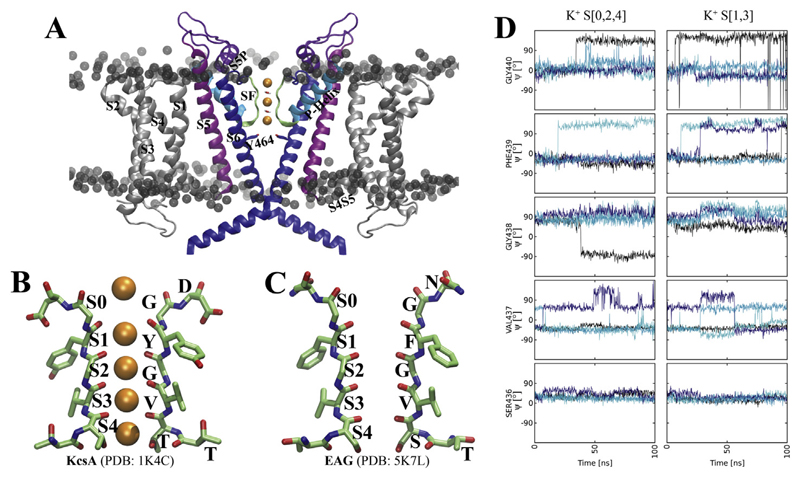
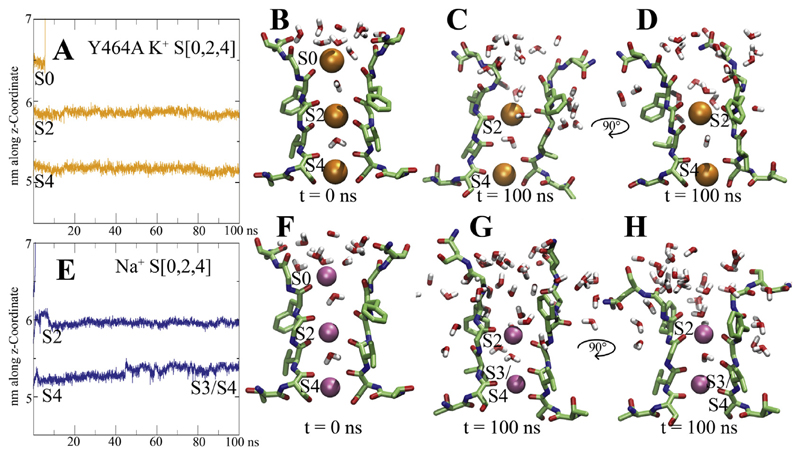
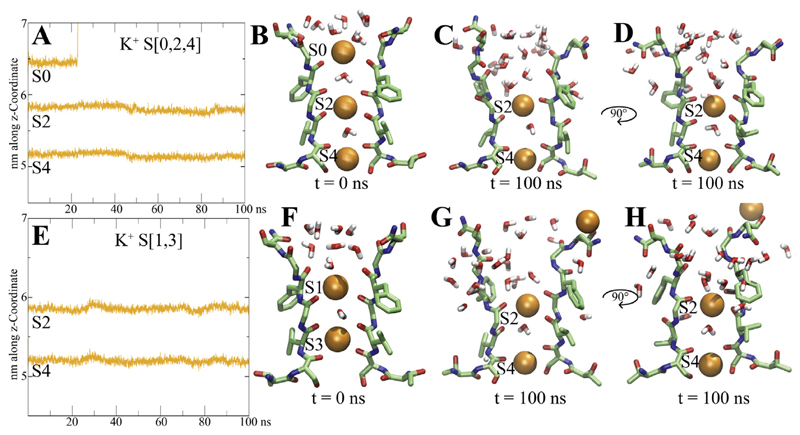
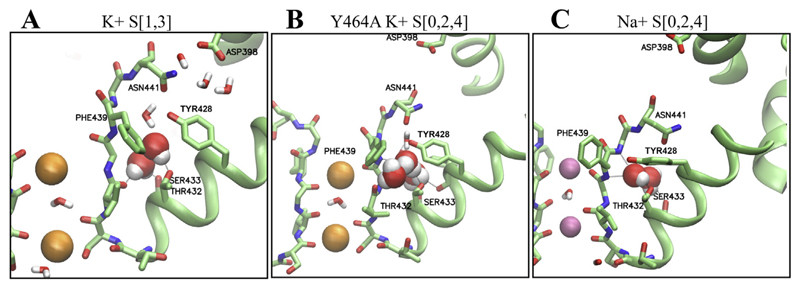
EAG1 channels belong to the KCNH family of voltage gated potassium channels. They are expressed in several brain regions and increased expression is linked to certain cancer types. Recent cryo-EM structure determination finally revealed the structure of these channels in atomic detail, allowing computational investigations. In this study, we performed molecular dynamics simulations to investigate the ion binding sites and the dynamical behavior of the selectivity filter. Our simulations suggest that sites S2 and S4 form stable ion binding sites, while ions placed at sites S1 and S3 rapidly switched to sites S2 and S4. Further, ions tended to dissociate away from S0 within less than 20 ns, due to increased filter flexibility. This was followed by water influx from the extracellular side, leading to a widening of the filter in this region, and likely non-conductive filter configurations. Simulations with the inactivation-enhancing mutant Y464A or Na ions lead to trapped water molecules behind the SF, suggesting that these simulations captured early conformational changes linked to C-type inactivation.
EAG1通道属于电压门控钾通道的KCNH家族。它们在多个脑区表达,其表达增加与某些癌症类型有关。最近通过冷冻电镜确定的结构最终揭示了这些通道的原子细节结构,从而能够进行计算研究。在本研究中,我们进行了分子动力学模拟,以研究离子结合位点和选择性过滤器的动力学行为。我们的模拟表明,位点S2和S4形成稳定的离子结合位点,而位于位点S1和S3的离子会迅速切换到位点S2和S4。此外,由于过滤器灵活性增加,离子倾向于在不到20纳秒的时间内从S0解离。随后细胞外侧的水流入,导致该区域过滤器变宽,并可能形成非传导性的过滤器构型。用增强失活的突变体Y464A或钠离子进行的模拟导致水分子被困在选择性过滤器后面,这表明这些模拟捕捉到了与C型失活相关的早期构象变化。