
通过T1弛豫测量法评估帕金森病皮质微结构的纵向变化。
Longitudinal changes of cortical microstructure in Parkinson's disease assessed with T1 relaxometry.
作者信息
Nürnberger Lucas, Gracien René-Maxime, Hok Pavel, Hof Stephanie-Michelle, Rüb Udo, Steinmetz Helmuth, Hilker Rüdiger, Klein Johannes C, Deichmann Ralf, Baudrexel Simon
机构信息
Department of Neurology, Goethe University, Frankfurt/Main, Germany; Brain Imaging Center, Goethe University, Frankfurt/Main, Germany.
Department of Neurology, Goethe University, Frankfurt/Main, Germany; Brain Imaging Center, Goethe University, Frankfurt/Main, Germany; Department of Neurology, Palacky University, Olomouc, Czech Republic.
出版信息
Neuroimage Clin. 2016 Dec 21;13:405-414. doi: 10.1016/j.nicl.2016.12.025. eCollection 2017.
BACKGROUND
Histological evidence suggests that pathology in Parkinson's disease (PD) goes beyond nigrostriatal degeneration and also affects the cerebral cortex. Quantitative MRI (qMRI) techniques allow the assessment of changes in brain tissue composition. However, the development and pattern of disease-related cortical changes have not yet been demonstrated in PD with qMRI methods. The aim of this study was to investigate longitudinal cortical microstructural changes in PD with quantitative T1 relaxometry.
METHODS
13 patients with mild to moderate PD and 20 matched healthy subjects underwent high resolution T1 mapping at two time points with an interval of 6.4 years (healthy subjects: 6.5 years). Data from two healthy subjects had to be excluded due to MRI artifacts. Surface-based analysis of cortical T1 values was performed with the FreeSurfer toolbox.
RESULTS
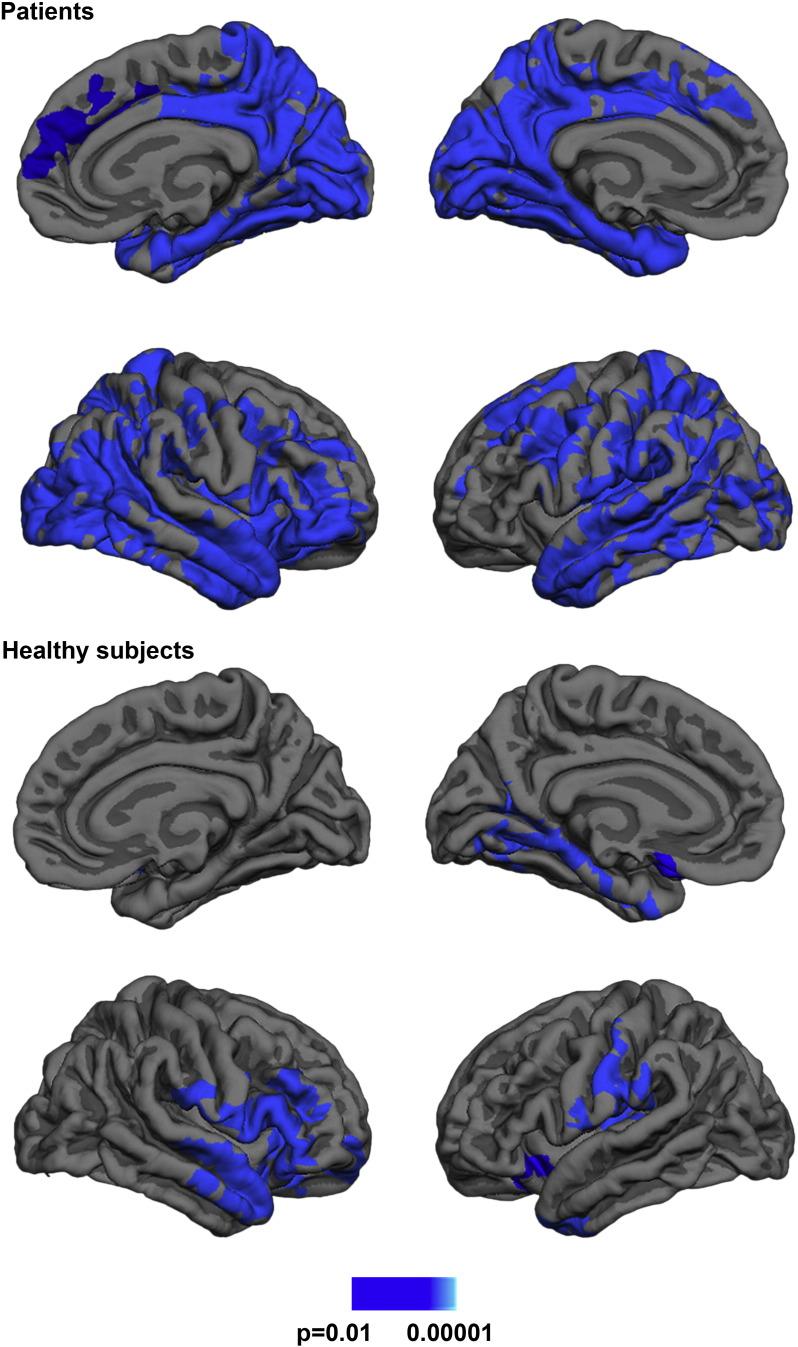
In PD patients, a widespread decrease of cortical T1 was detected during follow-up which affected large parts of the temporo-parietal and occipital cortices and also frontal areas. In contrast, age-related T1 decrease in the healthy control group was much less pronounced and only found in lateral frontal, parietal and temporal areas. Average cortical T1 values did not differ between the groups at baseline ( = 0.17), but were reduced in patients at follow-up ( = 0.0004). Annualized relative changes of cortical T1 were higher in patients vs. healthy subjects (patients: - 0.72 ± 0.64%/year; healthy subjects: - 0.17 ± 0.41%/year, = 0.007).
CONCLUSIONS
In patients with PD, the development of widespread changes in cortical microstructure was observed as reflected by a reduction of cortical T1. The pattern of T1 decrease in PD patients exceeded the normal T1 decrease as found in physiological aging and showed considerable overlap with the pattern of cortical thinning demonstrated in previous PD studies. Therefore, cortical T1 might be a promising additional imaging marker for future longitudinal PD studies. The biological mechanisms underlying cortical T1 reductions remain to be further elucidated.
背景
组织学证据表明,帕金森病(PD)的病理学变化不仅局限于黑质纹状体变性,还会影响大脑皮层。定量磁共振成像(qMRI)技术可用于评估脑组织成分的变化。然而,尚未通过qMRI方法证实PD中与疾病相关的皮层变化的发展过程和模式。本研究的目的是通过定量T1弛豫测量法研究PD患者皮层微观结构的纵向变化。
方法
13例轻度至中度PD患者和20名匹配的健康受试者在两个时间点接受了高分辨率T1映射,时间间隔为6.4年(健康受试者为6.5年)。由于MRI伪影,不得不排除两名健康受试者的数据。使用FreeSurfer工具包对皮层T1值进行基于表面的分析。
结果
在PD患者中,随访期间检测到皮层T1广泛降低,累及颞顶叶和枕叶大部分区域以及额叶区域。相比之下,健康对照组中与年龄相关的T1降低则不太明显,仅在额叶外侧、顶叶和颞叶区域出现。两组在基线时的平均皮层T1值无差异(P = 0.17),但随访时患者的平均皮层T1值降低(P = 0.0004)。患者皮层T1的年化相对变化高于健康受试者(患者:-0.72±0.64%/年;健康受试者:-0.17±0.41%/年,P = 0.007)。
结论
在PD患者中,观察到皮层微观结构出现广泛变化,表现为皮层T1降低。PD患者T1降低的模式超过了生理衰老过程中正常的T1降低,并且与先前PD研究中显示的皮层变薄模式有相当大的重叠。因此,皮层T1可能是未来PD纵向研究中一个有前景的额外成像标志物。皮层T1降低背后的生物学机制仍有待进一步阐明。



 Zotero 插件