Mahmoudi Elham, Swiatek Peter R, Chung Kevin C
Ann Arbor, Mich.
From the Department of Surgery, Section of Plastic Surgery, University of Michigan Medical School.
Plast Reconstr Surg. 2017 Feb;139(2):444e-454e. doi: 10.1097/PRS.0000000000002936.
Little is known about the association between the quality of trauma care and management of nonfatal injuries. The authors used emergency department wait times as a proxy for hospital structure, process, and availability of on-call surgeons with microsurgical skills. They evaluated the association between average hospital emergency department wait times and likelihood of undergoing digit replantation for patients with traumatic amputation digit injuries. The authors hypothesized that hospitals with shorter emergency department wait times were associated with higher odds of replantation.
Using the 2007 to 2012 National Trauma Data Bank, the authors' final sample included 12,126 patients. Regression modeling was used to first determine factors that were associated with longer emergency department wait times among patients with digit amputation injuries. Second, the authors examined the association between emergency department wait times for this population at a hospital level and replantation after all types of digit amputation and after complicated thumb amputation injuries only.
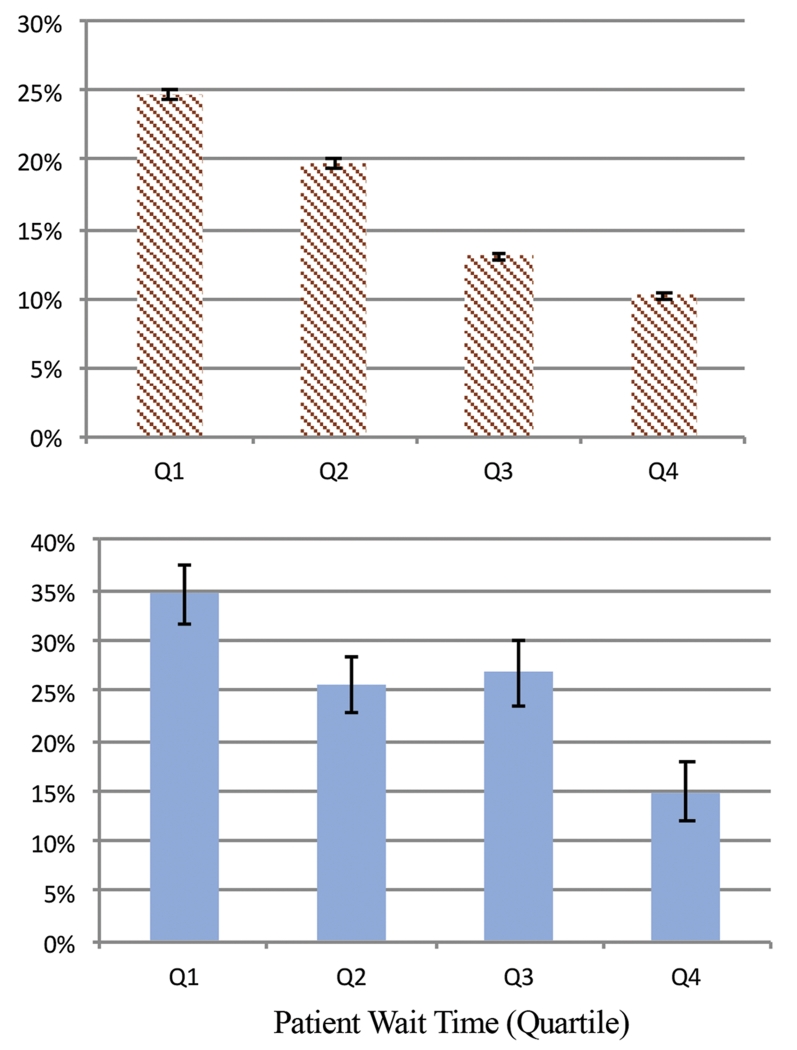
For patients with simple and complicated thumb amputation injuries, and patients with complicated thumb amputation injuries only, longer emergency department wait times were associated with lower odds of replantation. In addition, being minority and having no insurance were associated with longer emergency department wait times; teaching hospitals were associated with shorter emergency department wait times; and finally, for patients with complicated thumb amputation injuries only, there was no association between patients' minority or insurance status and replantation.
Variation in emergency department wait time and its effects on treatment of traumatic digit amputation may reflect maldistribution of hand or plastic surgeons with the required microsurgical skills among trauma centers across the United States.
CLINICAL QUESTION/LEVEL OF EVIDENCE: Therapeutic, III.
关于创伤护理质量与非致命伤管理之间的关联,人们了解甚少。作者将急诊科等待时间用作医院结构、流程以及具备显微外科技术的值班外科医生可及性的替代指标。他们评估了医院急诊科平均等待时间与创伤性断指损伤患者接受断指再植可能性之间的关联。作者假设急诊科等待时间较短的医院进行再植的几率更高。
利用2007年至2012年的国家创伤数据库,作者的最终样本包括12126名患者。回归模型首先用于确定与断指损伤患者急诊科等待时间较长相关的因素。其次,作者研究了医院层面该人群的急诊科等待时间与各类断指截肢后以及仅复杂拇指截肢后的再植之间的关联。
对于单纯性和复杂性拇指截肢患者以及仅复杂性拇指截肢患者,急诊科等待时间较长与再植几率较低相关。此外,少数族裔和未参保与急诊科等待时间较长相关;教学医院与急诊科等待时间较短相关;最后,仅对于复杂性拇指截肢患者,患者的少数族裔或保险状况与再植之间无关联。
急诊科等待时间的差异及其对创伤性断指截肢治疗的影响可能反映了美国各创伤中心之间具备所需显微外科技术的手外科或整形外科医生分布不均。
临床问题/证据水平:治疗性,III级。