Oliver Dominic, Tachtsidis Ilias, Hamilton Antonia F de C
a Institute of Cognitive Neuroscience , University College London , London , UK.
b Medical Physics and Biomedical Engineering , University College London , London , UK.
Soc Neurosci. 2018 Apr;13(2):214-225. doi: 10.1080/17470919.2017.1285812. Epub 2017 Feb 7.
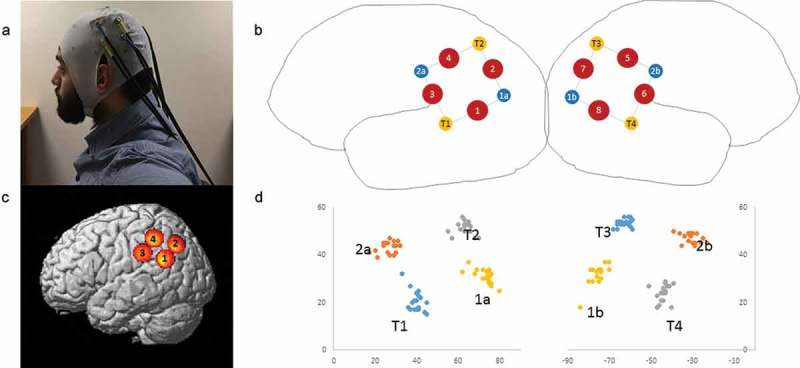
Previous studies have shown right parietal activation in response to observing irrational actions. Behavioral studies show that people sometimes imitate irrational actions, a phenomenon called overimitation. However, limitations on movement in functional magnetic resonance imaging (fMRI) mean that the neural basis of overimitation has not been studied. To address this, our study employed a less restrictive neuroimaging technique, functional near-infrared spectroscopy (fNIRS). Measurements were taken while participants observed either rational or irrational movements before performing movements on a computerized puzzle task. Observing irrational actions produced greater activation in right anterior inferior parietal lobule (aIPL), replicating results from the fMRI literature. This is a proof of principle that fNIRS can be used as an alternative to fMRI in social cognition experiments, and that parietal cortex has a core role in responding to irrational actions.
先前的研究表明,在观察非理性行为时右顶叶会被激活。行为研究表明,人们有时会模仿非理性行为,这一现象被称为过度模仿。然而,功能磁共振成像(fMRI)中对运动的限制意味着尚未对过度模仿的神经基础进行研究。为了解决这一问题,我们的研究采用了一种限制较少的神经成像技术,即功能近红外光谱技术(fNIRS)。在参与者观察理性或非理性动作之后,在电脑拼图任务中执行动作时进行测量。观察非理性行为会使右前下顶叶小叶(aIPL)产生更大的激活,这重复了fMRI文献中的结果。这证明了在社会认知实验中fNIRS可以用作fMRI的替代方法,并且顶叶皮层在对非理性行为的反应中起核心作用。