Li Li, Wang Wei, Pan Hong, Ma Ge, Shi Xinyi, Xie Hui, Liu Xiaoan, Ding Qiang, Zhou Wenbin, Wang Shui
Department of Breast Surgery, the First Affiliated Hospital, Nanjing Medical University, 300 Guangzhou Road, Nanjing, 210029, China.
J Transl Med. 2017 Jan 31;15(1):23. doi: 10.1186/s12967-017-1124-9.
Minimally invasive therapies, such as microwave ablation (MWA), are widely used for the treatment of solid tumors. Previous studies suggest that MWA is feasible for the treatment of small breast cancer, and thermal ablation may induce adaptive antitumor immunity. However, the induced immune responses are mostly weak, and the immunomodulation effects of MWA in breast cancer are unclear. Immunostimulant OK-432 can induce tumor-specific T-cell responses and may augment the immunity induced by MWA.
We treated 4T1 breast cancer bearing BALB/c mice with MWA, OK-432, MWA plus OK-432, or left without treatment. Survival time was evaluated with the Kaplan-Meyer method comparing survival curves by log-rank test. On day 25 after ablation, surviving mice received tumor rechallenge, and the rechallenged tumor volumes were calculated every 5 days. Immunohistochemistry and flow cytometry were used to evaluate the T-cell immune responses in ablated tissues and spleens. The tumor-specific immunity was assessed by enzyme-linked immunospot assays. Besides, the cytokine patterns were identified from enzyme-linked immunosorbent assay.
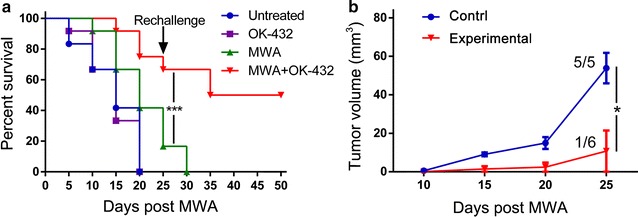
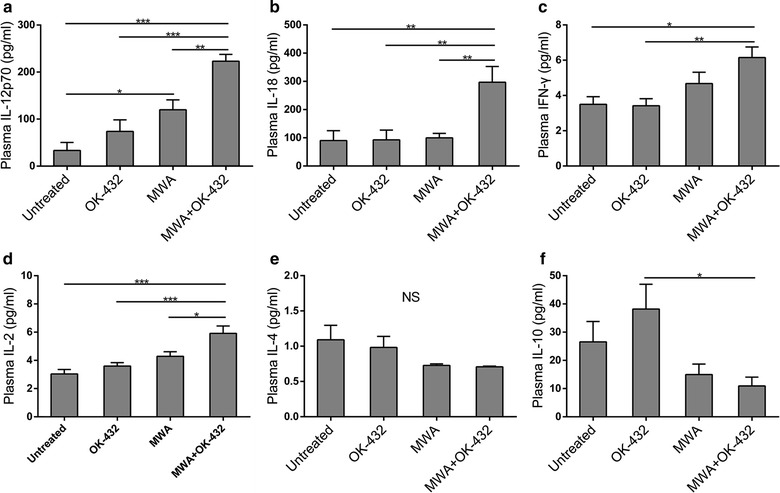
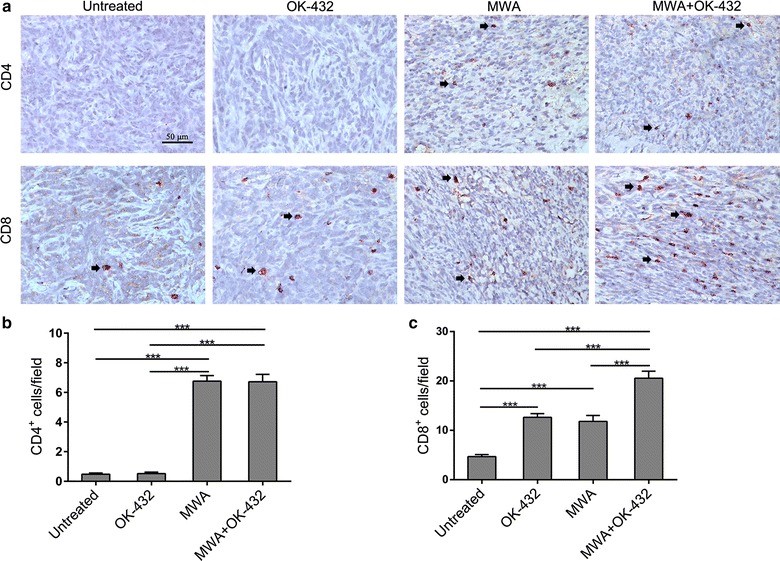
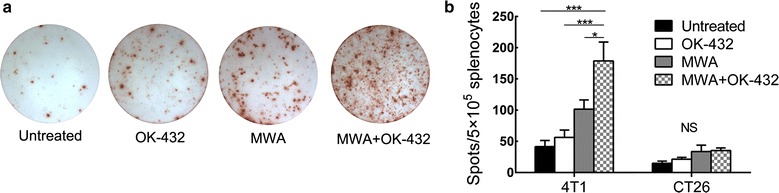
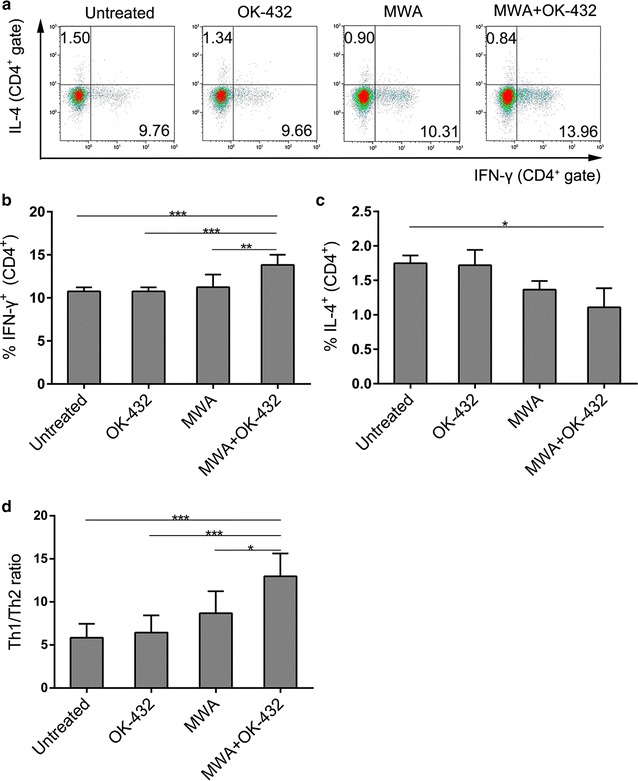
Microwave ablation plus OK-432 resulted in longer survival than single treatment and protect most surviving mice from tumor rechallenge. Both local and systemic T-cell responses were induced by MWA and were further enhanced by subsequent administration of OK-432. Moreover, the combination of MWA and OK-432 induced stronger tumor-specific immune responses than MWA alone. In addition, OK-432 and MWA synergistically promoted the production of Th1-type but not Th2-type cytokines, and polarized T-cell responses to Th1-dominant state.
The T-cell immune responses were activated by MWA in breast cancer. Furthermore, the combination of MWA and OK-432 induced Th1-type response and elicited specific antitumor immunity.
微创治疗,如微波消融(MWA),广泛应用于实体肿瘤的治疗。先前的研究表明,MWA治疗小乳腺癌是可行的,热消融可能诱导适应性抗肿瘤免疫。然而,诱导的免疫反应大多较弱,MWA在乳腺癌中的免疫调节作用尚不清楚。免疫刺激剂OK-432可诱导肿瘤特异性T细胞反应,并可能增强MWA诱导的免疫。
我们用MWA、OK-432、MWA加OK-432治疗携带4T1乳腺癌的BALB/c小鼠,或不进行治疗。用Kaplan-Meier方法评估生存时间,通过对数秩检验比较生存曲线。在消融后第25天,存活的小鼠接受肿瘤再攻击,每5天计算再攻击肿瘤的体积。采用免疫组织化学和流式细胞术评估消融组织和脾脏中的T细胞免疫反应。通过酶联免疫斑点试验评估肿瘤特异性免疫。此外,通过酶联免疫吸附试验确定细胞因子模式。
微波消融加OK-432比单一治疗导致更长的生存期,并保护大多数存活小鼠免受肿瘤再攻击。MWA诱导局部和全身T细胞反应,随后给予OK-432进一步增强。此外,MWA和OK-432联合诱导的肿瘤特异性免疫反应比单独使用MWA更强。此外,OK-432和MWA协同促进Th1型而非Th2型细胞因子的产生,并使T细胞反应向Th1主导状态极化。
MWA激活了乳腺癌中的T细胞免疫反应。此外,MWA和OK-432联合诱导Th1型反应并引发特异性抗肿瘤免疫。