Karimi Gharib, Zadsar Maryam, Pourfathollah Ali Akbar
Blood Transfusion Research Center, High Institute for Research and Education in Transfusion Medicine, Hemmat Exp. Way, Next to the Milad Tower, Tehran, Iran.
Department of Immunology, Faculty of Medical Sciences, Tarbiat Modares University, Tehran, Iran.
Virol J. 2017 Jan 30;14(1):14. doi: 10.1186/s12985-017-0693-9.
Human T-cell lymphotrophic virus type 1 (HTLV-1) has a worldwide distribution and it is endemic in some regions of Iran. One of the most important routes of HTLV-1 transmission is via transfusion of contaminated blood components. The risk of transmission through asymptomatic blood donors, particularly in endemic areas should be considered and appropriately managed. The main objective of this study was to determine the seroprevalence and description the geographic distribution of HTLV-1 among voluntary blood donors in Iran.
This retrospective study carried out using the data obtained from the main database of the seven blood transfusion centers of Iranian Blood Transfusion Organization between 2009 and 2013. The presence of anti-HTLV-1/2 antibodies were primarily assessed using Enzyme-linked Immunosorbent Assay. The Ab Kit assay, contain antigens for the screening of antibodies to HTLV type 1 and 2. So, it is expressed as HTLV 1/2 assay. Samples that were positive by the western blot confirmatory test were considered as definite positive HTLV-1 or HTLV-2 cases. The main socio-demographic variables were; age, gender, donation history and marital status. Descriptive and analytical statistics were used to summarize the gathered data. The chi-Square Statistical test was used to test the association between groups, P-value of less than 0.05 was considered significant.
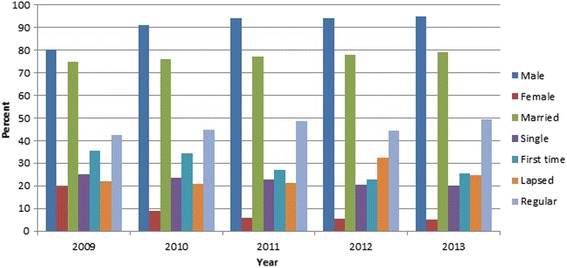
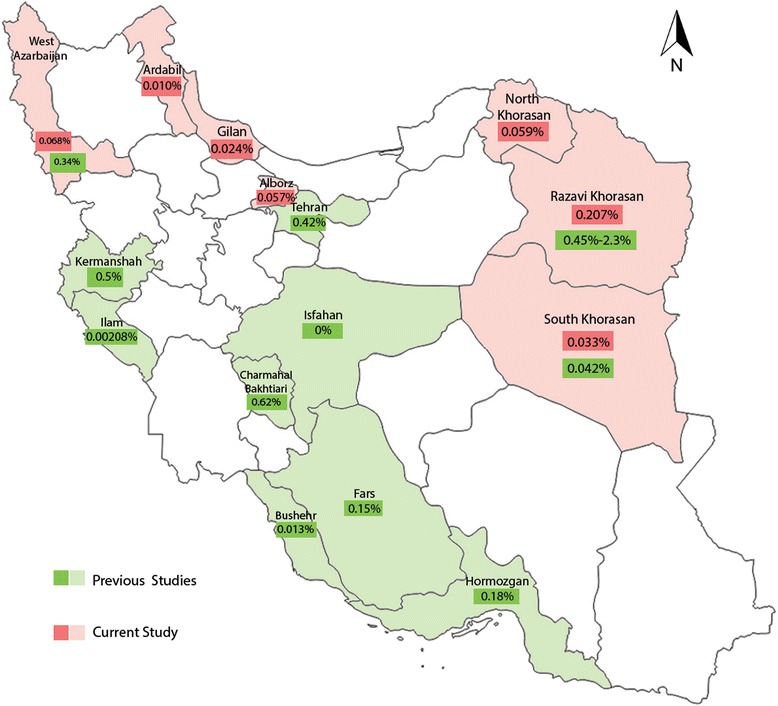
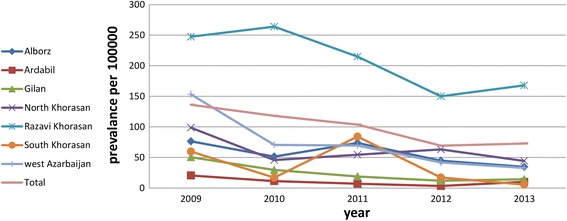
A total of 1864489 blood donations were evaluated. There were 1840 confirmed HTLV-1 positive donations (0.098%). None were positive for anti-HTLV-2. The overall HTLV-1 prevalence was 98.7 per 100,000 donations during the 5 year period. Seroprevalence was higher among females, married and older blood donors. The overall seropositivity among first time, regular and lapsed donors was, 0.29% (290/100000), 0.001% (1/100000) and 0.02% (20/100000) respectively. A significant difference was observed between regular and the first time (p <0.0001) and also between lapsed and regular blood donors (p <0.0001). Most of the HTLV-1 seropositive blood donors (175 per 100,000) were from northeastern regions. We observed a gradual decline in overall HTLV-1 prevalence during the course of the study, the prevalence rate decreased from 0.13% (130/100000) in 2009 to 0.07% (70/100000) in 2013.
The Seroprevalence of HTLV-1 among Iranian blood donors in the regions of our study still is considerable, but there is an obvious declining prevalence over the course of present study. Blood transfusion centers should continually evaluate the residual risk of infection in the country, especially in endemic areas.
人类嗜T淋巴细胞病毒1型(HTLV-1)在全球范围内均有分布,在伊朗的一些地区呈地方流行。HTLV-1传播的最重要途径之一是通过输注受污染的血液成分。应考虑并妥善管理无症状献血者的传播风险,尤其是在流行地区。本研究的主要目的是确定伊朗自愿献血者中HTLV-1的血清流行率并描述其地理分布。
本回顾性研究使用了2009年至2013年期间从伊朗输血组织七个输血中心的主要数据库中获得的数据。抗HTLV-1/2抗体的存在主要通过酶联免疫吸附测定进行评估。该抗体检测试剂盒包含用于筛查HTLV-1型和2型抗体的抗原。因此,它被称为HTLV 1/2检测。经蛋白质印迹确认试验呈阳性的样本被视为HTLV-1或HTLV-2确诊病例。主要的社会人口统计学变量为年龄、性别、献血史和婚姻状况。使用描述性和分析性统计方法对收集到的数据进行总结。采用卡方统计检验来检验组间关联,P值小于0.05被认为具有统计学意义。
共评估了1864489次献血。有1840次献血被确认为HTLV-1阳性(0.098%)。抗HTLV-2均为阴性。在这5年期间,HTLV-1的总体流行率为每10万次献血中有98.7例。女性、已婚和年龄较大的献血者中血清流行率较高。首次献血者、定期献血者和曾献血者的总体血清阳性率分别为0.29%(290/100000)、0.001%(1/100000)和0.02%(20/100000)。定期献血者与首次献血者之间(p<0.0001)以及曾献血者与定期献血者之间(p<0.0001)均观察到显著差异。大多数HTLV-1血清阳性献血者(每10万中有175例)来自东北地区。在研究过程中,我们观察到HTLV-1的总体流行率逐渐下降,流行率从2009年的0.13%(130/100000)降至2013年的0.07%(70/100000)。
在我们研究的地区,伊朗献血者中HTLV-1的血清流行率仍然相当可观,但在本研究过程中流行率有明显下降。输血中心应持续评估该国尤其是流行地区的残余感染风险。