State Key Laboratory of Microbial Technology, School of Life Science, Shandong University, Jinan, 250100, China.
Shandong Provincial Key Laboratory of Microbial Engineering, School of Bioengineering, QiLu University of Technology, Jinan, 250353, China.
Microb Cell Fact. 2017 Jan 31;16(1):17. doi: 10.1186/s12934-017-0641-9.
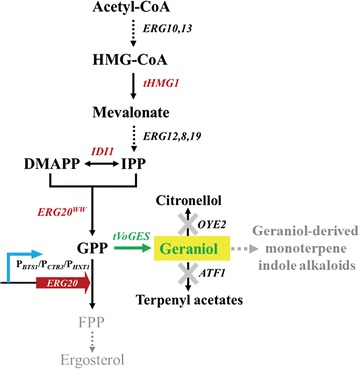
Microbial production of monoterpenes provides a promising substitute for traditional chemical-based methods, but their production is lagging compared with sesquiterpenes. Geraniol, a valuable monoterpene alcohol, is widely used in cosmetic, perfume, pharmaceutical and it is also a potential gasoline alternative. Previously, we constructed a geraniol production strain by engineering the mevalonate pathway together with the expression of a high-activity geraniol synthase.
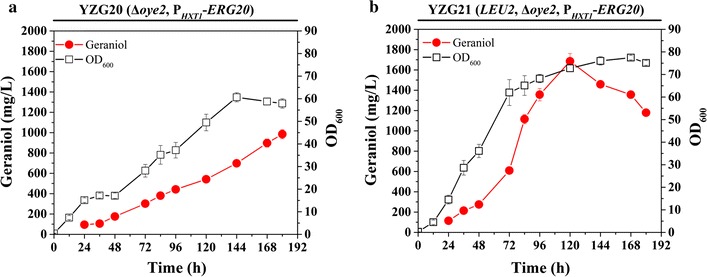
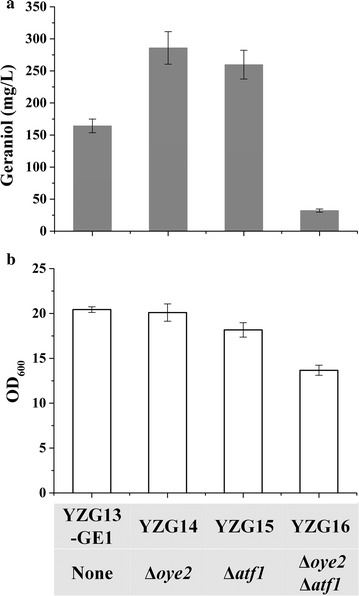
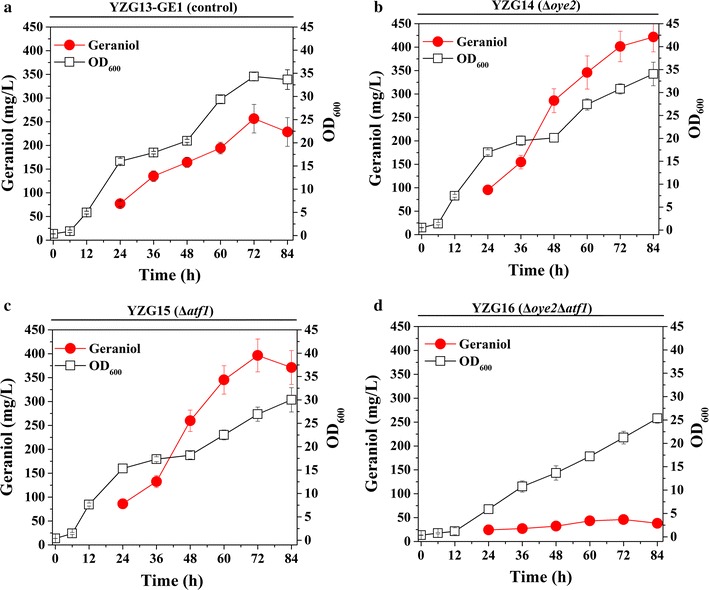
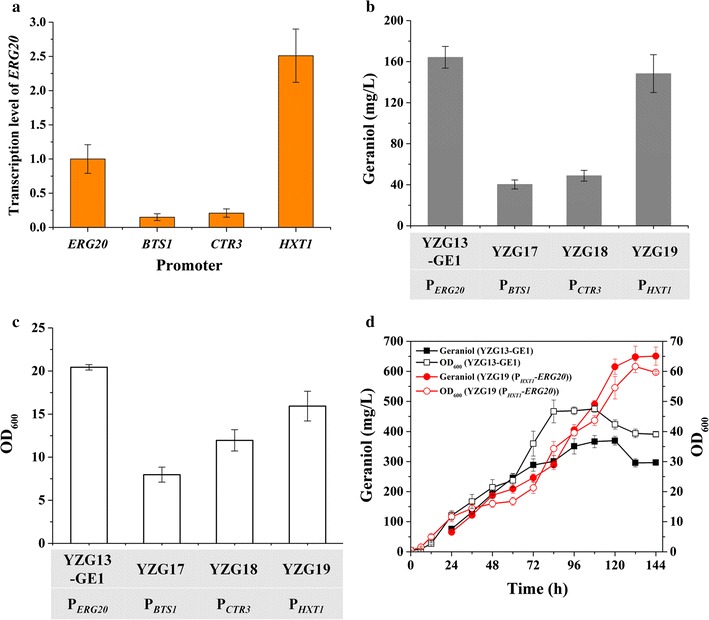
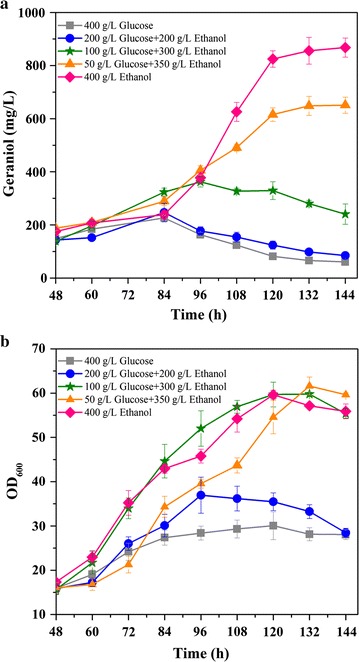
In this study, we further improved the geraniol production through reducing the endogenous metabolism of geraniol and controlling the precursor geranyl diphosphate flux distribution. The deletion of OYE2 (encoding an NADPH oxidoreductase) or ATF1 (encoding an alcohol acetyltransferase) both involving endogenous conversion of geraniol to other terpenoids, improved geraniol production by 1.7-fold or 1.6-fold in batch fermentation, respectively. In addition, we found that direct down-regulation of ERG20 expression, the branch point regulating geranyl diphosphate flux, does not improve geraniol production. Therefore, we explored dynamic control of ERG20 expression to redistribute the precursor geranyl diphosphate flux and achieved a 3.4-fold increase in geraniol production after optimizing carbon source feeding. Furthermore, the combination of dynamic control of ERG20 expression and OYE2 deletion in LEU2 prototrophic strain increased geraniol production up to 1.69 g/L with pure ethanol feeding in fed-batch fermentation, which is the highest reported production in engineered yeast.
An efficient geraniol production platform was established by reducing the endogenous metabolism of geraniol and by controlling the flux distribution of the precursor geranyl diphosphate. The present work also provides a production basis to synthesis geraniol-derived chemicals, such as monoterpene indole alkaloids.
微生物生产单萜为传统化学方法提供了有前途的替代品,但与倍半萜相比,其产量滞后。香叶醇是一种有价值的单萜醇,广泛应用于化妆品、香水、制药等领域,也是一种有潜力的汽油替代品。以前,我们通过工程化甲羟戊酸途径和表达高活性香叶醇合酶构建了香叶醇生产菌株。
在这项研究中,我们通过减少香叶醇的内源性代谢和控制前体香叶基二磷酸通量分布进一步提高了香叶醇的产量。缺失编码 NADPH 氧化还原酶的 OYE2 或编码醇乙酰转移酶的 ATF1(均涉及香叶醇向其他萜烯的内源性转化),分别使分批发酵中的香叶醇产量提高了 1.7 倍或 1.6 倍。此外,我们发现直接下调分支点调节香叶基二磷酸通量的 ERG20 表达,并不会提高香叶醇的产量。因此,我们探索了 ERG20 表达的动态控制,以重新分配前体香叶基二磷酸通量,并在优化碳源进料后实现了香叶醇产量的 3.4 倍增加。此外,在 LEU2 营养缺陷型菌株中,动态控制 ERG20 表达和 OYE2 缺失相结合,在补料分批发酵中用纯乙醇进料可使香叶醇产量提高到 1.69g/L,这是工程酵母中报道的最高产量。
通过减少香叶醇的内源性代谢和控制前体香叶基二磷酸的通量分布,建立了一个有效的香叶醇生产平台。本工作还为合成香叶醇衍生化学品,如单萜吲哚生物碱,提供了生产基础。