Department of Radiology, The Affiliated Drum Tower Hospital of Nanjing University Medical School, University of Nanjing, Nanjing, China.
Department of Neurology, The Affiliated Drum Tower Hospital of Nanjing University Medical School, Nanjing, China.
Sci Rep. 2017 Jan 31;7:41586. doi: 10.1038/srep41586.
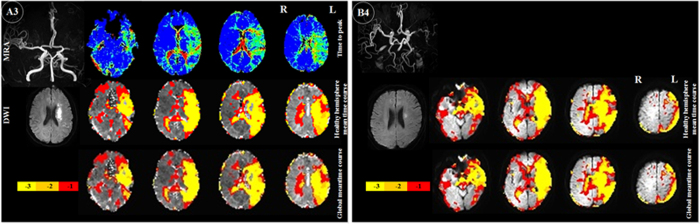
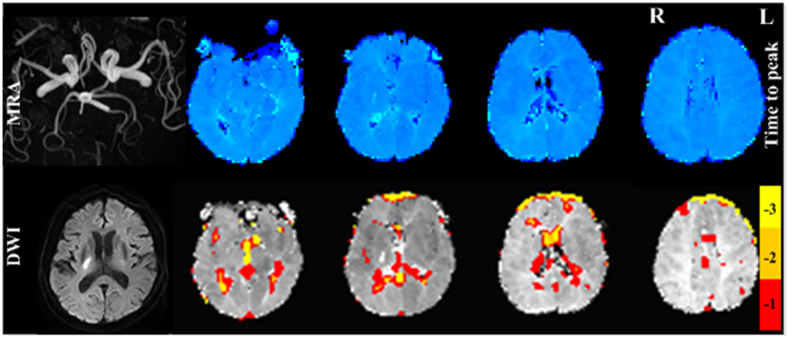
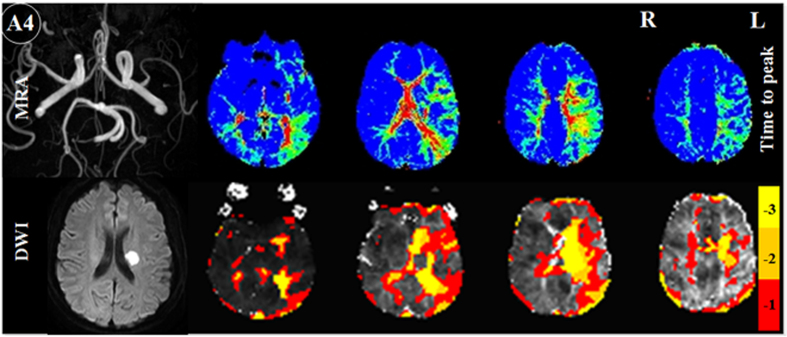
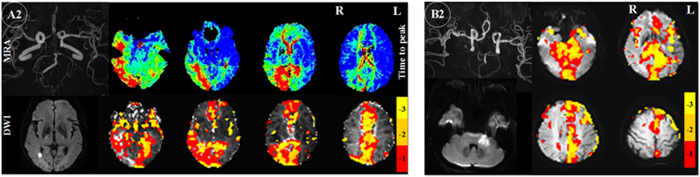
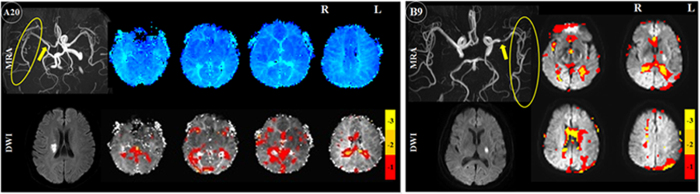
To evaluate the potential clinical value of the time-shift analysis (TSA) approach for resting-state fMRI (rs-fMRI) blood oxygenation level-dependent (BOLD) data in detecting hypoperfusion of subacute stroke patients through comparison with dynamic susceptibility contrast perfusion weighted imaging (DSC-PWI). Forty patients with subacute stroke (3-14 days after neurological symptom onset) underwent MRI examination. Cohort A: 31 patients had MRA, DSC-PWI and BOLD data. Cohort B: 9 patients had BOLD and MRA data. The time delay between the BOLD time course in each voxel and the mean signal of global and contralateral hemisphere was calculated using TSA. Time to peak (TTP) was employed to detect hypoperfusion. Among cohort A, 14 patients who had intracranial large-vessel occlusion/stenosis with sparse collaterals showed hypoperfusion by both of the two approaches, one with abundant collaterals showed neither TTP nor TSA time delay. The remaining 16 patients without obvious MRA lesions showed neither TTP nor TSA time delay. Among cohort B, eight patients showed time delay areas. The TSA approach was a promising alternative to DSC-PWI for detecting hypoperfusion in subacute stroke patients who had obvious MRA lesions with sparse collaterals, those with abundant collaterals would keep intact local perfusion.
为了评估时间漂移分析(TSA)方法在检测亚急性脑卒中患者低灌注中的潜在临床价值,我们通过与动态磁敏感对比灌注加权成像(DSC-PWI)进行比较,对亚急性脑卒中患者(发病后 3-14 天)的静息态功能磁共振成像(rs-fMRI)血氧水平依赖(BOLD)数据进行了评估。40 例亚急性脑卒中患者接受了 MRI 检查。队列 A:31 例患者有 MRA、DSC-PWI 和 BOLD 数据。队列 B:9 例患者有 BOLD 和 MRA 数据。使用 TSA 计算每个体素的 BOLD 时程与全脑和对侧半球平均信号之间的时间延迟。采用达峰时间(TTP)来检测低灌注。在队列 A 中,14 例颅内大血管闭塞/狭窄伴稀疏侧支循环的患者,两种方法均显示低灌注,其中 1 例侧支循环丰富的患者未出现 TTP 或 TSA 时间延迟。其余 16 例无明显 MRA 病变的患者均未出现 TTP 或 TSA 时间延迟。在队列 B 中,8 例患者出现时间延迟区域。在明显有稀疏侧支循环的 MRA 病变且伴丰富侧支循环的亚急性脑卒中患者中,TSA 方法是一种很有前途的 DSC-PWI 替代方法,可以检测低灌注,而局部灌注保持完整。