Department of Biomedical Engineering, McCormick School of Engineering and Applied Sciences, Northwestern University, Evanston, IL, United States of America.
Department of Physical Therapy and Human Movement Sciences, Feinberg School of Medicine, Northwestern University, Chicago, IL, United States of America.
Neuroimage. 2023 Jul 1;274:120120. doi: 10.1016/j.neuroimage.2023.120120. Epub 2023 Apr 16.
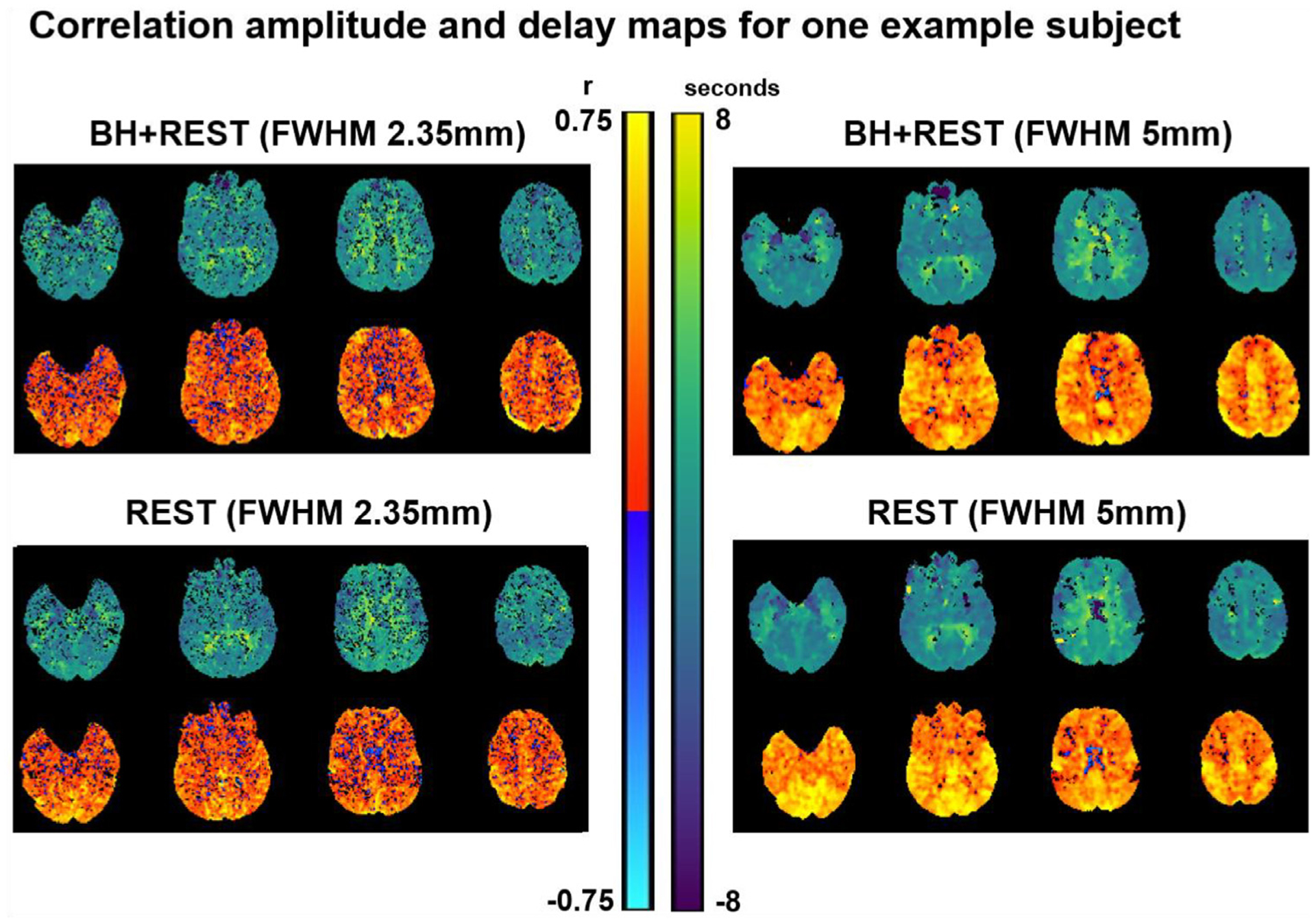
The blood flow response to a vasoactive stimulus demonstrates regional heterogeneity across both the healthy brain and in cerebrovascular pathology. The timing of a regional hemodynamic response is emerging as an important biomarker of cerebrovascular dysfunction, as well as a confound within fMRI analyses. Previous research demonstrated that hemodynamic timing is more robustly characterized when a larger systemic vascular response is evoked by a breathing challenge, compared to when only spontaneous fluctuations in vascular physiology are present (i.e., in resting-state data). However, it is not clear whether hemodynamic delays in these two conditions are physiologically interchangeable, and how methodological signal-to-noise factors may limit their agreement. To address this, we generated whole-brain maps of hemodynamic delays in nine healthy adults. We assessed the agreement of voxel-wise gray matter (GM) hemodynamic delays between two conditions: resting-state and breath-holding. We found that delay values demonstrated poor agreement when considering all GM voxels, but increasingly greater agreement when limiting analyses to voxels showing strong correlation with the GM mean time-series. Voxels showing the strongest agreement with the GM mean time-series were primarily located near large venous vessels, however these voxels explain some, but not all, of the observed agreement in timing. Increasing the degree of spatial smoothing of the fMRI data enhanced the correlation between individual voxel time-series and the GM mean time-series. These results suggest that signal-to-noise factors may be limiting the accuracy of voxel-wise timing estimates and hence their agreement between the two data segments. In conclusion, caution must be taken when using voxel-wise delay estimates from resting-state and breathing-task data interchangeably, and additional work is needed to evaluate their relative sensitivity and specificity to aspects of vascular physiology and pathology.
血流对血管活性刺激的反应在健康大脑和脑血管病中表现出区域性异质性。区域性血液动力学反应的时间已成为脑血管功能障碍的重要生物标志物,也是 fMRI 分析中的混杂因素。先前的研究表明,当通过呼吸挑战引起更大的全身血管反应时,比仅存在血管生理学自发波动(即,在静息状态数据中)时,血液动力学时间更能准确地描述。但是,尚不清楚在这两种情况下的血液动力学延迟是否在生理上可以互换,以及方法学信噪比因素如何限制它们的一致性。为了解决这个问题,我们在九名健康成年人中生成了全脑血液动力学延迟图。我们评估了两种条件下(静息状态和屏气),体素级灰质(GM)血液动力学延迟的一致性。我们发现,当考虑所有 GM 体素时,延迟值的一致性较差,但当将分析限制为与 GM 平均时间序列强烈相关的体素时,一致性会逐渐提高。与 GM 平均时间序列具有最强一致性的体素主要位于大静脉附近,但这些体素仅解释了观察到的时间一致性的一部分,而不是全部。增加 fMRI 数据的空间平滑度会增强个体体素时间序列与 GM 平均时间序列之间的相关性。这些结果表明,信噪比因素可能限制了体素时间估计的准确性,从而限制了两个数据段之间的时间估计的一致性。总之,在静息状态和呼吸任务数据之间互换体素延迟估计值时必须谨慎,并且需要进一步工作来评估它们对血管生理学和病理学方面的相对敏感性和特异性。