Chen Mao-Sheng, Pan Bang-Zhen, Fu Qiantang, Tao Yan-Bin, Martínez-Herrera Jorge, Niu Longjian, Ni Jun, Dong Yuling, Zhao Mei-Li, Xu Zeng-Fu
Key Laboratory of Tropical Plant Resources and Sustainable Use, Xishuangbanna Tropical Botanical Garden, Chinese Academy of Sciences Menglun, China.
Instituto Nacional de Investigaciones Forestales, Agrícolas y Pecuarias Huimanguillo, Mexico.
Front Plant Sci. 2017 Jan 17;7:1953. doi: 10.3389/fpls.2016.01953. eCollection 2016.
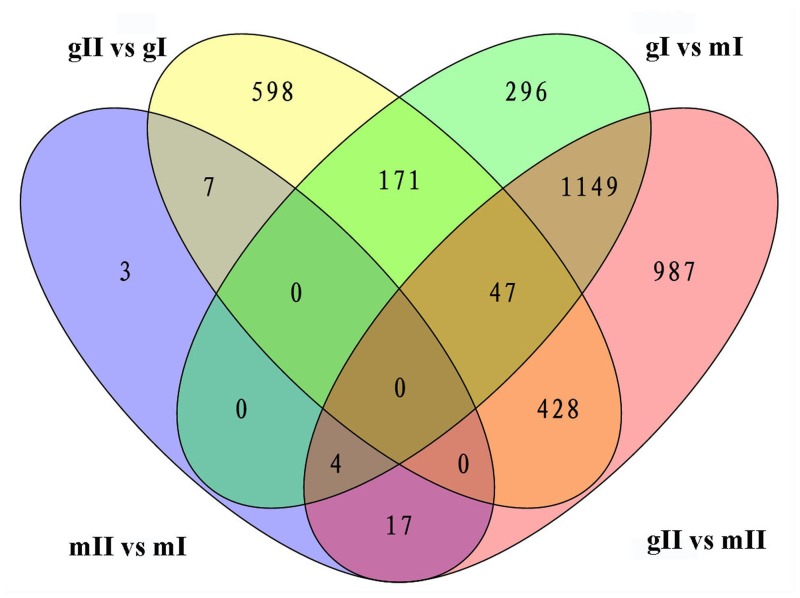
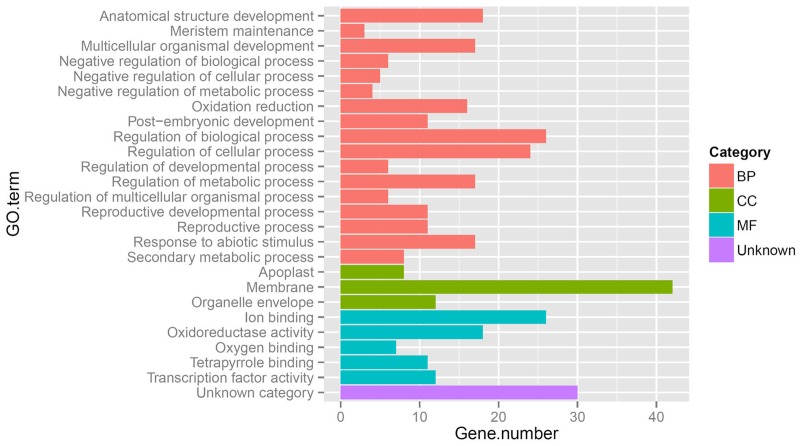
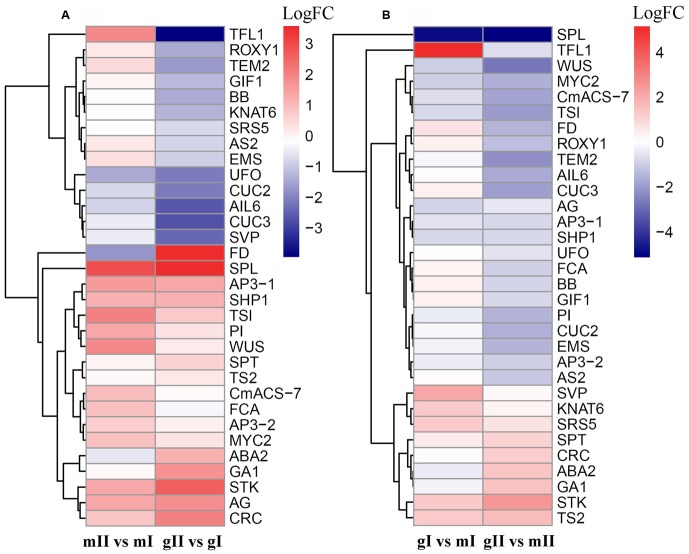
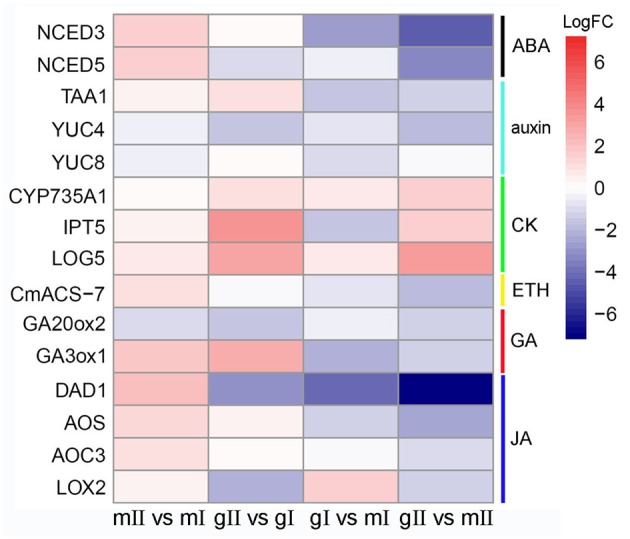
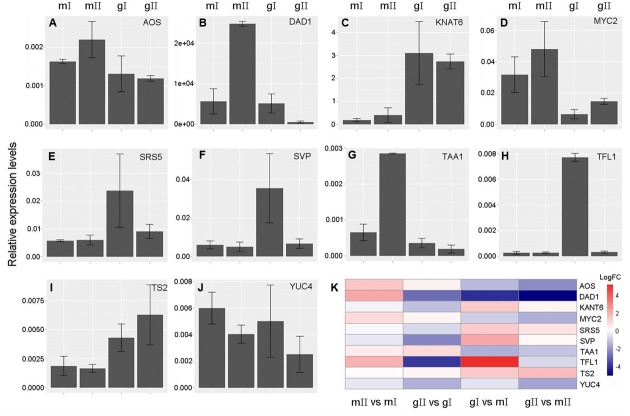
Most germplasms of the biofuel plant are monoecious. A gynoecious genotype of was found, whose male flowers are aborted at early stage of inflorescence development. To investigate the regulatory mechanism of transition from monoecious to gynoecious plants, a comparative transcriptome analysis between gynoecious and monoecious inflorescences were performed. A total of 3,749 genes differentially expressed in two developmental stages of inflorescences were identified. Among them, 32 genes were involved in floral development, and 70 in phytohormone biosynthesis and signaling pathways. Six genes homologous to (), , (), (), (), and (), which control floral development, were considered as candidate regulators that may be involved in sex differentiation in . Abscisic acid, auxin, gibberellin, and jasmonate biosynthesis were lower, whereas cytokinin biosynthesis was higher in gynoecious than that in monoecious inflorescences. Moreover, the exogenous application of gibberellic acid (GA) promoted perianth development in male flowers and partly prevented pistil development in female flowers to generate neutral flowers in gynoecious inflorescences. The arrest of stamen primordium at early development stage probably causes the abortion of male flowers to generate gynoecious individuals. These results suggest that some floral development genes and phytohormone signaling pathways orchestrate the process of sex determination in . Our study provides a basic framework for the regulation networks of sex determination in and will be helpful for elucidating the evolution of the plant reproductive system.
大多数生物燃料植物的种质是雌雄同株的。发现了一种雌株基因型,其雄花在花序发育早期败育。为了研究从雌雄同株向雌株转变的调控机制,对雌株和雌雄同株的花序进行了比较转录组分析。共鉴定出3749个在花序两个发育阶段差异表达的基因。其中,32个基因参与花发育,70个基因参与植物激素生物合成和信号通路。与控制花发育的()、()、()、()、()和()同源的6个基因被认为是可能参与该植物性别分化的候选调控因子。雌株花序中脱落酸、生长素、赤霉素和茉莉酸的生物合成较低,而细胞分裂素的生物合成高于雌雄同株的花序。此外,外源施加赤霉素(GA)促进了雌株花序雄花中花被的发育,并部分阻止了雌花中雌蕊的发育,从而产生中性花。雄蕊原基在发育早期的停滞可能导致雄花败育,从而产生雌株个体。这些结果表明,一些花发育基因和植物激素信号通路共同调控了该植物的性别决定过程。我们的研究为该植物性别决定的调控网络提供了一个基本框架,将有助于阐明植物生殖系统的进化。