Lee Kangeui, Lee So Hee, Park Taejin, Lee Ji Yeon
Department of Emergency Medicine, National Medical Center, Seoul, Korea.
Department of Psychiatry, National Medical Center, Seoul, Korea.
J Korean Med Sci. 2017 Mar;32(3):507-513. doi: 10.3346/jkms.2017.32.3.507.
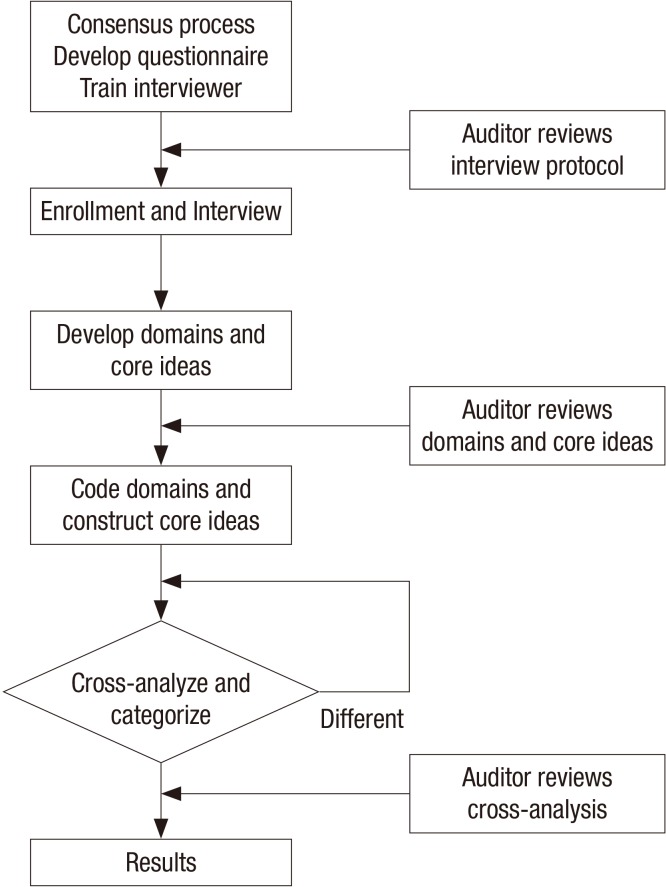
We conducted in-depth interviews with 11 Korean Disaster Relief Team (KDRT) members about stress related to disaster relief work and analyzed the interview data using the Consensual Qualitative Research (CQR) method in order to evaluate difficulties in disaster relief work and to develop solutions to these problems in cooperation with related organizations. Results showed that members typically experienced stress related to untrained team members, ineffective cooperation, and the shock and aftermath of aftershock experiences. Stress tended to stem from several factors: difficulties related to cooperation with new team members, the frightening disaster experience, and the aftermath of the disaster. Other stressors included conflict with the control tower, diverse problems at the disaster relief work site, and environmental factors. The most common reason that members participated in KDRT work despite all the stressors and difficulties was pride about the kind of work it involved. Many subjects in this study suffered from various stresses after the relief work, but they had no other choice than to attempt to forget about their experiences over time. It is recommended that the mental health of disaster relief workers will improve through the further development of effective treatment and surveillance programs in the future.
我们对11名韩国救灾团队(KDRT)成员进行了关于救灾工作压力的深入访谈,并使用共识定性研究(CQR)方法分析访谈数据,以评估救灾工作中的困难,并与相关组织合作制定解决这些问题的方案。结果表明,成员们通常会经历与未经培训的团队成员、无效合作以及余震经历的冲击和后果相关的压力。压力往往源于几个因素:与新团队成员合作的困难、可怕的灾难经历以及灾难的后果。其他压力源包括与指挥塔的冲突、救灾工作现场的各种问题以及环境因素。尽管存在所有这些压力源和困难,成员们参与KDRT工作的最常见原因是对其所从事工作的自豪感。本研究中的许多受试者在救灾工作后遭受了各种压力,但随着时间的推移,他们别无选择,只能试图忘记自己的经历。建议未来通过进一步开发有效的治疗和监测项目来改善救灾人员的心理健康。