Department of Health Sciences and Research, Medical University of South Carolina, Charleston2Department of Psychiatry and Behavioral Sciences, Medical University of South Carolina, Charleston.
Department of Psychiatry and Behavioral Sciences, Medical University of South Carolina, Charleston3Hollings Cancer Center, Medical University of South Carolina, Charleston.
JAMA Psychiatry. 2017 Mar 1;74(3):214-223. doi: 10.1001/jamapsychiatry.2016.3148.
Recent research on addiction-related memory processes suggests that protracted extinction training following brief cue-elicited memory retrieval (ie, retrieval-extinction [R-E] training) can attenuate/eradicate the ability of cues to elicit learned behaviors. One study reported that cue-elicited craving among detoxified heroin addicts was substantially attenuated following R-E training and through 6-month follow-up.
To build on these impressive findings by examining whether R-E training could attenuate smoking-related craving and behavior.
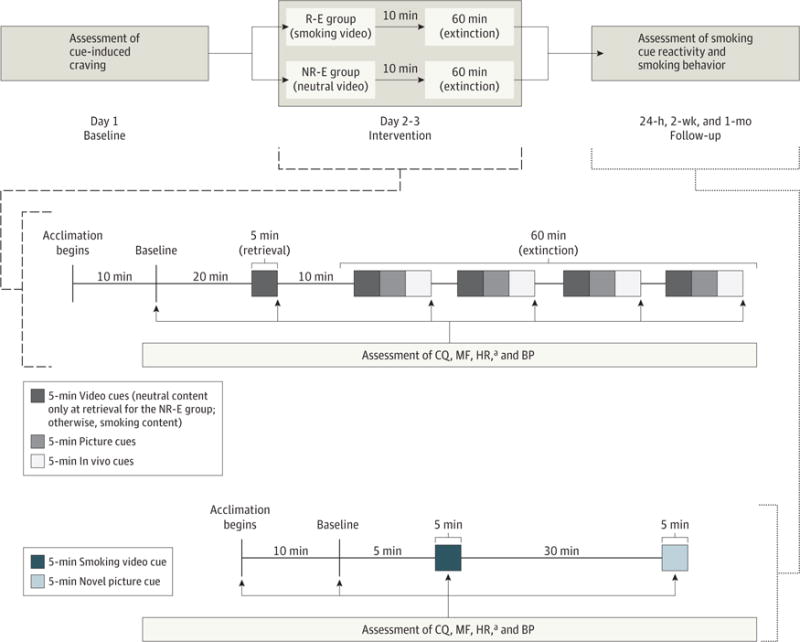
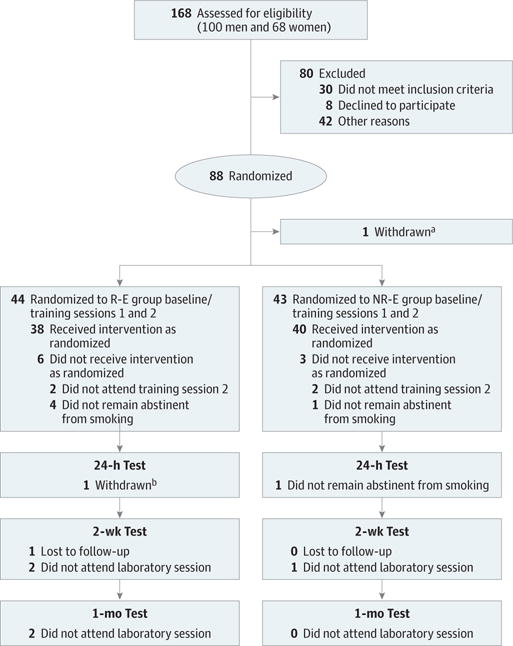
DESIGN, SETTING, AND PARTICIPANTS: This prospective, mixed-design, human laboratory randomized clinical trial took place between December 2013 and September 2015. Participants were recruited in Charleston, South Carolina. Study sessions took place at the Medical University of South Carolina. The participants were 168 screened volunteer smokers, of whom 88 were randomized; 72 of these 88 participants (81.8%) attended all the follow-up sessions through 1 month. The primary eligibility criteria were current nicotine dependence (DSM criteria), smoking 10 or more cigarettes per day, and a willingness to attempt smoking cessation.
Participants were randomly assigned to receive either smoking-related memory retrieval followed by extinction training (the R-E group) or nonsmoking-related retrieval followed by extinction training (the NR-E group).
Primary outcomes were cue-elicited craving and physiological responding to familiar and novel cues in the R-E group vs the NR-E group over a 1-month follow-up period. Secondary outcomes were smoking-related behaviors.
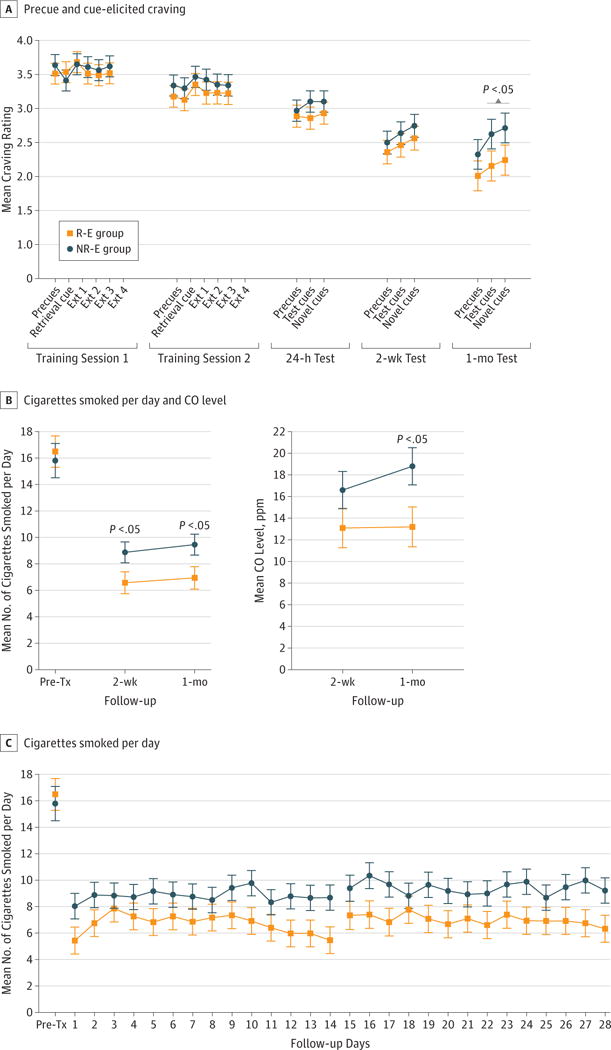
A total of 44 participants were randomly assigned to the R-E group (mean age, 48.3 years; 72.7% male); a total of 44 participants were randomly assigned to the NR-E group, with 43 attending at least 1 training session (mean age, 46.7 years; 55.8% male). The mean craving response to both familiar and novel smoking cues was significantly lower for participants in the R-E group than for participants in the NR-E group at 1-month follow-up (for both cue types: t1225 = 2.1, P = .04, d = 0.44, and Δ = 0.47 [95% CI, 0.04-0.90]). The mean numbers of cigarettes smoked per day at 2 weeks and 1-month were significantly lower for the R-E group than for the NR-E group (treatment main effect: F1,68 = 5.4, P = .02, d = 0.50, and Δ = 2.4 [95% CI, 0.4-4.5]). Significant differences in physiological responses, urine cotinine level, number of days abstinent, lapse, and relapse were not observed between groups (all between P = .06 and .75).
Retrieval-extinction training substantially attenuated craving to both familiar and novel smoking cues and reduced the number of cigarettes smoked per day by participants 1 month after treatment relative to extinction training alone. Between-group differences were not observed for physiological responses, cotinine level, number of days abstinent, relapse, or lapse. In summary, R-E training is a brief behavioral treatment that targets smoking-related memories and has the potential to enhance relapse prevention.
clinicaltrials.gov Identifier: NCT02154685.
最近有关成瘾相关记忆过程的研究表明,在短暂的线索诱发记忆检索后进行长时间的消退训练(即检索-消退[R-E]训练)可以减弱/消除线索诱发习得行为的能力。一项研究报告称,在 R-E 训练后以及 6 个月的随访中,海洛因成瘾者的线索诱发的渴求明显减弱。
通过研究 R-E 训练是否可以减弱与吸烟相关的渴求与行为,进一步验证这些令人印象深刻的发现。
设计、地点和参与者:这是一项前瞻性、混合设计、人体实验室随机临床试验,于 2013 年 12 月至 2015 年 9 月期间在南卡罗来纳州查尔斯顿进行。参与者在南卡罗来纳州查尔斯顿招募。研究会议在南卡罗来纳医科大学举行。参与者是 168 名经过筛选的志愿吸烟者,其中 88 名被随机分配;这 88 名参与者中有 72 名(81.8%)参加了所有的随访,直到 1 个月。主要入选标准为当前尼古丁依赖(DSM 标准)、每天吸烟 10 支或以上,以及愿意尝试戒烟。
参与者被随机分配接受与吸烟相关的记忆检索后进行消退训练(R-E 组)或与非吸烟相关的记忆检索后进行消退训练(NR-E 组)。
主要结局是在 1 个月的随访期间,与 NR-E 组相比,R-E 组中线索诱发的渴求及对熟悉和新颖线索的生理反应。次要结局是与吸烟相关的行为。
共有 44 名参与者被随机分配到 R-E 组(平均年龄 48.3 岁;72.7%为男性);共有 44 名参与者被随机分配到 NR-E 组,其中 43 名至少参加了 1 次训练(平均年龄 46.7 岁;55.8%为男性)。在 1 个月的随访中,与 NR-E 组相比,R-E 组参与者对熟悉和新颖吸烟线索的渴求反应明显较低(对于两种线索类型:t1225 = 2.1,P = .04,d = 0.44,Δ = 0.47 [95% CI,0.04-0.90])。在 2 周和 1 个月时,R-E 组参与者每天吸烟的数量明显低于 NR-E 组(治疗主效应:F1,68 = 5.4,P = .02,d = 0.50,Δ = 2.4 [95% CI,0.4-4.5])。两组间在生理反应、尿可替宁水平、戒烟天数、复吸和复发方面无显著差异(所有 P = .06 和.75)。
与单独进行消退训练相比,检索-消退训练显著减弱了参与者对熟悉和新颖吸烟线索的渴求,并在治疗后 1 个月减少了他们的吸烟量。两组间在生理反应、可替宁水平、戒烟天数、复发或复吸方面无差异。总之,R-E 训练是一种针对吸烟相关记忆的简短行为治疗方法,具有增强预防复发的潜力。
clinicaltrials.gov 标识符:NCT02154685。