David Geffen School of Medicine, University of California, Los Angeles.
Division of Cardiology, Department of Medicine, David Geffen School of Medicine, University of California, Los Angeles.
JAMA Cardiol. 2017 Mar 1;2(3):278-284. doi: 10.1001/jamacardio.2016.5303.
Electronic cigarettes (e-cigarettes) have gained unprecedented popularity, but virtually nothing is known about their cardiovascular risks.
To test the hypothesis that an imbalance of cardiac autonomic tone and increased systemic oxidative stress and inflammation are detectable in otherwise healthy humans who habitually use e-cigarettes.
DESIGN, SETTING, AND PARTICIPANTS: Cross-sectional case-control study of habitual e-cigarette users and nonuser control individuals from 2015 to 2016 at the University of California, Los Angeles. Otherwise healthy habitual e-cigarette users between the ages of 21 and 45 years meeting study criteria, including no current tobacco cigarette smoking and no known health problems or prescription medications, were eligible for enrollment. Healthy volunteers meeting these inclusion criteria who were not e-cigarette users were eligible to be enrolled as control individuals. A total of 42 participants meeting these criteria were enrolled in the study including 23 self-identified habitual e-cigarette users and 19 self-identified non-tobacco cigarette, non-e-cigarette user control participants.
Heart rate variability components were analyzed for the high-frequency component (0.15-0.4 Hz), an indicator of vagal activity, the low-frequency component (0.04-0.15 Hz), a mixture of both vagal and sympathetic activity, and the ratio of the low frequency to high frequency, reflecting the cardiac sympathovagal balance. Three parameters of oxidative stress were measured in plasma: (1) low-density lipoprotein oxidizability, (2) high-density lipoprotein antioxidant/anti-inflammatory capacity, and (3) paraoxonase-1 activity.
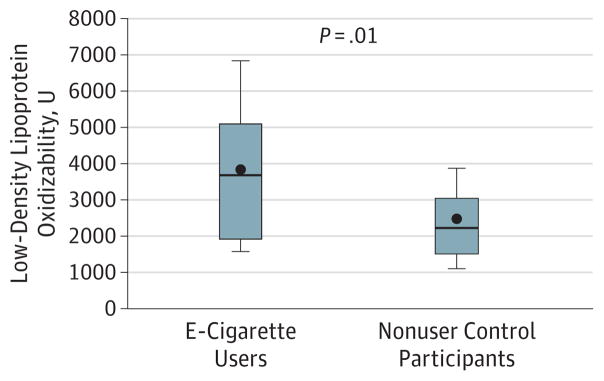
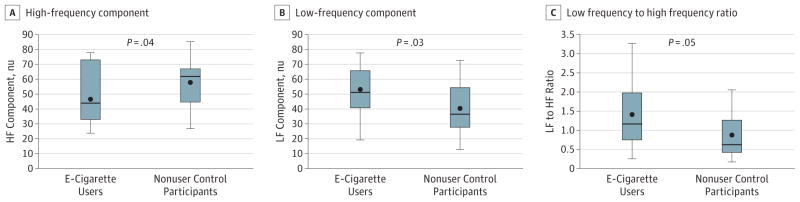
Of the 42 participants, 35% were women, 35% were white, and the mean age was 27.6 years. The high-frequency component was significantly decreased in the e-cigarette users compared with nonuser control participants (mean [SEM], 46.5 [3.7] nu vs 57.8 [3.6] nu; P = .04). The low-frequency component (mean [SEM], 52.7 [4.0] nu vs 39.9 [3.8] nu; P = .03) and the low frequency to high frequency ratio (mean [SEM], 1.37 [0.19] vs 0.85 [0.18]; P = .05) were significantly increased in the e-cigarette users compared with nonuser control participants, consistent with sympathetic predominance. Low-density lipoprotein oxidizability, indicative of the susceptibility of apolipoprotein B-containing lipoproteins to oxidation, was significantly increased in e-cigarette users compared with nonuser control individuals (mean [SEM], 3801.0 [415.7] U vs 2413.3 [325.0] U; P = .01) consistent with increased oxidative stress, but differences in high-density antioxidant/anti-inflammatory capacity and paraoxonase-1 activity were not significant.
In this study, habitual e-cigarette use was associated with a shift in cardiac autonomic balance toward sympathetic predominance and increased oxidative stress, both associated with increased cardiovascular risk.
电子烟(电子烟)空前普及,但人们对其心血管风险几乎一无所知。
测试这样一个假设,即在习惯性使用电子烟的健康人群中,可以检测到心脏自主神经平衡失调以及全身氧化应激和炎症增加。
设计、地点和参与者:2015 年至 2016 年,在加利福尼亚大学洛杉矶分校进行的习惯性电子烟使用者和非使用者对照个体的横断面病例对照研究。符合研究标准的年龄在 21 至 45 岁之间的习惯性电子烟使用者,包括目前不吸烟和没有已知健康问题或处方药物的人,有资格入组。符合这些纳入标准且不使用电子烟的健康志愿者有资格被纳入对照组个体。共有 42 名符合这些标准的参与者入组了这项研究,包括 23 名自我认定的习惯性电子烟使用者和 19 名自我认定的非烟草香烟、非电子烟使用者对照组参与者。
分析了心率变异性的高频成分(0.15-0.4 Hz),这是迷走活动的指标,低频成分(0.04-0.15 Hz),是迷走和交感活动的混合物,以及低频与高频的比值,反映了心脏交感神经和迷走神经的平衡。在血浆中测量了三种氧化应激参数:(1)低密度脂蛋白的氧化性,(2)高密度脂蛋白的抗氧化/抗炎能力,和(3)对氧磷酶-1 活性。
在 42 名参与者中,35%为女性,35%为白人,平均年龄为 27.6 岁。与非使用者对照组相比,电子烟使用者的高频成分明显降低(平均值[SEM],46.5[3.7]nu 与 57.8[3.6]nu;P=0.04)。与非使用者对照组相比,电子烟使用者的低频成分(平均值[SEM],52.7[4.0]nu 与 39.9[3.8]nu;P=0.03)和低频与高频的比值(平均值[SEM],1.37[0.19]与 0.85[0.18];P=0.05)均明显升高,提示交感神经占优势。与非使用者对照组相比,载脂蛋白 B 脂蛋白的易氧化性的指示物-低密度脂蛋白的氧化性明显增加(平均值[SEM],3801.0[415.7]U 与 2413.3[325.0]U;P=0.01),提示氧化应激增加,但高密度脂蛋白抗氧化/抗炎能力和对氧磷酶-1 活性的差异无统计学意义。
在这项研究中,习惯性电子烟的使用与心脏自主神经平衡向交感神经优势转变以及氧化应激增加有关,两者都与心血管风险增加有关。