Clinical Pharmacology Research Program Division of Cardiology Department of Medicine University of California San Francisco CA.
Center for Tobacco Control Research and Education University of California San Francisco CA.
J Am Heart Assoc. 2020 Dec;9(23):e017317. doi: 10.1161/JAHA.120.017317. Epub 2020 Nov 19.
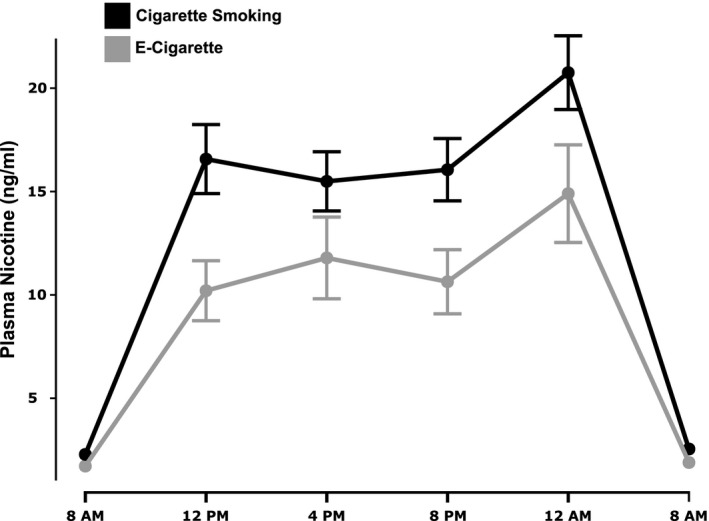
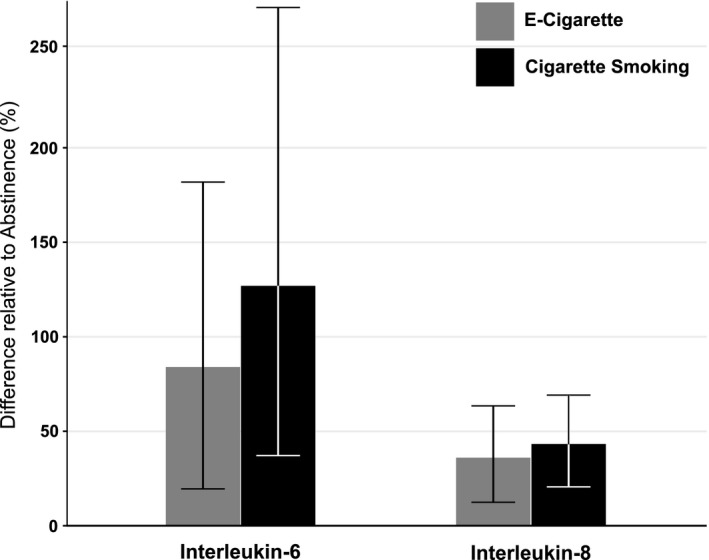
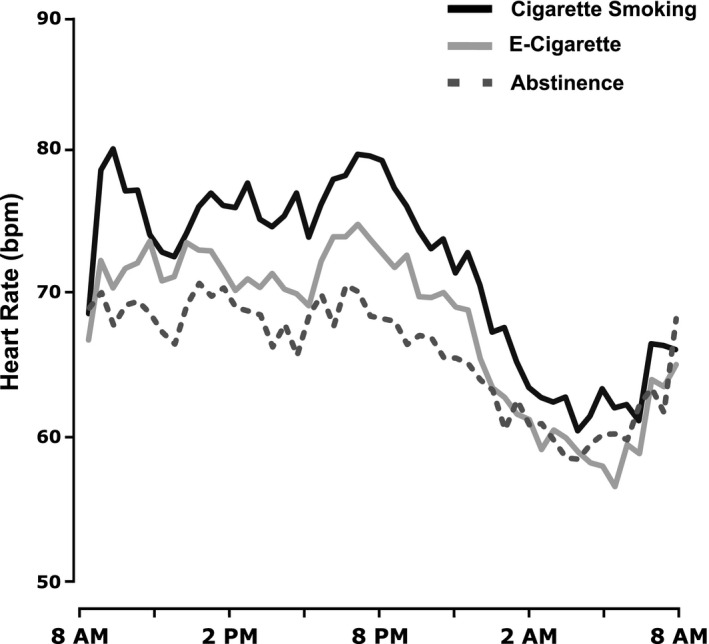
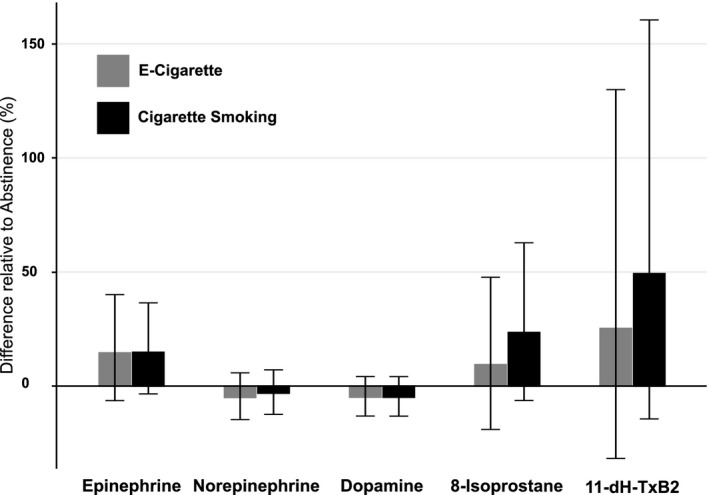
Background Cardiovascular safety is an important consideration regarding the benefits versus risks of electronic cigarette use (EC) for public health. The single-use cardiovascular effects of EC have been well studied but may not reflect effects of ad libitum use throughout the day. We aimed to compare the circadian hemodynamic effects as well as 24-hour biomarkers of oxidative stress, and platelet aggregation and inflammation, with ad libitum cigarette smoking (CS) versus EC versus no tobacco product use. Methods and Results Thirty-six healthy dual CS and EC users participated in a crossover study in a confined research setting. Circadian heart rate, blood pressure and plasma nicotine levels, 24-hour urinary catecholamines, 8-isoprostane and 11-dehydro-thromboxane B2, and plasma interleukin-6 and interleukin-8 were compared in CS, EC, and no nicotine conditions. Over 24 hours, and during daytime, heart rate and blood pressure were higher in CS and EC compared with no tobacco product conditions (<0.01). Heart rate on average was higher with CS versus EC. Urinary catecholamines, 8-isoprostane, and 11-dehydro-thromboxane B2 were not significantly different, but plasma IL-6 and IL-8 were higher with both CS and EC compared with no tobacco product (<0.01). Conclusions CS and EC had similar 24-hour patterns of hemodynamic effects compared with no tobacco product, with a higher average heart rate with CS versus EC, and similar effects on biomarkers of inflammation. EC may pose some cardiovascular risk, particularly to smokers with underlying cardiovascular disease, but may also provide a harm reduction opportunity for smokers willing to switch entirely to EC. Registration URL: https://www.clinicaltrials.gov; Unique Identifier: NCT02470754.
心血管安全性是权衡电子烟使用的健康效益与风险时需要考虑的一个重要因素。电子烟单次使用的心血管效应已经得到了充分研究,但可能无法反映全天随意使用的效果。我们旨在比较昼夜节律性血液动力学效应以及 24 小时氧化应激、血小板聚集和炎症的生物标志物,比较随意吸烟(CS)与电子烟(EC)与不使用任何烟草制品的情况。
36 名健康的 CS 和 EC 双重使用者参与了一个在封闭研究环境中的交叉研究。在 CS、EC 和无尼古丁条件下比较了昼夜心率、血压和血浆尼古丁水平、24 小时尿儿茶酚胺、8-异前列腺素和 11-脱氢血栓烷 B2 以及血浆白细胞介素-6 和白细胞介素-8。在 24 小时内和白天,CS 和 EC 的心率和血压均高于无烟草制品条件(<0.01)。与 EC 相比,CS 的平均心率更高。尿儿茶酚胺、8-异前列腺素和 11-脱氢血栓烷 B2 没有显著差异,但 CS 和 EC 与无烟草制品相比,血浆 IL-6 和 IL-8 更高(<0.01)。
CS 和 EC 与无烟草制品相比,具有相似的 24 小时血液动力学效应模式,CS 的平均心率高于 EC,且对炎症生物标志物的影响相似。EC 可能带来一些心血管风险,特别是对患有潜在心血管疾病的吸烟者,但对于愿意完全改用 EC 的吸烟者来说,也可能提供减少危害的机会。