Vetter Sylvia H, Sapkota Tek B, Hillier Jon, Stirling Clare M, Macdiarmid Jennie I, Aleksandrowicz Lukasz, Green Rosemary, Joy Edward J M, Dangour Alan D, Smith Pete
Institute of Biological and Environmental Sciences, University of Aberdeen, Aberdeen AB24 3UU, UK.
International Maize and Wheat Improvement Centre (CIMMYT), Sustainable Intensification Program, NASC Complex, New Delhi 110012, India.
Agric Ecosyst Environ. 2017 Jan 16;237:234-241. doi: 10.1016/j.agee.2016.12.024.
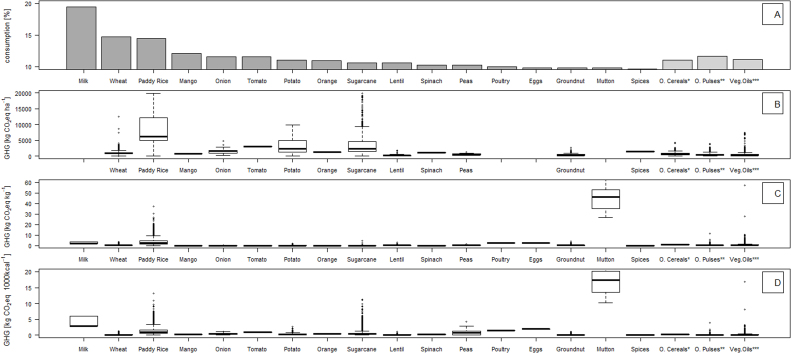
Agriculture is a major source of greenhouse gas (GHG) emissions globally. The growing global population is putting pressure on agricultural production systems that aim to secure food production while minimising GHG emissions. In this study, the GHG emissions associated with the production of major food commodities in India are calculated using the Cool Farm Tool. GHG emissions, based on farm management for major crops (including cereals like wheat and rice, pulses, potatoes, fruits and vegetables) and livestock-based products (milk, eggs, chicken and mutton meat), are quantified and compared. Livestock and rice production were found to be the main sources of GHG emissions in Indian agriculture with a country average of 5.65 kg COeq kg rice, 45.54 kg COeq kg mutton meat and 2.4 kg COeq kg milk. Production of cereals (except rice), fruits and vegetables in India emits comparatively less GHGs with <1 kg COeq kg product. These findings suggest that a shift towards dietary patterns with greater consumption of animal source foods could greatly increase GHG emissions from Indian agriculture. A range of mitigation options are available that could reduce emissions from current levels and may be compatible with increased future food production and consumption demands in India.
农业是全球温室气体排放的主要来源。不断增长的全球人口给农业生产系统带来了压力,这些系统旨在确保粮食生产的同时将温室气体排放降至最低。在本研究中,使用Cool Farm Tool计算了印度主要粮食商品生产相关的温室气体排放。基于主要作物(包括小麦和水稻等谷物、豆类、土豆、水果和蔬菜)以及畜牧产品(牛奶、鸡蛋、鸡肉和羊肉)的农场管理,对温室气体排放进行了量化和比较。结果发现,畜牧业和水稻生产是印度农业温室气体排放的主要来源,全国平均水平为每千克大米排放5.65千克二氧化碳当量、每千克羊肉排放45.54千克二氧化碳当量、每千克牛奶排放2.4千克二氧化碳当量。印度谷物(水稻除外)、水果和蔬菜的生产排放的温室气体相对较少,每千克产品的二氧化碳当量不到1千克。这些发现表明,转向更多消费动物源食品的饮食模式可能会大幅增加印度农业中的温室气体排放。有一系列缓解措施可供选择,这些措施可以将排放量从当前水平降低,并且可能与印度未来增加的粮食生产和消费需求相兼容。