Nivethitha L, Mooventhan A, Manjunath N K, Bathala Lokesh, Sharma Vijay K
Department of Research and Development, S-VYASA University, Bengaluru, Karnataka, India.
Department of Neurology, Cauvery Medical Centre, Aster CMI Hospital, Bengaluru, Karnataka, India.
J Neurosci Rural Pract. 2017 Jan-Mar;8(1):60-63. doi: 10.4103/0976-3147.193532.
Pranayama techniques are known to produce variable physiological effects on the body. We evaluated the effect of the two commonly practiced Pranayama techniques on cerebral hemodynamics.
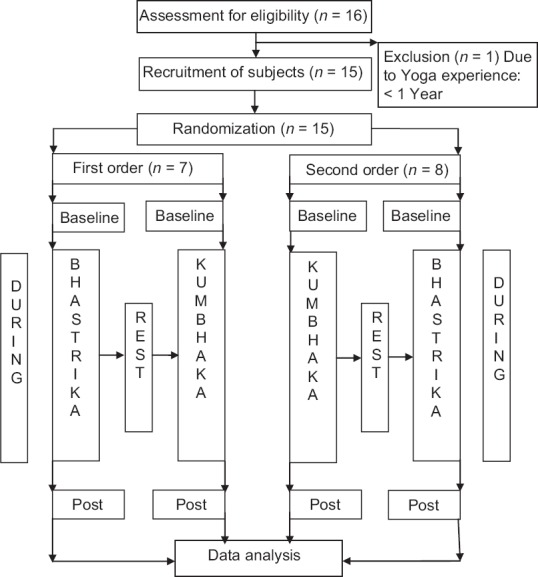
Fifteen healthy male volunteers, trained in Yoga and Pranayama, were included in the study. Mean age was 24 years (range 22-32 years). Study participants performed 2 Pranayamas in 2 different orders. Order 1 ( = 7) performed Bhastrika (bellows breaths) followed by Kumbhaka (breath retention) while order 2 ( = 8) performed Kumbhaka followed by Bhastrika. Both breathing techniques were performed for 1 min each. Continuous transcranial Doppler (TCD) monitoring was performed during the breathing techniques. TCD parameters that were recorded included peak systolic velocity (PSV), end-diastolic velocity (EDV), mean flow velocity (MFV), and pulsatility index (PI) of the right middle cerebral artery at baseline, 15, 30, 45, and 60 s.
Significant reductions in EDV (3.67 ± 6.48; < 0.001) and MFV (22.00 ± 7.30; < 0.001) with a significant increase in PI (2.43 ± 0.76; < 0.001) were observed during Bhastrika. On the contrary, a significant increase in PSV (65.27 ± 13.75; < 0.001), EDV (28.67 ± 12.03; < 0.001), and MFV (43.67 ± 12.85; < 0.001) with a significant reduction in PI (0.89 ± 0.28; < 0.01) was observed only during Kumbhaka.
Bhastrika and Kumbhaka practices of Pranayama produce considerable and opposing effects on cerebral hemodynamic parameters. Our findings may play a potential role in designing the Pranayama techniques according to patients' requirements.
已知调息法对身体会产生多种生理效应。我们评估了两种常见的调息法对脑血流动力学的影响。
15名接受过瑜伽和调息法训练的健康男性志愿者纳入本研究。平均年龄24岁(范围22 - 32岁)。研究参与者以两种不同顺序进行两种调息法。顺序1(n = 7)先进行风箱式呼吸(Bhastrika),然后是屏息(Kumbhaka);顺序2(n = 8)先进行屏息,然后是风箱式呼吸。两种呼吸法均各进行1分钟。在进行呼吸法期间进行连续经颅多普勒(TCD)监测。记录的TCD参数包括基线、15、30、45和60秒时右大脑中动脉的收缩期峰值流速(PSV)、舒张末期流速(EDV)、平均流速(MFV)和搏动指数(PI)。
在风箱式呼吸期间,观察到EDV显著降低(3.67 ± 6.48;P < 0.001)和MFV显著降低(22.00 ± 7.30;P < 0.001),同时PI显著升高(2.43 ± 0.76;P < 0.001)。相反,仅在屏息期间观察到PSV显著升高(65.27 ± 13.75;P < 0.001)、EDV显著升高(28.67 ± 12.03;P < 0.001)和MFV显著升高(43.67 ± 12.85;P < 0.001),同时PI显著降低(0.89 ± 0.28;P < 0.01)。
调息法中的风箱式呼吸和屏息对脑血流动力学参数产生显著且相反的影响。我们的研究结果可能在根据患者需求设计调息法方面发挥潜在作用。