Dickie David Alexander, Shenkin Susan D, Anblagan Devasuda, Lee Juyoung, Blesa Cabez Manuel, Rodriguez David, Boardman James P, Waldman Adam, Job Dominic E, Wardlaw Joanna M
Brain Research Imaging Centre, Neuroimaging Sciences, Centre for Clinical Brain Sciences, Royal Infirmary of Edinburgh, The University of EdinburghEdinburgh, UK; Scottish Imaging Network, A Platform for Scientific Excellence (SINAPSE) CollaborationGlasgow, UK.
Brain Research Imaging Centre, Neuroimaging Sciences, Centre for Clinical Brain Sciences, Royal Infirmary of Edinburgh, The University of EdinburghEdinburgh, UK; Geriatric Medicine Unit, Royal Infirmary of Edinburgh, The University of EdinburghEdinburgh, UK; Department of Psychology, Centre for Cognitive Ageing and Cognitive Epidemiology, The University of EdinburghEdinburgh, UK.
Front Neuroinform. 2017 Jan 19;11:1. doi: 10.3389/fninf.2017.00001. eCollection 2017.
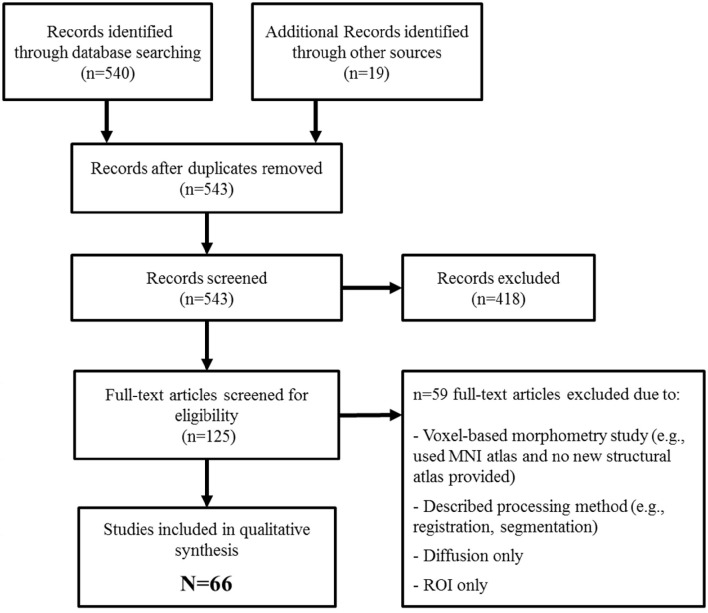
Brain MRI atlases may be used to characterize brain structural changes across the life course. Atlases have important applications in research, e.g., as registration and segmentation targets to underpin image analysis in population imaging studies, and potentially in future in clinical practice, e.g., as templates for identifying brain structural changes out with normal limits, and increasingly for use in surgical planning. However, there are several caveats and limitations which must be considered before successfully applying brain MRI atlases to research and clinical problems. For example, the influential Talairach and Tournoux atlas was derived from a single fixed cadaveric brain from an elderly female with limited clinical information, yet is the basis of many modern atlases and is often used to report locations of functional activation. We systematically review currently available whole brain structural MRI atlases with particular reference to the implications for population imaging through to emerging clinical practice. We found 66 whole brain structural MRI atlases world-wide. The vast majority were based on T1, T2, and/or proton density (PD) structural sequences, had been derived using parametric statistics (inappropriate for brain volume distributions), had limited supporting clinical or cognitive data, and included few younger (>5 and <18 years) or older (>60 years) subjects. To successfully characterize brain structural features and their changes across different stages of life, we conclude that whole brain structural MRI atlases should include: more subjects at the upper and lower extremes of age; additional structural sequences, including fluid attenuation inversion recovery (FLAIR) and T2 sequences; a range of appropriate statistics, e.g., rank-based or non-parametric; and detailed cognitive and clinical profiles of the included subjects in order to increase the relevance and utility of these atlases.
脑磁共振成像图谱可用于描述一生中脑结构的变化。图谱在研究中具有重要应用,例如作为配准和分割目标,以支持人群成像研究中的图像分析,并且在未来可能应用于临床实践,例如作为识别超出正常范围的脑结构变化的模板,以及越来越多地用于手术规划。然而,在成功将脑磁共振成像图谱应用于研究和临床问题之前,必须考虑几个注意事项和局限性。例如,有影响力的Talairach和Tournoux图谱源自一名老年女性的单一固定尸体脑,临床信息有限,但却是许多现代图谱的基础,并且经常用于报告功能激活的位置。我们系统地综述了目前可用的全脑结构磁共振成像图谱,特别提及了对从人群成像到新兴临床实践的影响。我们发现全球有66种全脑结构磁共振成像图谱。绝大多数基于T1、T2和/或质子密度(PD)结构序列,使用参数统计方法得出(不适用于脑体积分布),支持的临床或认知数据有限,并且包括的年轻(>5岁和<18岁)或年长(>60岁)受试者较少。为了成功描述不同生命阶段的脑结构特征及其变化,我们得出结论,全脑结构磁共振成像图谱应包括:更多年龄上限和下限的受试者;额外的结构序列,包括液体衰减反转恢复(FLAIR)和T2序列;一系列适当的统计方法,例如基于秩或非参数的方法;以及所纳入受试者的详细认知和临床概况,以提高这些图谱的相关性和实用性。