Meunier Natascha V, Sebulime Peregrine, White Richard G, Kock Richard
Department of Pathology and Pathogen Biology, Royal Veterinary College; Faculty of Epidemiology and Population Health, London School of Hygiene and Tropical Medicine.
Onderstepoort J Vet Res. 2017 Jan 23;84(1):e1-e10. doi: 10.4102/ojvr.v84i1.1221.
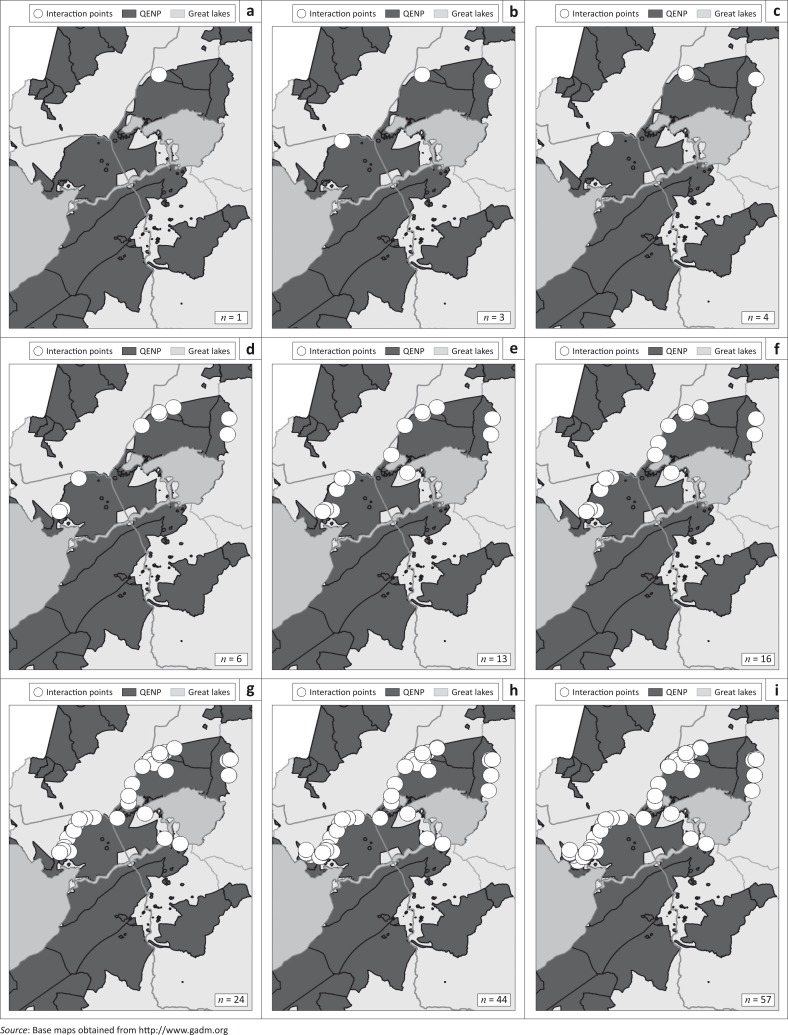
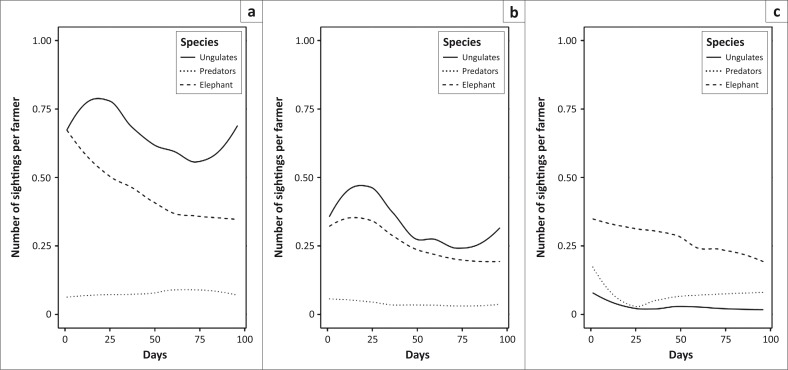
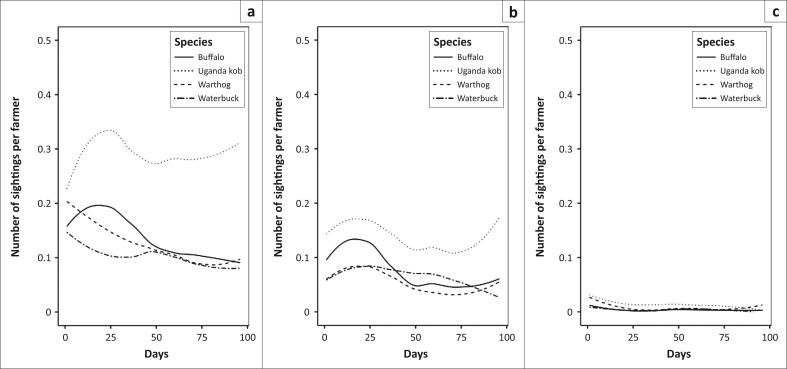
The transmission of diseases between livestock and wildlife can be a hindrance to effective disease control. Maintenance hosts and contact rates should be explored to further understand the transmission dynamics at the wildlife-livestock interface. Bovine tuberculosis (BTB) has been shown to have wildlife maintenance hosts and has been confirmed as present in the African buffalo (Syncerus caffer) in the Queen Elizabeth National Park (QENP) in Uganda since the 1960s. The first aim of this study was to explore the spatio-temporal spread of cattle illegally grazing within the QENP recorded by the Uganda Wildlife Authority (UWA) rangers in a wildlife crime database. Secondly, we aimed to quantify wildlife-livestock interactions and cattle movements, on the border of QENP, using a longitudinal questionnaire completed by 30 livestock owners. From this database, 426 cattle sightings were recorded within QENP in 8 years. Thirteen (3.1%) of these came within a 300 m-4 week space-time window of a buffalo herd, using the recorded GPS data. Livestock owners reported an average of 1.04 (95% CI 0.97-1.11) sightings of Uganda kob, waterbuck, buffalo or warthog per day over a 3-month period, with a rate of 0.22 (95% CI 0.20-0.25) sightings of buffalo per farmer per day. Reports placed 85.3% of the ungulate sightings and 88.0% of the buffalo sightings as further than 50 m away. Ungulate sightings were more likely to be closer to cattle at the homestead (OR 2.0, 95% CI 1.1-3.6) compared with the grazing area. Each cattle herd mixed with an average of five other cattle herds at both the communal grazing and watering points on a daily basis. Although wildlife and cattle regularly shared grazing and watering areas, they seldom came into contact close enough for aerosol transmission. Between species infection transmission is therefore likely to be by indirect or non-respiratory routes, which is suspected to be an infrequent mechanism of transmission of BTB. Occasional cross-species spillover of infection is possible, and the interaction of multiple wildlife species needs further investigation. Controlling the interface between wildlife and cattle in a situation where eradication is not being considered may have little impact on BTB disease control in cattle.
牲畜与野生动物之间的疾病传播可能会阻碍有效的疾病控制。应探究维持宿主和接触率,以进一步了解野生动物与牲畜界面处的传播动态。牛结核病(BTB)已被证明存在野生动物维持宿主,并且自20世纪60年代以来,已在乌干达伊丽莎白女王国家公园(QENP)的非洲水牛(非洲野水牛)中得到证实。本研究的首要目的是探究乌干达野生动物管理局(UWA)护林员在野生动物犯罪数据库中记录的非法在QENP内放牧的牛的时空扩散情况。其次,我们旨在通过30位牲畜所有者填写的纵向调查问卷,量化QENP边界处野生动物与牲畜的相互作用以及牛的移动情况。从该数据库中,8年内记录到在QENP内有426次牛的目击记录。利用记录的GPS数据,其中13次(3.1%)发生在水牛群的300米 - 4周时空窗口内。牲畜所有者报告,在3个月的时间里,平均每天有1.04次(95%置信区间0.97 - 1.11)看到乌干达水羚、水羚、水牛或疣猪,每位农民每天看到水牛的比率为0.22次(95%置信区间0.20 - 0.25)。报告显示,85.3%的有蹄类动物目击记录和88.0%的水牛目击记录距离超过50米。与放牧区相比,在宅基地处有蹄类动物的目击记录更有可能靠近牛群(优势比2.0,95%置信区间1.1 - 3.6)。每个牛群每天在公共放牧点和饮水点平均与其他五个牛群混在一起。尽管野生动物和牛经常共享放牧和饮水区域,但它们很少近距离接触到足以进行气溶胶传播的程度。因此,物种间的感染传播可能是通过间接或非呼吸道途径,这被怀疑是牛结核病传播的一种不常见机制。偶尔的跨物种感染溢出是可能的,多种野生动物物种之间的相互作用需要进一步研究。在不考虑根除的情况下,控制野生动物与牛之间的界面可能对牛结核病的控制影响不大。