Thorpe Stephen D, Gambassi Silvia, Thompson Clare L, Chandrakumar Charmilie, Santucci Annalisa, Knight Martin M
Institute of Bioengineering, School of Engineering and Materials Science, Queen Mary University of London, London, United Kingdom.
Dipartimento di Biotecnologie, Chimica e Farmacia, Università degli Studi di Siena, Siena, Italy.
J Cell Physiol. 2017 Sep;232(9):2407-2417. doi: 10.1002/jcp.25839. Epub 2017 Mar 31.
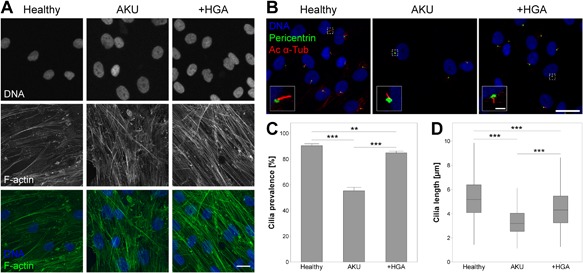
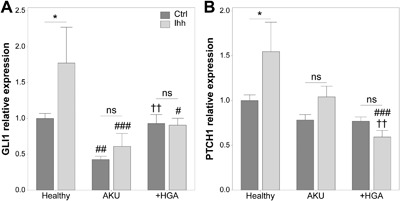
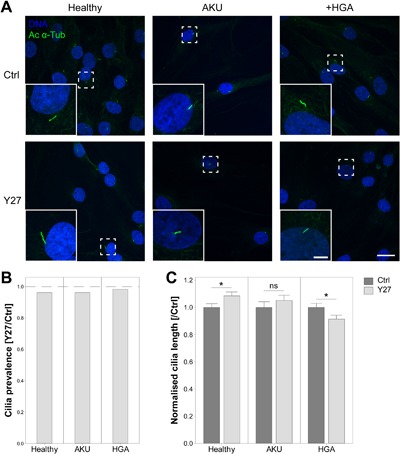
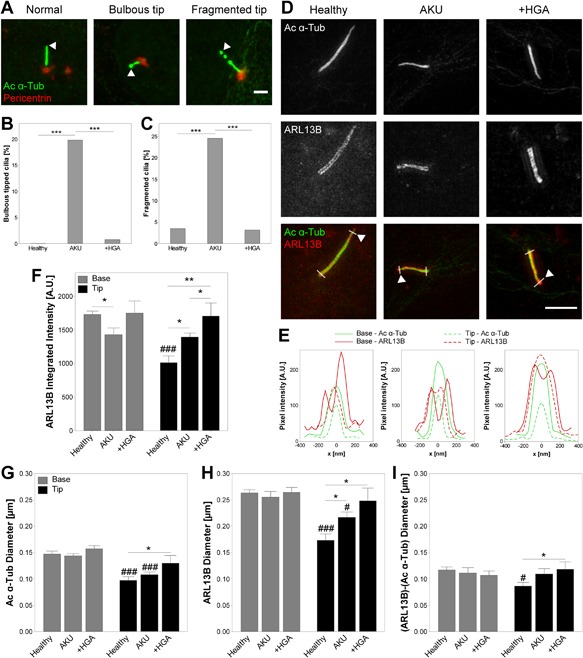
Alkaptonuria (AKU) is a rare inherited disease resulting from a deficiency of the enzyme homogentisate 1,2-dioxygenase which leads to the accumulation of homogentisic acid (HGA). AKU is characterized by severe cartilage degeneration, similar to that observed in osteoarthritis. Previous studies suggest that AKU is associated with alterations in cytoskeletal organization which could modulate primary cilia structure/function. This study investigated whether AKU is associated with changes in chondrocyte primary cilia and associated Hedgehog signaling which mediates cartilage degradation in osteoarthritis. Human articular chondrocytes were obtained from healthy and AKU donors. Additionally, healthy chondrocytes were treated with HGA to replicate AKU pathology (+HGA). Diseased cells exhibited shorter cilia with length reductions of 36% and 16% in AKU and +HGA chondrocytes respectively, when compared to healthy controls. Both AKU and +HGA chondrocytes demonstrated disruption of the usual cilia length regulation by actin contractility. Furthermore, the proportion of cilia with axoneme breaks and bulbous tips was increased in AKU chondrocytes consistent with defective regulation of ciliary trafficking. Distribution of the Hedgehog-related protein Arl13b along the ciliary axoneme was altered such that its localization was increased at the distal tip in AKU and +HGA chondrocytes. These changes in cilia structure/trafficking in AKU and +HGA chondrocytes were associated with a complete inability to activate Hedgehog signaling in response to exogenous ligand. Thus, we suggest that altered responsiveness to Hedgehog, as a consequence of cilia dysfunction, may be a contributing factor in the development of arthropathy highlighting the cilium as a novel target in AKU.
黑尿症(AKU)是一种罕见的遗传性疾病,由尿黑酸1,2-双加氧酶缺乏引起,导致尿黑酸(HGA)积累。AKU的特征是严重的软骨退变,类似于骨关节炎中观察到的情况。先前的研究表明,AKU与细胞骨架组织的改变有关,这可能会调节初级纤毛的结构/功能。本研究调查了AKU是否与软骨细胞初级纤毛的变化以及相关的刺猬信号通路有关,该信号通路介导骨关节炎中的软骨降解。从健康和AKU供体获取人关节软骨细胞。此外,用HGA处理健康软骨细胞以复制AKU病理状态(+HGA)。与健康对照相比,患病细胞的纤毛较短,AKU和+HGA软骨细胞的长度分别减少了36%和16%。AKU和+HGA软骨细胞均表现出肌动蛋白收缩力对正常纤毛长度调节的破坏。此外,AKU软骨细胞中具有轴丝断裂和球状尖端的纤毛比例增加,这与纤毛运输的调节缺陷一致。刺猬相关蛋白Arl13b沿纤毛轴丝的分布发生改变,使其在AKU和+HGA软骨细胞的远端尖端定位增加。AKU和+HGA软骨细胞中纤毛结构/运输的这些变化与对外源配体完全无法激活刺猬信号通路有关。因此,我们认为,由于纤毛功能障碍导致的对刺猬信号通路反应性改变可能是关节病发展的一个促成因素,突出了纤毛作为AKU中的一个新靶点。