VanderWeele Tyler J
From the Department of Epidemiology, Harvard T.H. Chan School of Public Health, Boston, MA.
Epidemiology. 2017 May;28(3):399-402. doi: 10.1097/EDE.0000000000000641.
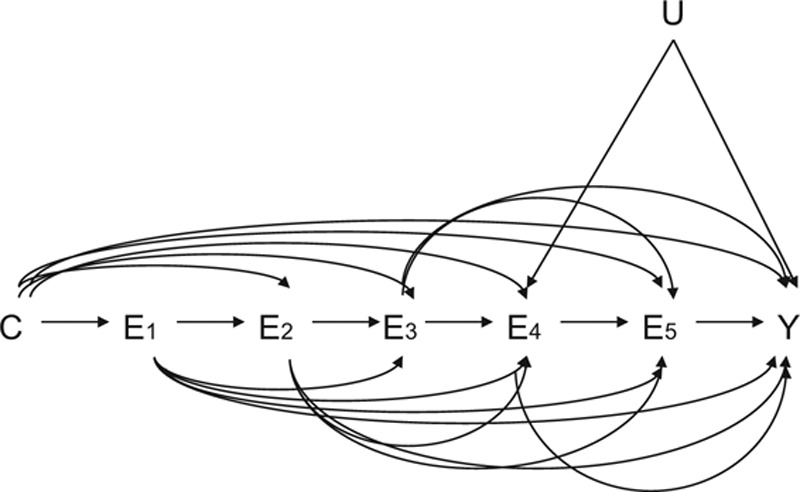
The author proposes that epidemiologic studies should more often assess the associations of a single exposure with multiple outcomes simultaneously. Such "outcome-wide epidemiology" will be especially important for exposures that may be beneficial for some outcomes but harmful for others. Outcome-wide epidemiology may also be helpful in prioritizing public health recommendations. Methodologically, the conduct of outcome-wide epidemiology will generally be more straightforward than recent proposals for exposure-wide epidemiologic studies, in which the associations between a single outcome and many exposures are assessed simultaneously. Such exposure-wide studies are likely to be subject to numerous biases because of the inability to make simultaneous confounding control and because exposures are likely to affect, and mediate the effects of, other exposures. These problems simplify considerably in an outcome-wide approach when a single exposure is being considered. Moreover, outcome-wide approaches will generally be more useful than exposure-wide approaches in shaping public health recommendations.
作者提议,流行病学研究应更频繁地同时评估单一暴露与多种结局之间的关联。这种“全结局流行病学”对于某些结局可能有益而对其他结局有害的暴露而言尤为重要。全结局流行病学在确定公共卫生建议的优先次序方面也可能有所帮助。在方法上,开展全结局流行病学通常比近期关于全暴露流行病学研究的提议更为直接,后者是同时评估单一结局与多种暴露之间的关联。由于无法同时进行混杂控制,且暴露可能会影响其他暴露并介导其效应,此类全暴露研究可能会受到众多偏倚的影响。当考虑单一暴露时,在全结局研究方法中这些问题会大大简化。此外,在制定公共卫生建议方面,全结局研究方法通常比全暴露研究方法更有用。