Cen Chao-Qun, Liang Ya-Yong, Chen Qiu-Ru, Chen Kai-Yun, Deng Hong-Zhu, Chen Bi-Yuan, Zou Xiao-Bing
Child Developmental-Behavioral Center, The Third Affiliated Hospital of Sun Yat-sen University, No. 600, Tianhe Rd., Guangzhou, 510630, China.
Department of Pediatrics, Huizhou First Hospital, NO.20, South Sanxin Rd., Huizhou, 516000, China.
BMC Psychiatry. 2017 Feb 6;17(1):51. doi: 10.1186/s12888-016-1185-y.
Researchers from several different countries have found the Social Responsiveness Scale (SRS) to have good psychometric properties. However, to our knowledge, no studies on this subject have been reported in Mainland China. In this study, we investigated the psychometric properties of the Chinese Mandarin version of the SRS when used in Mainland China.
The reliability and validity of the parent-report SRS in a sample of 749 children of 4- to 14-year-olds: 411 typically developing and 338 clinical participants (202 with autism spectrum disorder (ASD)) were examined.
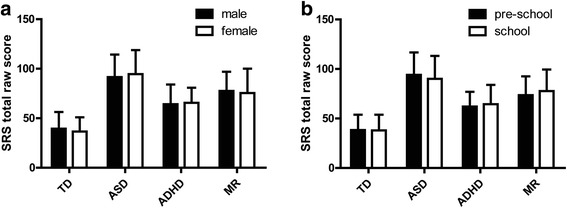
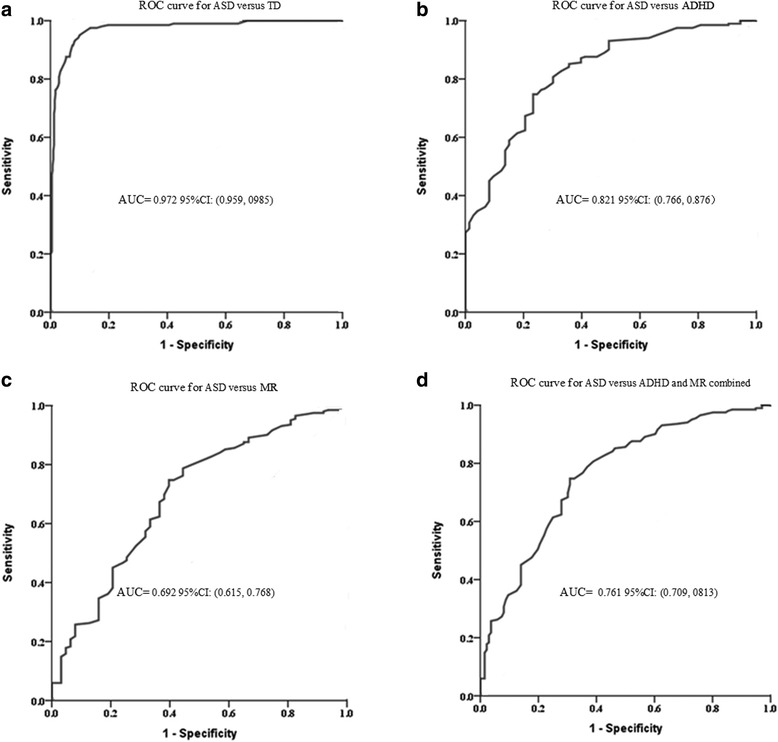
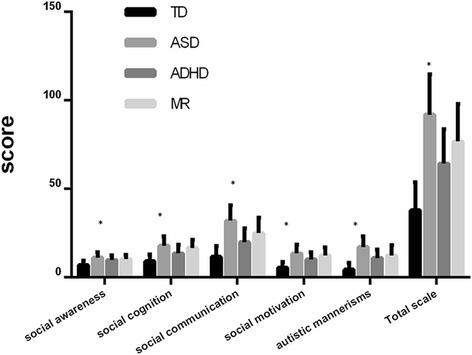
Internal consistency for total scale (0.871-0.922), test-retest reliability (0.81-0.94), and convergent validity with the Autism Behavior Checklist (ABC) (0.302-0.647) were satisfactory. The SRS total score discriminated between the ASD and other developmental disorders. Receiver operating characteristic (ROC) analyses revealed that the SRS was predicted to accurately classify 69.2-97.2% of youth ASD. Exploratory factor analysis (EFA) supported a single-factor solution for the ASD subsample. Confirmatory factor analysis (CFA) did not confirm the theoretical construct of five factors model with inadequate fit in the ASD subsample.
Overall, our findings supported the reliability and validity of the parent-report SRS as one ASD screening instrument. In addition, we also suggest that the use of separate cut-offs for screening purposes (optimizing sensitivity) vs. clinical confirmation (optimizing specificity) should be considered.
来自几个不同国家的研究人员发现社会反应量表(SRS)具有良好的心理测量学特性。然而,据我们所知,中国大陆尚未有关于该主题的研究报道。在本研究中,我们调查了中国大陆使用的中文普通话版SRS的心理测量学特性。
对749名4至14岁儿童的家长报告SRS的信效度进行了检验,其中411名发育正常儿童和338名临床参与者(202名患有自闭症谱系障碍(ASD))。
总量表的内部一致性(0.871 - 0.922)、重测信度(0.81 - 0.94)以及与自闭症行为量表(ABC)的收敛效度(0.302 - 0.647)均令人满意。SRS总分能够区分ASD和其他发育障碍。受试者工作特征(ROC)分析显示,SRS预计能准确分类69.2% - 97.2%的青少年ASD。探索性因素分析(EFA)支持ASD子样本的单因素解决方案。验证性因素分析(CFA)未证实ASD子样本中五因素模型的理论结构,拟合度不足。
总体而言,我们的研究结果支持家长报告SRS作为一种ASD筛查工具的信效度。此外,我们还建议应考虑使用不同的临界值进行筛查目的(优化敏感性)与临床确诊(优化特异性)。