Department of Brain and Cognitive Engineering, Korea University, Seoul 02841, Republic of Korea.
Department of Brain and Cognitive Engineering, Korea University, Seoul 02841, Republic of Korea.
Med Image Anal. 2017 Apr;37:101-113. doi: 10.1016/j.media.2017.01.008. Epub 2017 Jan 24.
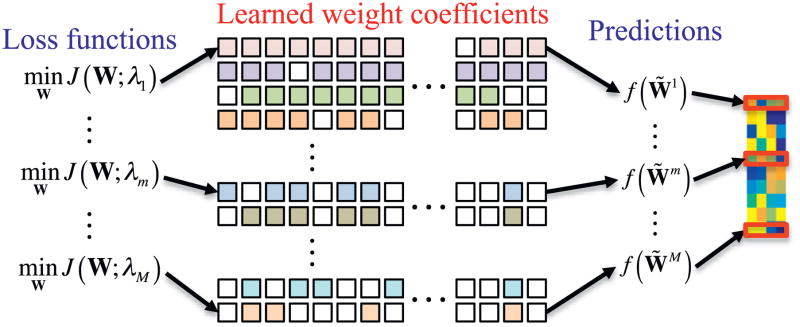
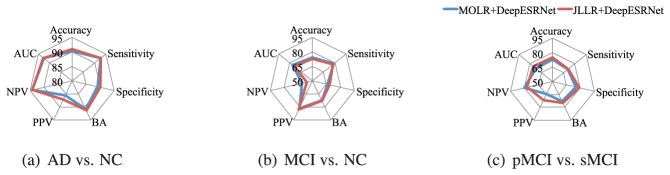
Recent studies on brain imaging analysis witnessed the core roles of machine learning techniques in computer-assisted intervention for brain disease diagnosis. Of various machine-learning techniques, sparse regression models have proved their effectiveness in handling high-dimensional data but with a small number of training samples, especially in medical problems. In the meantime, deep learning methods have been making great successes by outperforming the state-of-the-art performances in various applications. In this paper, we propose a novel framework that combines the two conceptually different methods of sparse regression and deep learning for Alzheimer's disease/mild cognitive impairment diagnosis and prognosis. Specifically, we first train multiple sparse regression models, each of which is trained with different values of a regularization control parameter. Thus, our multiple sparse regression models potentially select different feature subsets from the original feature set; thereby they have different powers to predict the response values, i.e., clinical label and clinical scores in our work. By regarding the response values from our sparse regression models as target-level representations, we then build a deep convolutional neural network for clinical decision making, which thus we call 'Deep Ensemble Sparse Regression Network.' To our best knowledge, this is the first work that combines sparse regression models with deep neural network. In our experiments with the ADNI cohort, we validated the effectiveness of the proposed method by achieving the highest diagnostic accuracies in three classification tasks. We also rigorously analyzed our results and compared with the previous studies on the ADNI cohort in the literature.
最近的脑成像分析研究见证了机器学习技术在计算机辅助脑疾病诊断中的核心作用。在各种机器学习技术中,稀疏回归模型已被证明在处理高维数据方面非常有效,尤其是在医学问题上,但其训练样本数量较少。与此同时,深度学习方法在各种应用中表现出色,取得了巨大的成功。在本文中,我们提出了一种新颖的框架,将稀疏回归和深度学习这两种概念上不同的方法结合起来,用于阿尔茨海默病/轻度认知障碍的诊断和预后。具体来说,我们首先训练多个稀疏回归模型,每个模型都使用不同的正则化控制参数值进行训练。因此,我们的多个稀疏回归模型可能会从原始特征集中选择不同的特征子集;从而它们具有不同的预测响应值的能力,即在我们的工作中,即临床标签和临床评分。通过将稀疏回归模型的响应值视为目标级表示,我们构建了一个用于临床决策的深度卷积神经网络,我们称之为“深度集成稀疏回归网络”。据我们所知,这是将稀疏回归模型与深度神经网络相结合的首次尝试。在对 ADNI 队列的实验中,我们通过在三个分类任务中实现最高的诊断准确率验证了该方法的有效性。我们还对结果进行了严格的分析,并与文献中 ADNI 队列的先前研究进行了比较。