Yang Mingxiao, Chen Xiangzhu, Bo Linna, Lao Lixing, Chen Jiao, Yu Siyi, Yu Zheng, Tang Hongzhi, Yi Ling, Wu Xi, Yang Jie, Liang Fanrong
School of Acupuncture and moxibustion, Chengdu University of Traditional Chinese Medicine, Chengdu, Sichuan, China.
Pixian Hospital of Traditional Chinese Medicine, Chengdu, Sichuan, China.
PLoS One. 2017 Feb 7;12(2):e0170952. doi: 10.1371/journal.pone.0170952. eCollection 2017.
Though moxibustion is frequently used to treat primary dysmenorrhea in China, relevant evidence supporting its effectiveness is still scanty.
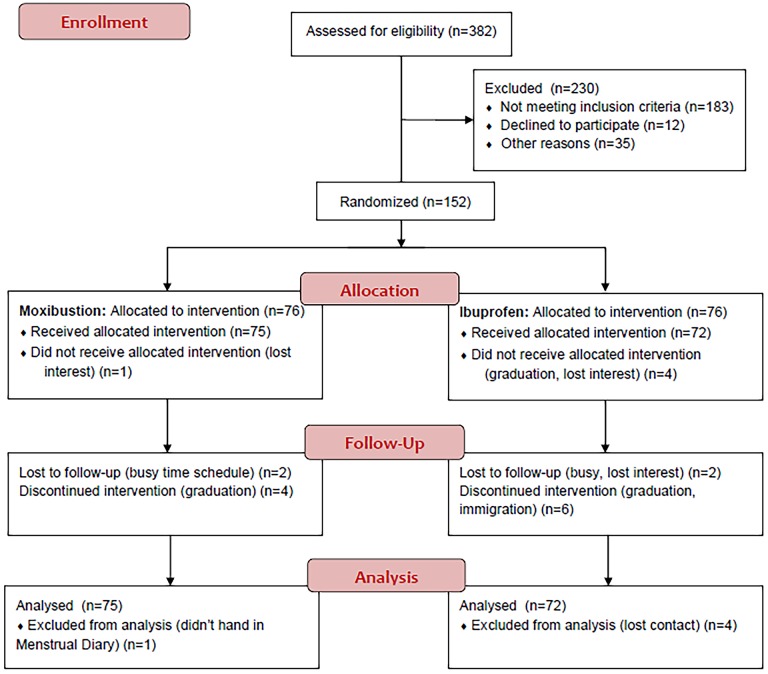
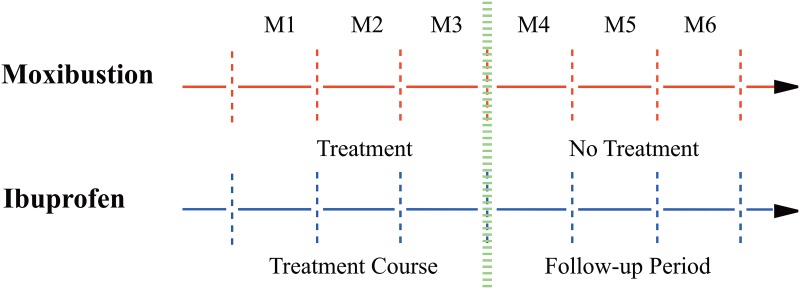
This study was a pragmatic randomized, conventional drug controlled, open-labeled clinical trial. After initial screen, 152 eligible participants were averagely randomized to receive two different treatment strategies: Moxibustion and conventional drugs. Participants and practitioners were not blinded in this study. The duration of each treatment was 3 months. The primary outcome was pain relief measured by the Visual Analogue Scale. The menstrual pain severity was recorded in a menstrual pain diary.
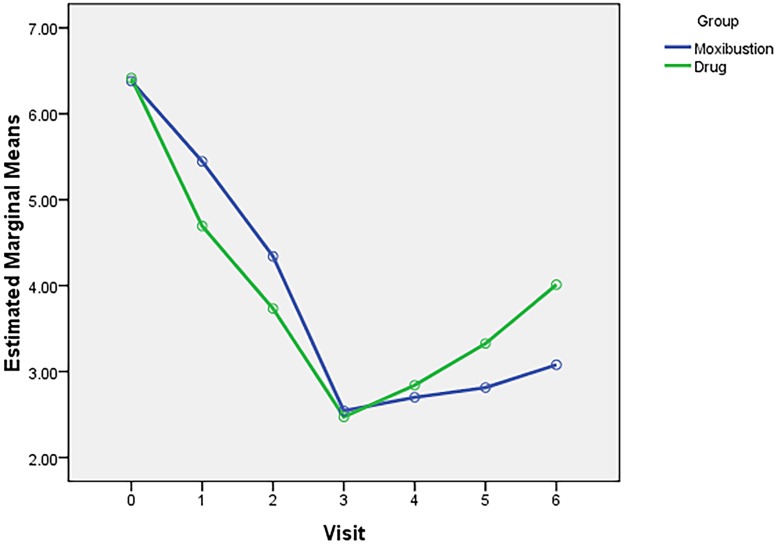
152 eligible patients were included but only 133 of them eventually completed the whole treatment course. The results showed that the menstrual pain intensity in experimental group and control group was reduced from 6.38±1.28 and 6.41±1.29, respectively, at baseline, to 2.54±1.41 and 2.47±1.29 after treatment. The pain reduction was not significantly different between these two groups (P = 0.76), however; the pain intensity was significantly reduced relative to baseline for each group (P<0.01). Three months after treatment, the effectiveness of moxibustion sustained and started to be superior to the drug's effect (-0.87, 95%CI -1.32 to -0.42, P<0.01). Secondary outcome analyses showed that moxibustion was as effective as drugs in alleviating menstrual pain-related symptoms. The serum levels of pain mediators, such as PGF2α, OT, vWF, β-EP, PGE2, were significantly improved after treatment in both groups (P<0.05). No adverse events were reported in this trial.
Both moxibustion and conventional drug showed desirable merits in managing menstrual pain, given their treatment effects and economic costs. This study as a pragmatic trial only demonstrates the effectiveness, not the efficacy, of moxibustion for menstrual pain. It can't rule out the effect of psychological factors during treatment process, because no blind procedure or sham control was used due to availability. In clinical practice, moxibustion should be used at the discretion of patients and their physicians.
ClinialTrials.gov NCT01972906.
在中国,艾灸常用于治疗原发性痛经,但支持其有效性的相关证据仍然不足。
本研究是一项实用的随机、传统药物对照、开放标签的临床试验。经过初步筛选,152名符合条件的参与者被平均随机分为两组,接受两种不同的治疗策略:艾灸和传统药物。本研究中参与者和医生均未设盲。每种治疗持续3个月。主要结局是通过视觉模拟量表测量的疼痛缓解情况。月经疼痛严重程度记录在月经疼痛日记中。
纳入152名符合条件的患者,但最终只有133人完成了整个治疗过程。结果显示,实验组和对照组的月经疼痛强度在基线时分别为6.38±1.28和6.41±1.29,治疗后分别降至2.54±1.41和2.47±1.29。然而,两组之间的疼痛减轻差异不显著(P = 0.76);但每组的疼痛强度相对于基线均显著降低(P<0.01)。治疗3个月后,艾灸的效果持续且开始优于药物治疗效果(-0.87,95%CI -1.32至-0.42,P<0.01)。次要结局分析表明,艾灸在缓解与月经疼痛相关的症状方面与药物效果相当。两组治疗后疼痛介质如PGF2α、OT、vWF、β-EP、PGE2的血清水平均显著改善(P<0.05)。本试验未报告不良事件。
考虑到艾灸和传统药物的治疗效果和经济成本,两者在治疗月经疼痛方面均显示出理想的优点。本研究作为一项实用试验,仅证明了艾灸治疗月经疼痛的有效性,而非疗效。由于可行性原因未采用盲法程序或假对照,因此无法排除治疗过程中心理因素的影响。在临床实践中,艾灸应根据患者及其医生的判断使用。
ClinicalTrials.gov NCT01972906。