College of Resources and Environmental Sciences, China Agricultural University, 2 Yuanmingyuan West Road, Beijing 100193, China.
School of Geography Science, Nanjing Normal University, Nanjing 210023, China.
Sci Rep. 2017 Feb 8;7:42247. doi: 10.1038/srep42247.
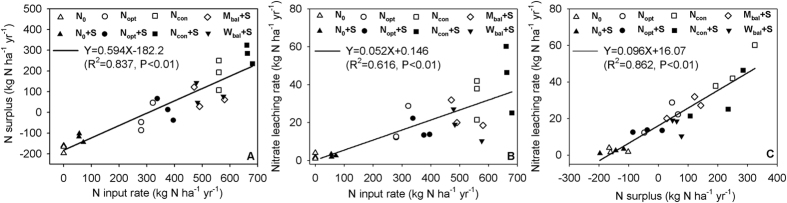
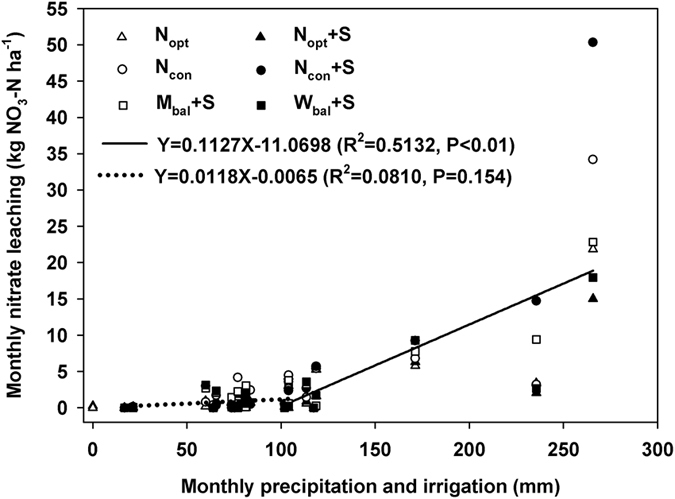
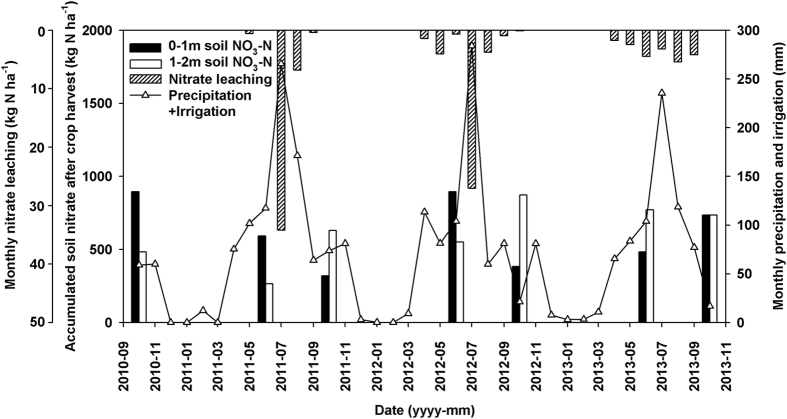
Nitrate leaching is one of the most important pathways of nitrogen (N) loss which leads to groundwater contamination or surface water eutrophication. Clarifying the rates, controlling factors and characteristics of nitrate leaching is the pre-requisite for proposing effective mitigation strategies. We investigated the effects of interactions among chemical N fertilizer, straw and manure applications on nitrogen leaching in an intensively managed calcareous Fluvo-aquic soil with winter wheat-summer maize cropping rotations on the North China Plain from October 2010 to September 2013 using ceramic suction cups and seepage water calculations based on a long-term field experiment. Annual nitrate leaching reached 38-60 kg N ha from conventional N managements, but declined by 32-71% due to optimum N, compost manure or municipal waste treatments, respectively. Nitrate leaching concentrated in the summer maize season, and fewer leaching events with high amounts are the characteristics of nitrate leaching in this region. Overuse of chemical N fertilizers, high net mineralization and nitrification, together with predominance of rainfall in the summer season with light soil texture are the main controlling factors responsible for the high nitrate leaching loss in this soil-crop-climatic system.
硝酸盐淋失是氮(N)损失的最重要途径之一,会导致地下水污染或地表水富营养化。阐明硝酸盐淋失的速率、控制因素和特征是提出有效缓解策略的前提。我们在华北平原利用长期田间试验,使用陶瓷吸盘和渗漏水计算,研究了 2010 年 10 月至 2013 年 9 月冬季小麦-夏季玉米轮作中,化学氮肥、秸秆和有机肥施用之间相互作用对钙质潮土中氮淋失的影响。常规氮管理下,年硝酸盐淋失量达到 38-60kgNha,但由于最佳 N、堆肥或城市垃圾处理,分别减少了 32-71%。硝酸盐淋失主要集中在夏季玉米季,且淋失事件少但数量高是该地区硝酸盐淋失的特征。过量使用化学氮肥、高净矿化和硝化作用,以及夏季降雨多且土壤质地较轻,是导致该土壤-作物-气候系统中硝酸盐淋失损失较高的主要控制因素。