Ding Xiao-Han, Wang Xiaona, Cao Ruihua, Yang Xu, Xiao Wenkai, Zhang Yun, Bai Yongyi, Wu Hongmei, Ye Ping
Department of Geriatric Cardiology, Chinese PLA General Hospital, Beijing Department of Health Care and Geriatrics, Lanzhou General Hospital of Lanzhou Military Command, Lanzhou, Gansu Province, China.
Medicine (Baltimore). 2017 Feb;96(6):e5957. doi: 10.1097/MD.0000000000005957.
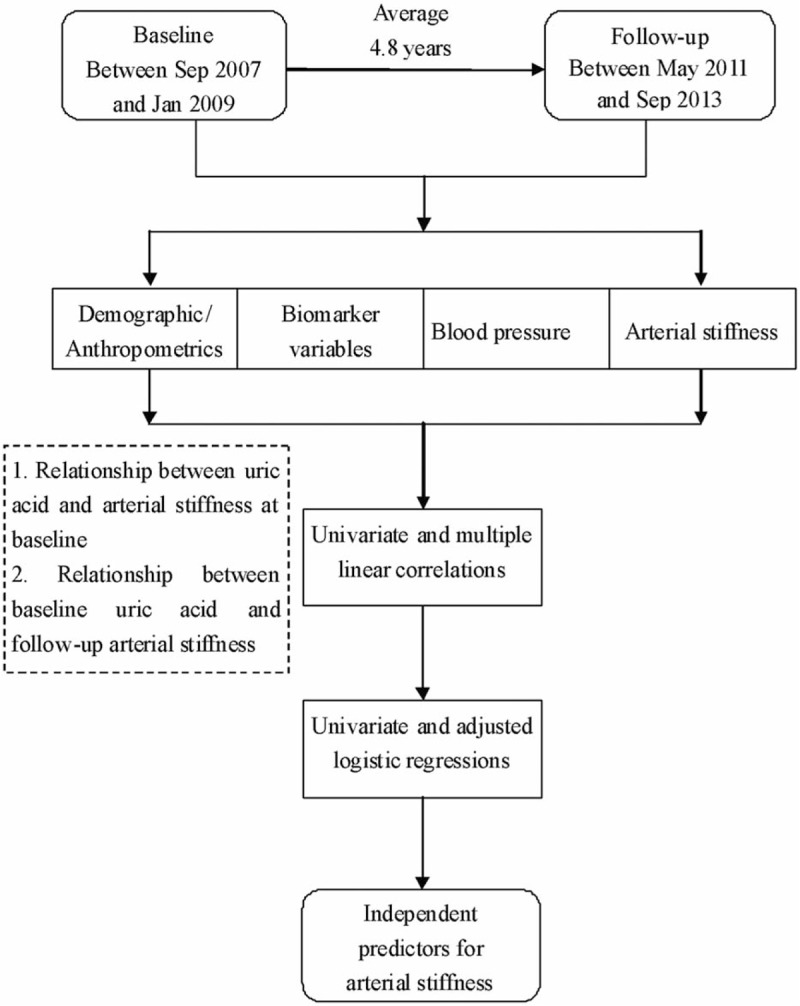
Hyperuricemia has been demonstrated to be a risk factor for cardiovascular diseases. Though the association between uric acid (UA) and arterial stiffness has been investigated previously in patients with basic diseases, the predictive value of baseline UA level for arterial stiffness has not been conducted. We aimed at identifying the predictive role of UA for arterial stiffness prospectively.A longitudinal follow-up study in a routine health check-up population was performed with an average follow-up of 4.8 years. The demographic information, baseline and follow-up anthropometric parameters, arterial stiffness (pulse-wave velocity, PWV), and biomarker variables including UA have been measured and analyzed.A total of 1447 valid follow-ups were available for the final analysis. Both of the baseline and follow-up UA levels were significantly higher in the arterial stiffness groups than that in the nonarterial stiffness groups (all P values <0.001). The follow-up carotid-femoral PWV [(cf-PWV), r = 0.161, P < 0.001] was strongly correlated with baseline UA. At the follow-up cross-section, cf-PWV was also closely associated with UA (r = 0.101, P < 0.001). Logistic regressions revealed that a higher baseline UA level was an independent predictor of follow-up arterial stiffness assessed by cf-PWV [odds ratio (OR): 1.824; P = 0.046].A higher baseline level of UA is closely related to arterial stiffness and is an independent predictor of arterial stiffening.
高尿酸血症已被证明是心血管疾病的一个危险因素。虽然之前已经在患有基础疾病的患者中研究了尿酸(UA)与动脉僵硬度之间的关联,但尚未探讨基线UA水平对动脉僵硬度的预测价值。我们旨在前瞻性地确定UA对动脉僵硬度的预测作用。
对常规健康体检人群进行了一项纵向随访研究,平均随访时间为4.8年。测量并分析了人口统计学信息、基线和随访时的人体测量参数、动脉僵硬度(脉搏波速度,PWV)以及包括UA在内的生物标志物变量。
共有1447次有效随访可用于最终分析。动脉僵硬度组的基线和随访时的UA水平均显著高于非动脉僵硬度组(所有P值<0.001)。随访时的颈股PWV[(cf-PWV),r = 0.161,P < 0.001]与基线UA密切相关。在随访横断面中,cf-PWV也与UA密切相关(r = 0.101,P < 0.001)。逻辑回归显示,较高的基线UA水平是通过cf-PWV评估的随访动脉僵硬度的独立预测因素[比值比(OR):1.824;P = 0.046]。
较高的基线UA水平与动脉僵硬度密切相关,是动脉僵硬度增加的独立预测因素。