Mooney Robert, Quinlan Leo R, Corley Gavin, Godfrey Alan, Osborough Conor, ÓLaighin Gearóid
Electrical & Electronic Engineering, School of Engineering & Informatics, NUI Galway, Galway, Ireland.
Bioelectronics Research Cluster, National Centre for Biomedical Engineering Science, NUI Galway, Galway, Ireland.
PLoS One. 2017 Feb 8;12(2):e0170902. doi: 10.1371/journal.pone.0170902. eCollection 2017.
The study aims were to evaluate the validity of two commercially available swimming activity monitors for quantifying temporal and kinematic swimming variables.
Ten national level swimmers (5 male, 5 female; 15.3±1.3years; 164.8±12.9cm; 62.4±11.1kg; 425±66 FINA points) completed a set protocol comprising 1,500m of swimming involving all four competitive swimming strokes. Swimmers wore the Finis Swimsense and the Garmin Swim activity monitors throughout. The devices automatically identified stroke type, swim distance, lap time, stroke count, stroke rate, stroke length and average speed. Video recordings were also obtained and used as a criterion measure to evaluate performance.
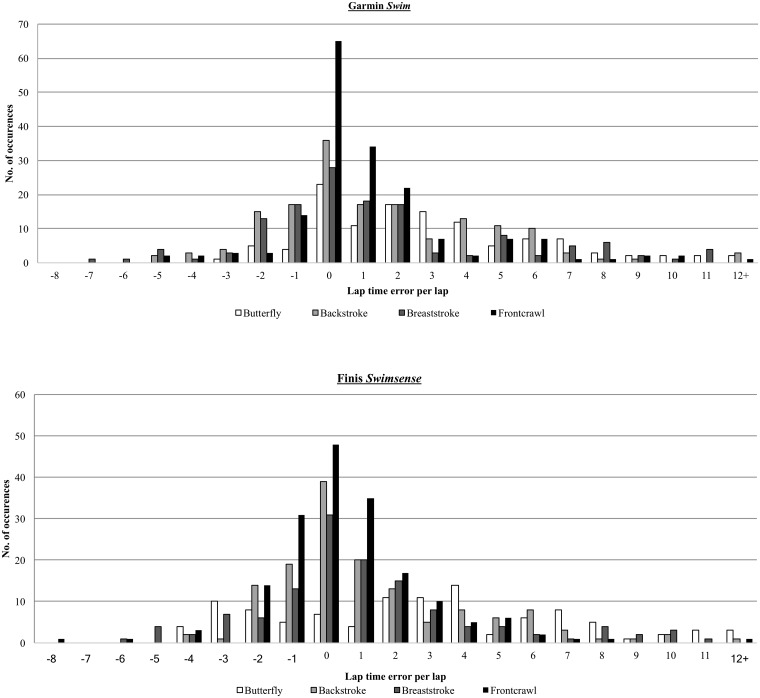
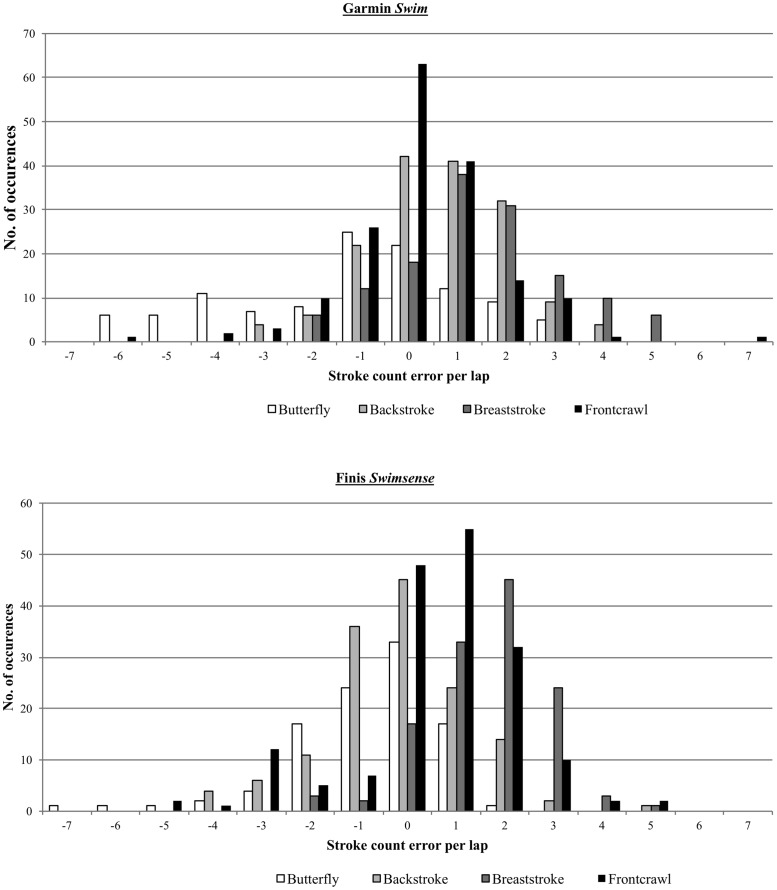
A significant positive correlation was found between the monitors and video for the identification of each of the four swim strokes (Garmin: X2 (3) = 31.292, p<0.05; Finis:X2 (3) = 33.004, p<0.05). No significant differences were found for swim distance measurements. Swimming laps performed in the middle of a swimming interval showed no significant difference from the criterion (Garmin: bias -0.065, 95% confidence intervals -3.828-6.920; Finis bias -0.02, 95% confidence intervals -3.095-3.142). However laps performed at the beginning and end of an interval were not as accurately timed. Additionally, a statistical difference was found for stroke count measurements in all but two occasions (p<0.05). These differences affect the accuracy of stroke rate, stroke length and average speed scores reported by the monitors, as all of these are derived from lap times and stroke counts.
Both monitors were found to operate with a relatively similar performance level and appear suited for recreational use. However, issues with feature detection accuracy may be related to individual variances in stroke technique. It is reasonable to expect that this level of error would increase when the devices are used by recreational swimmers rather than elite swimmers. Further development to improve accuracy of feature detection algorithms, specifically for lap time and stroke count, would also increase their suitability within competitive settings.
本研究旨在评估两款市售游泳活动监测器在量化游泳时间和运动学变量方面的有效性。
十名国家级游泳运动员(5名男性,5名女性;年龄15.3±1.3岁;身高164.8±12.9厘米;体重62.4±11.1千克;国际泳联积分425±66)完成了一套包含1500米游泳的固定方案,其中涉及所有四种竞技游泳姿势。游泳运动员全程佩戴Finis Swimsense和佳明游泳活动监测器。这些设备能自动识别划水类型、游泳距离、圈数时间、划水次数、划水频率、划水长度和平均速度。还获取了视频记录,并将其用作评估表现的标准测量方法。
在识别四种游泳姿势中的每一种时,监测器与视频之间均发现显著正相关(佳明:卡方(3)=31.292,p<0.05;Finis:卡方(3)=33.004,p<0.05)。在游泳距离测量方面未发现显著差异。在游泳时段中间完成的游泳圈数与标准测量结果无显著差异(佳明:偏差-0.065,95%置信区间-3.828至6.920;Finis偏差-0.02,95%置信区间-3.095至3.142)。然而,在时段开始和结束时完成的圈数计时并不那么准确。此外,除了两次之外,在所有情况下划水次数测量均存在统计学差异(p<0.05)。这些差异影响了监测器报告的划水频率、划水长度和平均速度得分的准确性,因为所有这些都是从圈数时间和划水次数得出的。
发现两款监测器的运行性能水平相对相似,似乎适用于休闲游泳。然而,特征检测准确性方面的问题可能与划水技术的个体差异有关。可以合理预期,当这些设备由休闲游泳者而非精英游泳者使用时,这种误差水平将会增加。进一步改进特征检测算法的准确性,特别是针对圈数时间和划水次数的算法,也将提高它们在竞技环境中的适用性。