Chung Yeon Soo, Park Young Kyung, Park Yong Ho, Park Kun Taek
Department of Veterinary Microbiology, College of Veterinary Medicine, BK21 Plus Program for Veterinary Science and Research Institute for Veterinary Science, Seoul National University, Seoul 151-742, Republic of Korea.
J Vet Med Sci. 2017 Mar 18;79(3):486-491. doi: 10.1292/jvms.16-0585. Epub 2017 Feb 11.
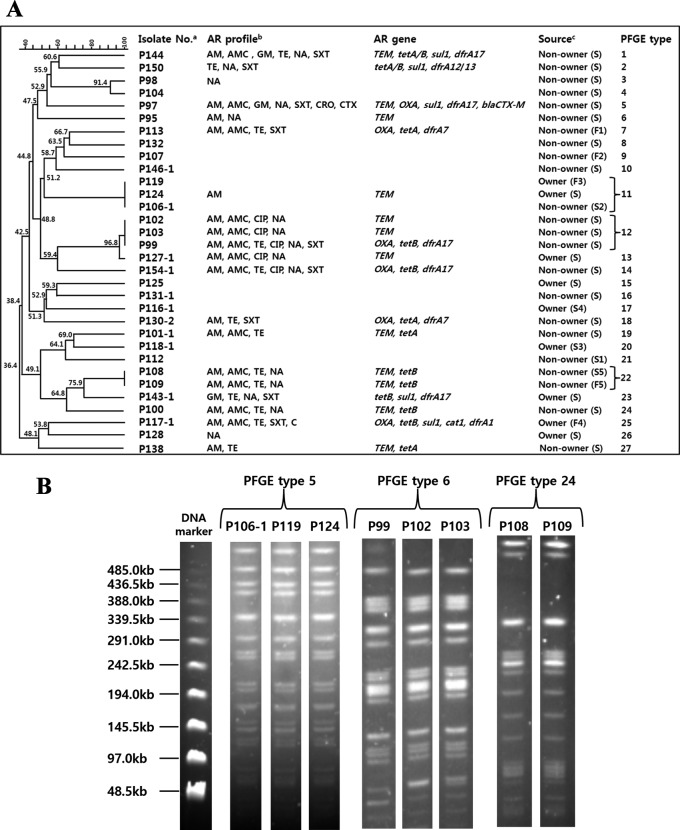
Companion animals are considered as one of the reservoirs of antimicrobial-resistant (AR) bacteria that can be cross-transmitted to humans. However, limited information is available on the possibility of AR bacteria originating from companion animals being transmitted secondarily from owners to non-owners sharing the same space. To address this issue, the present study investigated clonal relatedness among AR E. coli isolated from dog owners and non-owners in the same college classroom or household. Anal samples (n=48) were obtained from 14 owners and 34 non-owners; 31 E. coli isolates were collected (nine from owners and 22 from non-owners). Of 31 E. coli, 20 isolates (64.5%) were resistant to at least one antimicrobial, and 16 isolates (51.6%) were determined as multi-drug resistant E. coli. Six isolates (19.4%) harbored integrase genes (five harbored class I integrase gene and one harbored class 2 integrase gene, respectively). Pulsed-field gel electrophoretic analysis identified three different E. coli clonal sets among isolates, indicating that cross-transmission of AR E. coli can easily occur between owners and non-owners. The findings emphasize a potential risk of spread of AR bacteria originating from pets within human communities, once they are transferred to humans. Further studies are needed to evaluate the exact risk and identify the risk factors of secondarily transmission by investigating larger numbers of isolates from pets, their owners and non-owners in a community.
伴侣动物被认为是耐抗菌药物(AR)细菌的储存宿主之一,这些细菌可交叉传播给人类。然而,关于源自伴侣动物的AR细菌从主人二次传播给共享同一空间的非主人的可能性,目前可用信息有限。为解决这一问题,本研究调查了从同一大学教室或家庭中的狗主人和非主人分离出的AR大肠杆菌之间的克隆相关性。从14名主人和34名非主人处采集了肛拭子样本(n = 48);共收集到31株大肠杆菌分离株(9株来自主人,22株来自非主人)。在这31株大肠杆菌中,20株分离株(64.5%)对至少一种抗菌药物耐药,16株分离株(51.6%)被确定为多重耐药大肠杆菌。6株分离株(19.4%)携带整合酶基因(分别有5株携带I类整合酶基因,1株携带2类整合酶基因)。脉冲场凝胶电泳分析在分离株中鉴定出三种不同的大肠杆菌克隆群,表明AR大肠杆菌可在主人和非主人之间轻易发生交叉传播。研究结果强调了源自宠物的AR细菌一旦传播给人类,在人类社区中传播的潜在风险。需要进一步研究,通过调查社区中更多来自宠物、其主人和非主人的分离株,来评估确切风险并确定二次传播的风险因素。