Chung Yeon Soo, Hu Yoon Sung, Shin Sook, Lim Suk Kyung, Yang Soo Jin, Park Yong Ho, Park Kun Taek
Department of Veterinary Microbiology, College of Veterinary Medicine, BK21 Plus Program for Veterinary Science and Research Institute for Veterinary Science, Seoul National University, Seoul 08826, Korea.
Animal and Plant Quarantine Agency, Gimcheon 39660, Korea.
J Vet Sci. 2017 Dec 31;18(4):449-456. doi: 10.4142/jvs.2017.18.4.449.
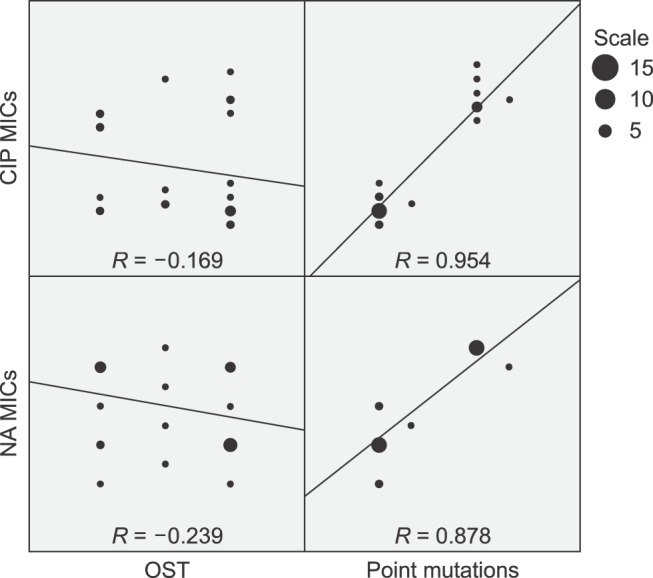
The present study investigated the prevalence and mechanisms of fluoroquinolone (FQ)/quinolone (Q) resistance in (.) isolates from companion animals, pet-owners, and non-pet-owners. A total of 63 isolates were collected from 104 anal swab samples, and 27 nalidixic acid (NA)-resistant isolates were identified. Of those, 10 showed ciprofloxacin (CIP) resistance. A plasmid-mediated Q resistance gene was detected in one isolate. Increased efflux pump activity, as measured by organic solvent tolerance assay, was detected in 18 NA-resistant isolates (66.7%), but was not correlated with an increase in minimum inhibitory concentration (MIC). Target gene mutations in Q resistance-determining regions (QRDRs) were the main cause of (FQ)Q resistance in Point mutations in QRDRs were detected in all NA-resistant isolates, and the number of mutations was strongly correlated with increased MIC ( = 0.878 for NA and 0.954 for CIP). All CIP-resistant isolates (n = 10) had double mutations in the gene, with additional mutations in and . Interestingly, (FQ)Q resistance mechanisms in isolates from companion animals were the same as those in humans. Therefore, prudent use of (FQ)Q in veterinary medicine is warranted to prevent the dissemination of (FQ)Q-resistant bacteria from animals to humans.
本研究调查了来自伴侣动物、宠物主人和非宠物主人的(.)分离株中氟喹诺酮(FQ)/喹诺酮(Q)耐药性的流行情况及其机制。从104份肛门拭子样本中总共收集了63株分离株,鉴定出27株对萘啶酸(NA)耐药的分离株。其中,10株对环丙沙星(CIP)耐药。在一株分离株中检测到质粒介导的Q耐药基因。通过有机溶剂耐受性试验测定,在18株对NA耐药的分离株(66.7%)中检测到外排泵活性增加,但与最低抑菌浓度(MIC)的增加无关。喹诺酮耐药决定区(QRDRs)的靶基因突变是(FQ)Q耐药的主要原因。在所有对NA耐药的分离株中均检测到QRDRs的点突变,突变数量与MIC增加密切相关(NA为0.878,CIP为0.954)。所有对CIP耐药的分离株(n = 10)在基因中都有双重突变,在和中还有额外的突变。有趣的是,来自伴侣动物的分离株中(FQ)Q耐药机制与人类相同。因此,有必要在兽医学中谨慎使用(FQ)Q,以防止(FQ)Q耐药菌从动物传播给人类。