Li Bin, Hu Yan, Zhao Yaochao, Cheng Mengqi, Qin Hui, Cheng Tao, Wang Qiaojie, Peng Xiaochun, Zhang Xianlong
Department of Orthopedics, Shanghai Sixth People' Hospital, Shanghai Jiao Tong University , Shanghai , China.
Front Immunol. 2017 Jan 31;8:55. doi: 10.3389/fimmu.2017.00055. eCollection 2017.
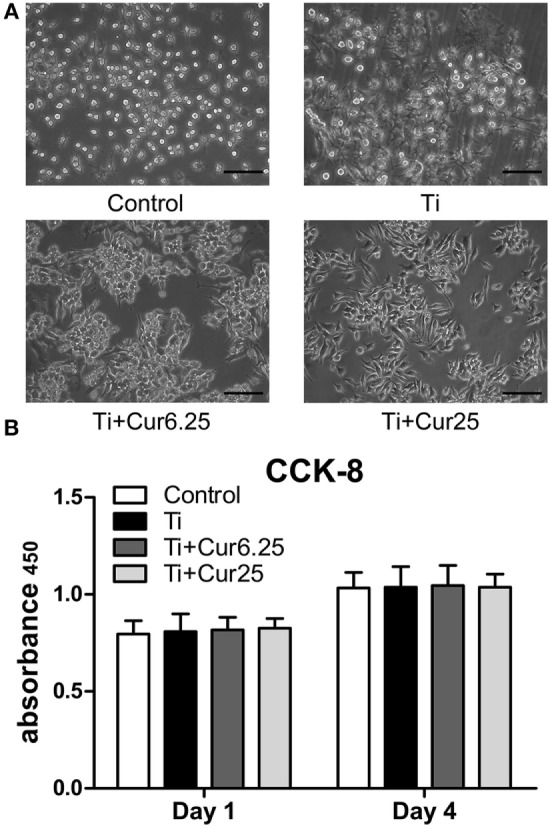
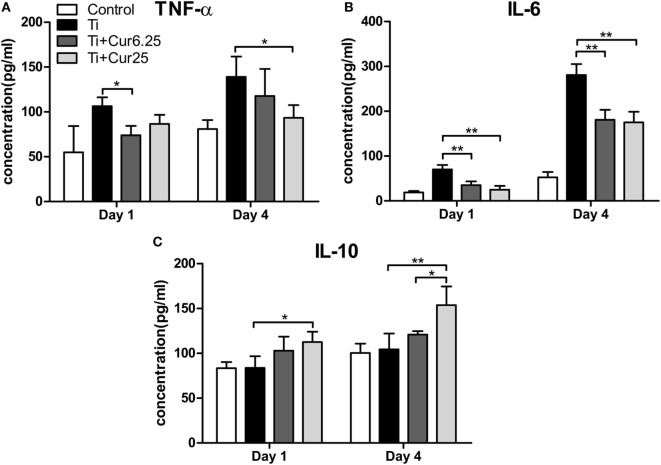
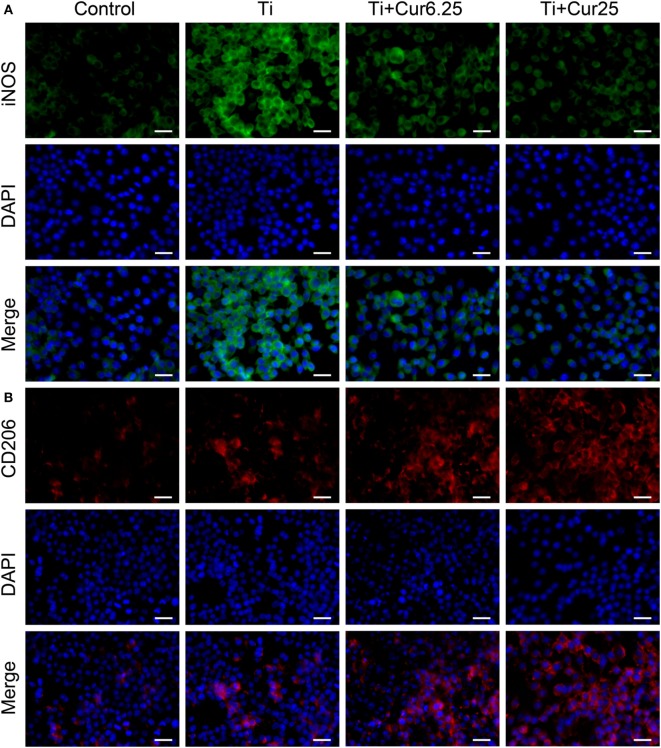
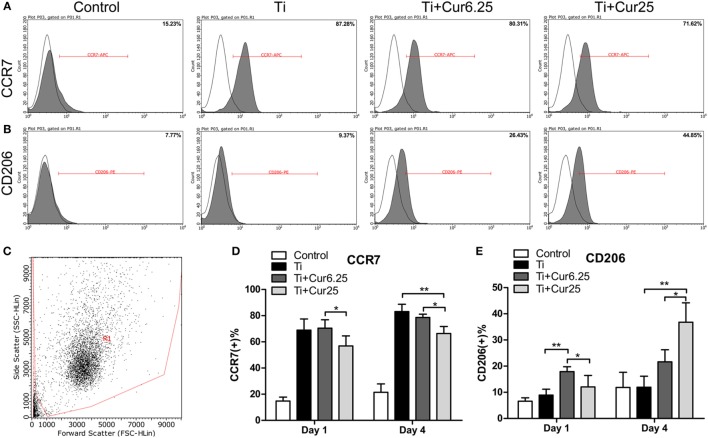
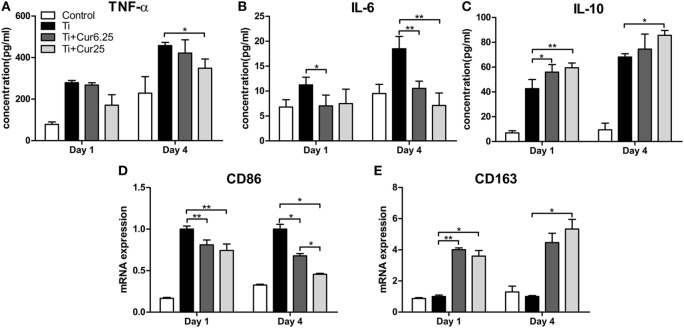
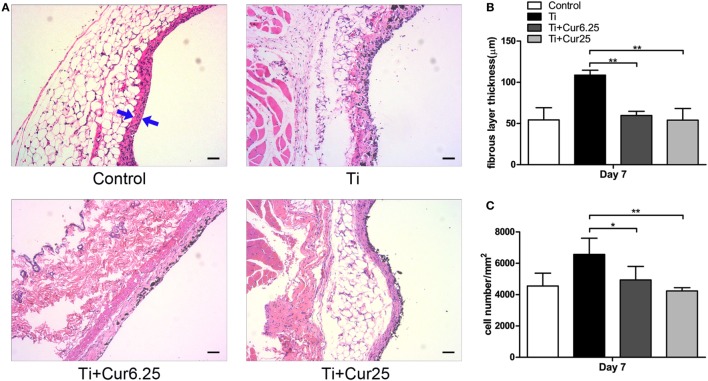
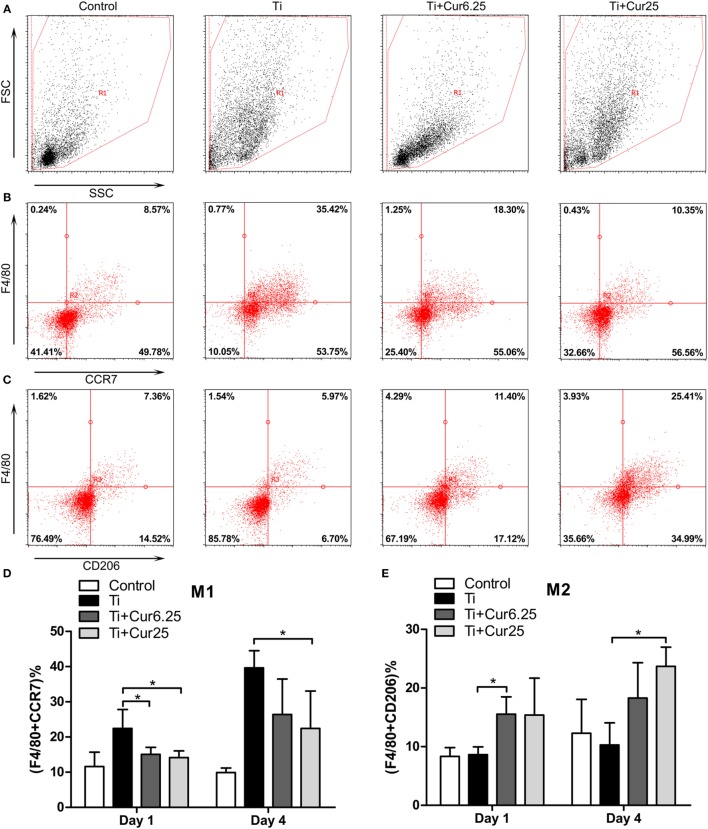
Periprosthetic inflammatory osteolysis and subsequent aseptic loosening are commonly observed in total joint arthroplasty. Other than revision surgery, few approved treatments are available for this complication. Wear particle-induced inflammation and macrophage polarization state play critical roles in periprosthetic osteolysis. We investigated the effects of curcumin, a polyphenol extracted from , on titanium (Ti) particle-induced inflammation and macrophage polarization using the murine cell line RAW 264.7 and using a murine air pouch model. The expression of specific macrophage markers was qualitatively analyzed by immunofluorescence (inducible nitric oxide synthase and CD206) and quantitatively analyzed by flow cytometry (CCR7 and CD206), representing M1 and M2 macrophages, respectively. Our results show that curcumin induced a higher percentage of M2 macrophages together with a higher concentration of anti-inflammatory cytokine IL-10, and a lower percentage of M1 macrophages with a lower concentration of pro-inflammatory cytokines (TNF-α and IL-6). The genes encoding CD86 (M1) and CD163 (M2), two additional markers, were shifted by curcumin toward an M2 phenotype. C57BL/J6 mice were injected with air and Ti particles to establish an air pouch model. Curcumin reduced cell infiltration in the pouch membrane and decreased membrane thickness. The analysis of exudates obtained from pouches demonstrated that the effects of curcumin on macrophage polarization and cytokine production were similar to those observed . These results prove that curcumin suppresses Ti particle-induced inflammation by regulating macrophage polarization. Thus, curcumin could be developed as a new therapeutic candidate for the prevention and treatment of inflammatory osteolysis and aseptic loosening.
人工关节周围炎性骨溶解及随后的无菌性松动在全关节置换术中很常见。除了翻修手术外,针对这种并发症几乎没有获批的治疗方法。磨损颗粒诱导的炎症和巨噬细胞极化状态在人工关节周围骨溶解中起关键作用。我们使用小鼠细胞系RAW 264.7并通过小鼠气袋模型研究了姜黄素(一种从[具体来源未给出]中提取的多酚)对钛(Ti)颗粒诱导的炎症和巨噬细胞极化的影响。通过免疫荧光(诱导型一氧化氮合酶和CD206)对特定巨噬细胞标志物的表达进行定性分析,并通过流式细胞术(CCR7和CD206)进行定量分析,分别代表M1和M2巨噬细胞。我们的结果表明,姜黄素诱导产生更高百分比的M2巨噬细胞以及更高浓度的抗炎细胞因子IL-10,同时M1巨噬细胞的百分比更低,促炎细胞因子(TNF-α和IL-6)的浓度也更低。编码另外两个标志物CD86(M1)和CD163(M2)的基因被姜黄素转向M2表型。向C57BL/J6小鼠注射空气和Ti颗粒以建立气袋模型。姜黄素减少了气袋膜中的细胞浸润并降低了膜厚度。对从气袋中获得的渗出物的分析表明,姜黄素对巨噬细胞极化和细胞因子产生的影响与在[具体实验条件未给出]中观察到的相似。这些结果证明姜黄素通过调节巨噬细胞极化来抑制Ti颗粒诱导的炎症。因此,姜黄素可被开发为预防和治疗炎性骨溶解及无菌性松动的新治疗候选药物。