Auer Matthias K, Liedl Anita, Fuss Johannes, Nieder Timo, Briken Peer, Stalla Günter K, Hildebrandt Thomas, Biedermann Sarah V, Sievers Caroline
Research Group Clinical Neuroendocrinology, Max Planck Institute of Psychiatry, Munich, Germany.
Institute for Sex Research and Forensic Psychiatry, University Medical Center Hamburg-Eppendorf, Hamburg, Germany.
PLoS One. 2017 Feb 15;12(2):e0171640. doi: 10.1371/journal.pone.0171640. eCollection 2017.
Studies in the general population suggest that determinants of QoL are often sex-dependent. Sex-dependent analyses of QoL in transgender populations have not been performed so far.
To identify sex-specific and potentially modifiable determinants of QoL in transgender patients.
In this cross-sectional multicentre study including 82 transwomen (TW) and 72 transmen (TM) at different treatment stages, we investigated potential determinants for QoL focusing on the impact of mood (BDI, STAI-X), sleep quality (PSQI), chronic pain (GPQ), body image (FBeK) and social support (SSS).
Health-related quality of life measured with the Short Form (36) Health Survey (SF-36).
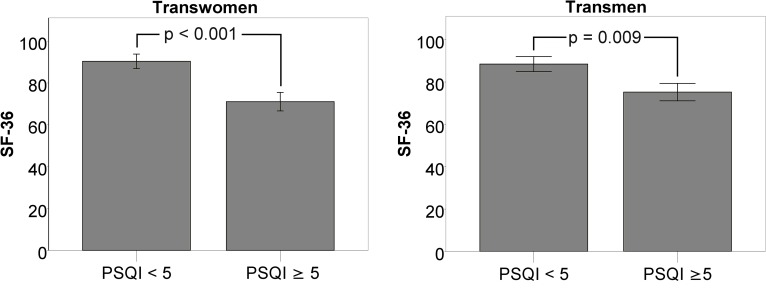
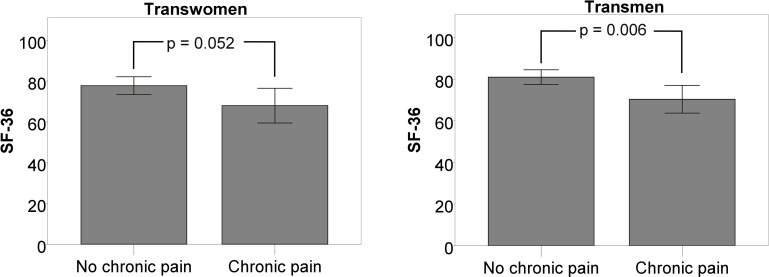
The age-adjusted SF-36 total score and its subscales did not significantly differ between TM and TW. Using a multivariate regression analysis approach, we identified common but also sex-dependent determinants for QoL (Adjusted R2 = 0.228; 0.650 respectively). Accounting for general characteristics such as age, BMI and treatment status, sleep quality according to the PSQI was an independent and strong determinant of QoL in both sexes (β = -0.451, p = 0.003 TM; β = -0.320; p = 0.0029 TW). Chronic pain was a significant independent predictor of QoL in TM (β = -0.298; p = 0.042) but not in TW. In contrast, anxiety (β = -0.451; p< 0.001) being unemployed (β = -0.206; p = 0.020) and insecurity about the own appearance (FBeK) (β = -0.261; p = 0.01) were independent predictors of QoL in TW. The rate of those reporting high sleep disturbances (PSQI ≥5) was high with 79.2% in TW and 81.2% in TM. Accordingly, age-adjusted QoL was also significantly lower in those reporting poor sleep in both sexes.
Sleep strongly affected QoL in both genders, while other factors, like pain and body image, seem to be gender specific in transgender individuals.
普通人群的研究表明,生活质量的决定因素通常与性别有关。迄今为止,尚未对跨性别群体的生活质量进行性别差异分析。
确定跨性别患者生活质量中特定于性别的以及可能可改变的决定因素。
在这项横断面多中心研究中,纳入了处于不同治疗阶段的82名跨性别女性(TW)和72名跨性别男性(TM),我们调查了生活质量的潜在决定因素,重点关注情绪(BDI、STAI-X)、睡眠质量(PSQI)、慢性疼痛(GPQ)、身体形象(FBeK)和社会支持(SSS)的影响。
使用简短健康调查问卷(SF-36)测量与健康相关的生活质量。
经年龄调整后的SF-36总分及其子量表在TM和TW之间无显著差异。采用多元回归分析方法,我们确定了生活质量的共同决定因素以及特定于性别的决定因素(调整后的R2分别为0.228和0.650)。考虑年龄、BMI和治疗状态等一般特征后,根据PSQI得出的睡眠质量是两性生活质量的一个独立且重要的决定因素(β = -0.451,p = 0.003,TM;β = -0.320;p = 0.0029,TW)。慢性疼痛是TM生活质量的一个显著独立预测因素(β = -0.298;p = 0.042),但在TW中不是。相反,焦虑(β = -0.451;p < 0.001)、失业(β = -0.206;p = 0.020)以及对自身外表的不安全感(FBeK)(β = -0.261;p = 0.01)是TW生活质量的独立预测因素。报告有高度睡眠障碍(PSQI≥5)的比例很高,TW中为79.2%,TM中为81.2%。相应地,报告睡眠不佳的两性中,经年龄调整后的生活质量也显著较低。
睡眠对两性的生活质量都有强烈影响,而疼痛和身体形象等其他因素在跨性别个体中似乎具有性别特异性。