Santos Rilma F S, Conceição Gildásio C, Martins Márcia S, Kraychete Angiolina, Penalva Maria A C, Carvalho Edgar M, Lopes Antonio Alberto, Rocha Paulo Novis
Division of Nephrology, Hospital Geral Roberto Santos, Salvador, Brazil.
Postgraduate Program in Health Sciences, Federal University of Bahia, Salvador, Brazil.
BMC Nephrol. 2017 Feb 15;18(1):64. doi: 10.1186/s12882-017-0484-y.
Infection with the human T-cell lymphotropic virus type 1 (HTLV-1), although asymptomatic in most cases, can lead to potentially grave consequences, such as adult T-cell leukemia-lymphoma and HTLV-1-associated myelopathy / tropical spastic paraparesis. Its prevalence varies widely across different populations and geographic regions. A population-based study in the city of Salvador, located in the Northeast region of Brazil, showed an overall prevalence of HTLV-1 seropositivity of 1.7%. Blood borne virus infections are recognized as important hazards for patients and staff in maintenance hemodialysis (MHD) units but most studies focus on hepatitis B, hepatitis C and human immunodeficiency viruses. There are scarce data about HTLV-1 infection in the MHD population. We aimed to determine the prevalence and risk factors for HTLV-1 infection among MHD patients in the city of Salvador-Bahia, Brazil.
We conducted a multi-center, cross-sectional study nested in a prospective cohort of MHD patients enrolled from four outpatient clinics. HTLV-1 screening was performed with ELISA and positive cases were confirmed by Western Blot. Factors associated with HTLV-1 seropositivity were identified by multivariable logistic regression.
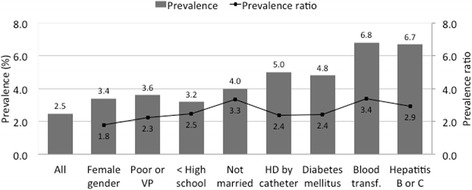
605 patients were included in the study. The overall prevalence of HTLV-1 infection was 2.48% (15/605), which was similar to that of hepatitis B [1.98% (12/605)] and C [3.14% (19/605)] viruses in our sample. HTLV-1 seropositivity was positively associated with age [prevalence odds ratio (POR) 1.04; 95% confidence interval (CI) 1.01-1.08], unmarried status (POR 3.65; 95% CI 1.13-11.65), and history of blood transfusion (POR 3.35; 95% CI 1.01-11.13).
The overall prevalence of HTLV-1 infection in a sample of MHD patients was similar to that of other viral infections, such as hepatitis B and C. Our data revealed that MHD patients who are older, unmarried or who have received blood transfusions are at higher risk for HTLV-1 infection.
人类嗜T淋巴细胞病毒1型(HTLV-1)感染在大多数情况下虽无症状,但可能导致严重后果,如成人T细胞白血病淋巴瘤和HTLV-1相关脊髓病/热带痉挛性截瘫。其在不同人群和地理区域的患病率差异很大。在巴西东北部城市萨尔瓦多进行的一项基于人群的研究显示,HTLV-1血清阳性的总体患病率为1.7%。血源病毒感染被认为是维持性血液透析(MHD)单位患者和工作人员的重要危险因素,但大多数研究集中在乙型肝炎、丙型肝炎和人类免疫缺陷病毒。关于MHD人群中HTLV-1感染的数据很少。我们旨在确定巴西巴伊亚州萨尔瓦多市MHD患者中HTLV-1感染的患病率和危险因素。
我们进行了一项多中心横断面研究,该研究嵌套于一个从四个门诊诊所招募的MHD患者前瞻性队列中。采用酶联免疫吸附测定(ELISA)进行HTLV-1筛查,阳性病例通过免疫印迹法确认。通过多变量逻辑回归确定与HTLV-1血清阳性相关的因素。
605名患者纳入研究。HTLV-1感染的总体患病率为2.48%(15/605),与我们样本中乙型肝炎[1.98%(12/605)]和丙型肝炎[3.14%(19/605)]病毒的患病率相似。HTLV-1血清阳性与年龄[患病率比值比(POR)1.04;95%置信区间(CI)1.01-1.08]、未婚状态(POR 3.65;95%CI 1.13-11.65)和输血史(POR 3.35;95%CI 1.01-11.13)呈正相关。
MHD患者样本中HTLV-1感染的总体患病率与乙型肝炎和丙型肝炎等其他病毒感染的患病率相似。我们的数据显示,年龄较大、未婚或接受过输血的MHD患者感染HTLV-1的风险更高。