Wahn Basil, Murali Supriya, Sinnett Scott, König Peter
Institute of Cognitive Science, University of Osnabrück, Osnabrück, Germany.
Department of Psychology, University of Hawai'i at Mānoa, Honolulu, Hawai'i, USA.
Iperception. 2017 Jan 1;8(1):2041669516688026. doi: 10.1177/2041669516688026. eCollection 2017 Jan-Feb.
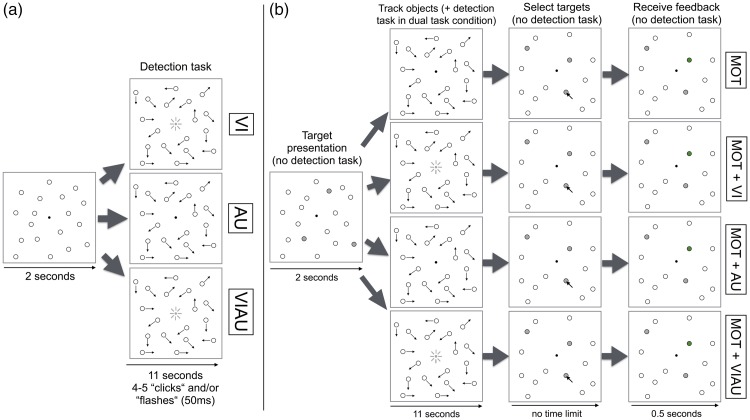
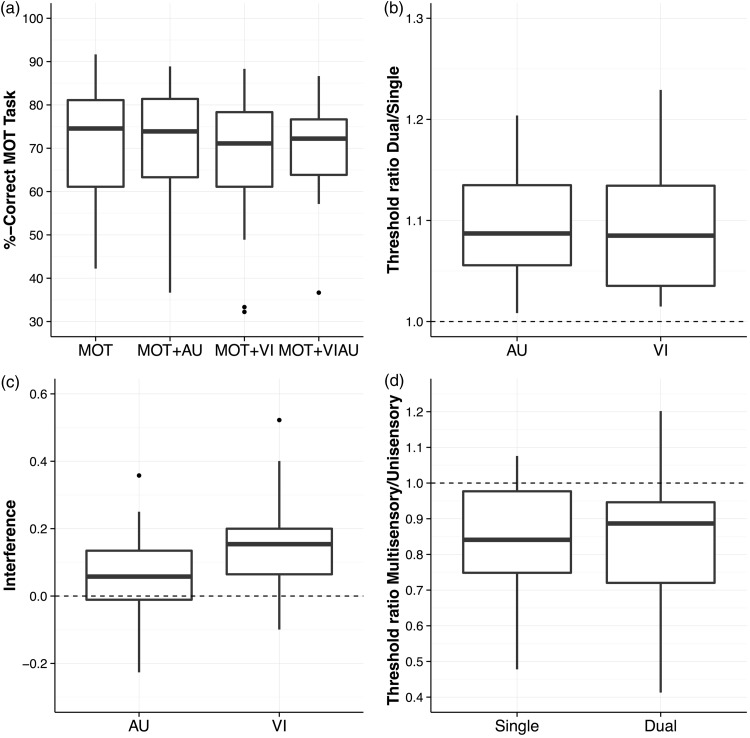
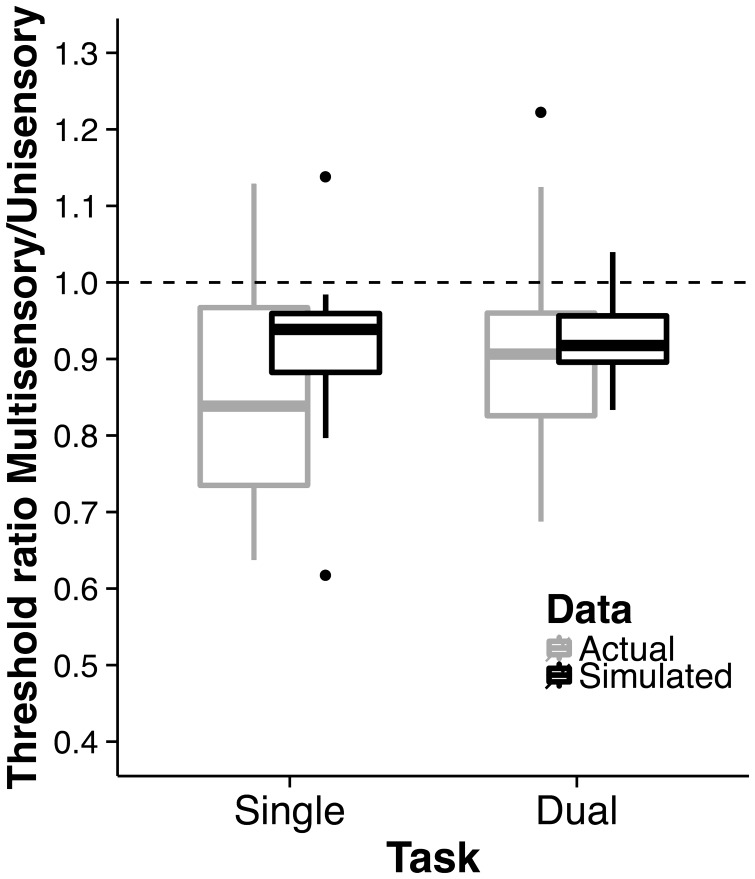
Humans' ability to detect relevant sensory information while being engaged in a demanding task is crucial in daily life. Yet, limited attentional resources restrict information processing. To date, it is still debated whether there are distinct pools of attentional resources for each sensory modality and to what extent the process of multisensory integration is dependent on attentional resources. We addressed these two questions using a dual task paradigm. Specifically, participants performed a multiple object tracking task and a detection task either separately or simultaneously. In the detection task, participants were required to detect visual, auditory, or audiovisual stimuli at varying stimulus intensities that were adjusted using a staircase procedure. We found that tasks significantly interfered. However, the interference was about 50% lower when tasks were performed in separate sensory modalities than in the same sensory modality, suggesting that attentional resources are partly shared. Moreover, we found that perceptual sensitivities were significantly improved for audiovisual stimuli relative to unisensory stimuli regardless of whether attentional resources were diverted to the multiple object tracking task or not. Overall, the present study supports the view that attentional resource allocation in multisensory processing is task-dependent and suggests that multisensory benefits are not dependent on attentional resources.
人类在执行一项要求较高的任务时检测相关感官信息的能力在日常生活中至关重要。然而,有限的注意力资源会限制信息处理。迄今为止,对于每种感官模态是否存在不同的注意力资源池以及多感官整合过程在多大程度上依赖于注意力资源仍存在争议。我们使用双任务范式解决了这两个问题。具体而言,参与者分别或同时执行多目标跟踪任务和检测任务。在检测任务中,要求参与者检测视觉、听觉或视听刺激,这些刺激的强度各不相同,并通过阶梯法进行调整。我们发现任务之间存在显著干扰。然而,当任务在不同感官模态中执行时,干扰比在相同感官模态中执行时低约50%,这表明注意力资源存在部分共享。此外,我们发现,无论注意力资源是否被转移到多目标跟踪任务上,相对于单感官刺激,视听刺激的感知敏感性都显著提高。总体而言,本研究支持多感官处理中的注意力资源分配取决于任务的观点,并表明多感官优势并不依赖于注意力资源。