McStay Catrina L, Prescott Susan L, Bower Carol, Palmer Debra J
Department of Health Western Australia, Perth 6004, Western Australia, Australia.
School of Paediatrics and Child Health, The University of Western Australia, Subiaco 6008, Western Australia, Australia.
Nutrients. 2017 Feb 9;9(2):123. doi: 10.3390/nu9020123.
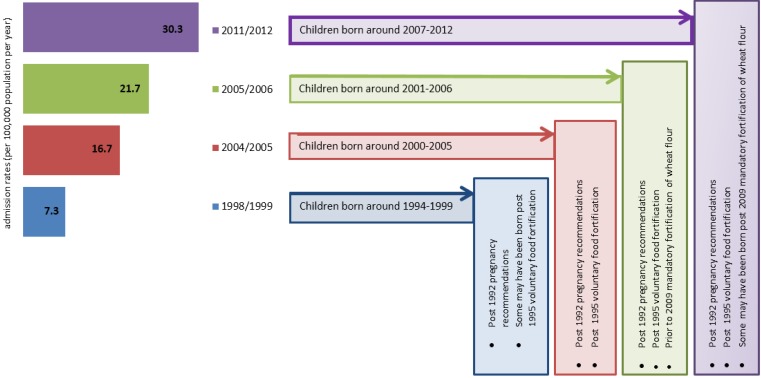
Since the early 1990s, maternal folic acid supplementation has been recommended prior to and during the first trimester of pregnancy, to reduce the risk of infant neural tube defects. In addition, many countries have also implemented the folic acid fortification of staple foods, in order to promote sufficient intakes amongst women of a childbearing age, based on concerns surrounding variable dietary and supplementation practices. As many women continue to take folic acid supplements beyond the recommended first trimester, there has been an overall increase in folate intakes, particularly in countries with mandatory fortification. This has raised questions on the consequences for the developing fetus, given that folic acid, a methyl donor, has the potential to epigenetically modify gene expression. In animal studies, folic acid has been shown to promote an allergic phenotype in the offspring, through changes in DNA methylation. Human population studies have also described associations between folate status in pregnancy and the risk of subsequent childhood allergic disease. In this review, we address the question of whether ongoing maternal folic acid supplementation after neural tube closure, could be contributing to the rise in early life allergic diseases.
自20世纪90年代初以来,建议在怀孕前和孕早期补充叶酸,以降低婴儿神经管缺陷的风险。此外,许多国家还实施了主食叶酸强化措施,以促进育龄妇女的充足摄入,这是基于对不同饮食和补充剂使用习惯的担忧。由于许多妇女在推荐的孕早期之后仍继续服用叶酸补充剂,叶酸摄入量总体有所增加,特别是在实行强制强化的国家。鉴于叶酸作为一种甲基供体,有可能对基因表达进行表观遗传修饰,这引发了关于对发育中胎儿影响的问题。在动物研究中,叶酸已被证明可通过DNA甲基化的变化促进后代出现过敏表型。人群研究也描述了孕期叶酸状态与儿童期后续过敏性疾病风险之间的关联。在本综述中,我们探讨神经管闭合后持续补充叶酸是否可能导致早期过敏性疾病增加的问题。