Gendreau Kerry L, Haney Robert A, Schwager Evelyn E, Wierschin Torsten, Stanke Mario, Richards Stephen, Garb Jessica E
Department of Biological Sciences, University of Massachusetts Lowell, Lowell, MA, 01854, USA.
Department of Biological Sciences, Virginia Tech, Biocomplexity Institute, Blacksburg, VA, 24061, USA.
BMC Genomics. 2017 Feb 16;18(1):178. doi: 10.1186/s12864-017-3551-7.
Black widow spiders are infamous for their neurotoxic venom, which can cause extreme and long-lasting pain. This unusual venom is dominated by latrotoxins and latrodectins, two protein families virtually unknown outside of the black widow genus Latrodectus, that are difficult to study given the paucity of spider genomes. Using tissue-, sex- and stage-specific expression data, we analyzed the recently sequenced genome of the house spider (Parasteatoda tepidariorum), a close relative of black widows, to investigate latrotoxin and latrodectin diversity, expression and evolution.
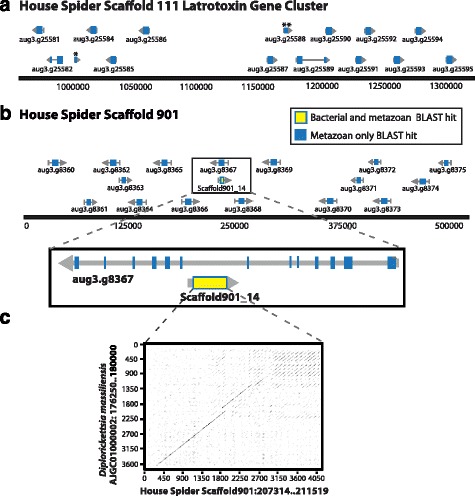
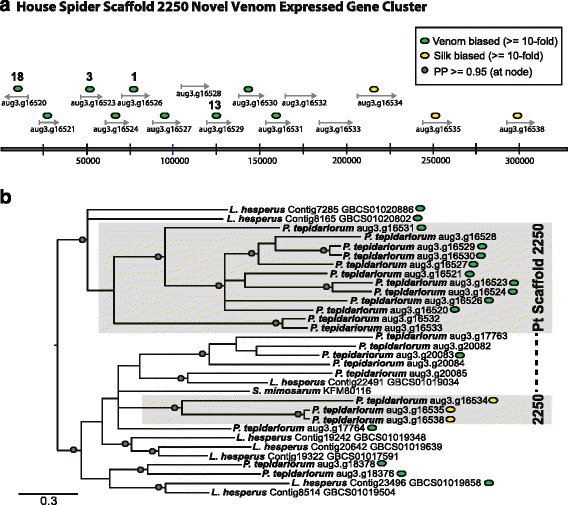
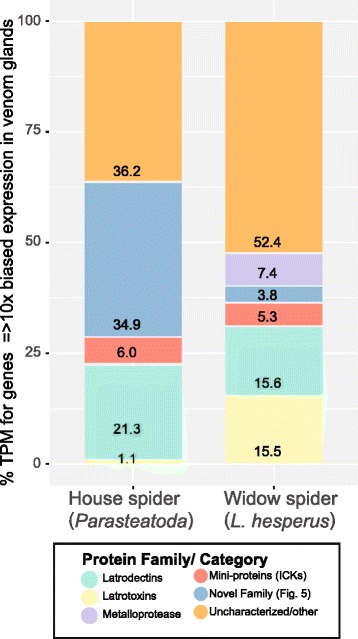
We discovered at least 47 latrotoxin genes in the house spider genome, many of which are tandem-arrayed. Latrotoxins vary extensively in predicted structural domains and expression, implying their significant functional diversification. Phylogenetic analyses show latrotoxins have substantially duplicated after the Latrodectus/Parasteatoda split and that they are also related to proteins found in endosymbiotic bacteria. Latrodectin genes are less numerous than latrotoxins, but analyses show their recruitment for venom function from neuropeptide hormone genes following duplication, inversion and domain truncation. While latrodectins and other peptides are highly expressed in house spider and black widow venom glands, latrotoxins account for a far smaller percentage of house spider venom gland expression.
The house spider genome sequence provides novel insights into the evolution of venom toxins once considered unique to black widows. Our results greatly expand the size of the latrotoxin gene family, reinforce its narrow phylogenetic distribution, and provide additional evidence for the lateral transfer of latrotoxins between spiders and bacterial endosymbionts. Moreover, we strengthen the evidence for the evolution of latrodectin venom genes from the ecdysozoan Ion Transport Peptide (ITP)/Crustacean Hyperglycemic Hormone (CHH) neuropeptide superfamily. The lower expression of latrotoxins in house spiders relative to black widows, along with the absence of a vertebrate-targeting α-latrotoxin gene in the house spider genome, may account for the extreme potency of black widow venom.
黑寡妇蜘蛛因其神经毒性毒液而声名狼藉,这种毒液会引发剧烈且持久的疼痛。这种独特的毒液主要由α- latrotoxins和latrodectins组成,这两个蛋白质家族在黑寡妇属(Latrodectus)之外几乎无人知晓,鉴于蜘蛛基因组数量稀少,对它们的研究颇具难度。我们利用组织、性别和发育阶段特异性表达数据,分析了与黑寡妇亲缘关系较近的家蛛(Parasteatoda tepidariorum)最近测序的基因组,以研究α- latrotoxins和latrodectins的多样性、表达及进化情况。
我们在家蛛基因组中发现了至少47个α- latrotoxin基因,其中许多是串联排列的。α- latrotoxins在预测的结构域和表达方面差异很大,这意味着它们具有显著的功能多样化。系统发育分析表明,α- latrotoxins在Latrodectus/Parasteatoda分化后大量复制,并且它们还与内共生细菌中发现的蛋白质有关。Latrodectin基因的数量比α- latrotoxins少,但分析表明,它们在复制、倒位和结构域截短后从神经肽激素基因招募而来行使毒液功能。虽然latrodectins和其他肽在家蛛和黑寡妇的毒腺中高度表达,但α- latrotoxins在家蛛毒腺表达中所占比例要小得多。
家蛛基因组序列为曾被认为是黑寡妇独有的毒液毒素的进化提供了新的见解。我们的研究结果极大地扩展了α- latrotoxin基因家族的规模,强化了其狭窄的系统发育分布,并为α- latrotoxins在蜘蛛和细菌内共生体之间的横向转移提供了更多证据。此外,我们加强了latrodectin毒液基因从蜕皮动物离子转运肽(ITP)/甲壳类高血糖激素(CHH)神经肽超家族进化而来的证据。家蛛中α- latrotoxins的表达低于黑寡妇,以及家蛛基因组中缺乏靶向脊椎动物的α- latrotoxin基因,这可能是黑寡妇毒液具有极强毒性的原因。