Been-Dahmen Janet M J, Walter Margot J, Dwarswaard Jolanda, Hazes Johanna M W, van Staa AnneLoes, Ista Erwin
Research Center Innovations in Care, Rotterdam University of Applied Sciences, Rochussenstraat 198, P.O. Box 25035, 3001, HA, Rotterdam, The Netherlands.
Rheumatology Department, Erasmus MC University Medical Center, P.O. Box 2040, 3000, CA, Rotterdam, The Netherlands.
BMC Musculoskelet Disord. 2017 Feb 16;18(1):84. doi: 10.1186/s12891-017-1440-5.
Today, patients are expected to take an active role in the form of self-management. Given the burden of a rheumatic disorder, the patients cannot be expected to self-manage on their own. In order to develop self-management interventions that fit patients' needs and preferences, it is essential to examine patients' perspective on how support can be optimized. This study aimed to identify support needs of outpatients with rheumatic disorders and preferences for who should provide self-management support.
A qualitative study was conducted using focus groups and individual interviews with outpatients with rheumatic disorders treated in a Dutch university hospital. Interview data was analysed with Directed Content Analysis and coded with predetermined codes derived from our model about support needs of chronically ill patients. This model distinguished three types of support: instrumental, psychosocial and relational support.
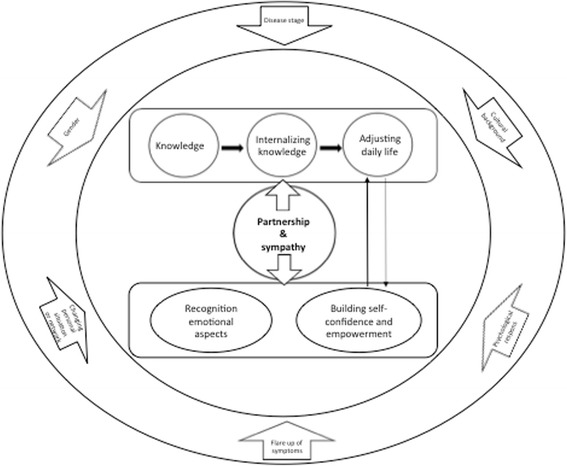
Fourteen patients participated in two focus group interviews and six were interviewed individually. Most patients preferred an active role in self-management. Nonetheless, they notably needed support in developing skills for self-managing their rheumatic disorder in daily life. The extent of support needs was influenced by disease stage, presence of symptoms and changes in one's situation. A trusted relationship and partnership were conditional for receiving any kind of professional support. Patients wanted to be seen as experienced experts of living with a rheumatic disorder. Acquiring specific disease-related knowledge, learning how to deal with symptoms and fluctuations, talking about emotional aspects, and discussing daily life issues and disease-related information were identified as important elements of self-management support. It was considered crucial that support be tailored to individual needs and expertise. Professionals and relatives were preferred as support givers. Few patients desired support from fellow patients.
Self-management was primarily seen as patient's own task. Above all, patients wanted to be seen as the experienced experts. Professionals' self-management support should be focused on coaching patients in developing problem-solving skills, for which practical tools and training are needed.
如今,患者需要以自我管理的形式发挥积极作用。鉴于风湿性疾病的负担,不能期望患者独自进行自我管理。为了开发符合患者需求和偏好的自我管理干预措施,审视患者对于如何优化支持的看法至关重要。本研究旨在确定风湿性疾病门诊患者的支持需求以及对自我管理支持提供者的偏好。
采用焦点小组和个体访谈对一家荷兰大学医院治疗的风湿性疾病门诊患者进行了定性研究。访谈数据采用定向内容分析法进行分析,并用从我们关于慢性病患者支持需求的模型中得出的预定编码进行编码。该模型区分了三种支持类型:工具性支持、心理社会支持和关系性支持。
14名患者参加了两次焦点小组访谈,6名患者接受了个体访谈。大多数患者希望在自我管理中发挥积极作用。尽管如此,他们在培养日常生活中自我管理风湿性疾病的技能方面明显需要支持。支持需求的程度受疾病阶段、症状的存在以及个人情况变化的影响。信任关系和伙伴关系是获得任何专业支持的条件。患者希望被视为患有风湿性疾病的经验丰富的专家。获取特定的疾病相关知识、学习如何应对症状和病情波动、谈论情感方面以及讨论日常生活问题和疾病相关信息被确定为自我管理支持的重要要素。支持应根据个体需求和专业知识进行量身定制被认为至关重要。专业人员和亲属更受青睐作为支持提供者。很少有患者希望得到病友的支持。
自我管理主要被视为患者自己的任务。最重要的是,患者希望被视为经验丰富的专家。专业人员的自我管理支持应侧重于指导患者培养解决问题的技能,为此需要实用工具和培训。