Zucki Fernanda, Morata Thais C, Duarte Josilene L, Ferreira Maria Cecília F, Salgado Manoel H, Alvarenga Kátia F
Universidade de São Paulo (USP), Faculdade de Odontologia de Bauru, Bauru, SP, Brazil.
National Institute for Occupational Safety and Health (NIOSH), Atlanta, USA.
Braz J Otorhinolaryngol. 2018 Mar-Apr;84(2):150-158. doi: 10.1016/j.bjorl.2016.12.004. Epub 2017 Jan 23.
The literature has reported the association between lead and auditory effects, based on clinical and experimental studies. However, there is no consensus regarding the effects of lead in the auditory system, or its correlation with the concentration of the metal in the blood.
To investigate the maturation state of the auditory system, specifically the auditory nerve and brainstem, in rats exposed to lead acetate and supplemented with ferrous sulfate.
30 weanling male rats (Rattus norvegicus, Wistar) were distributed into six groups of five animals each and exposed to one of two concentrations of lead acetate (100 or 400mg/L) and supplemented with ferrous sulfate (20mg/kg). The maturation state of the auditory nerve and brainstem was analyzed using Brainstem Auditory Evoked Potential before and after lead exposure. The concentration of lead in blood and brainstem was analyzed using Inductively Coupled Plasma-Mass Spectrometry.
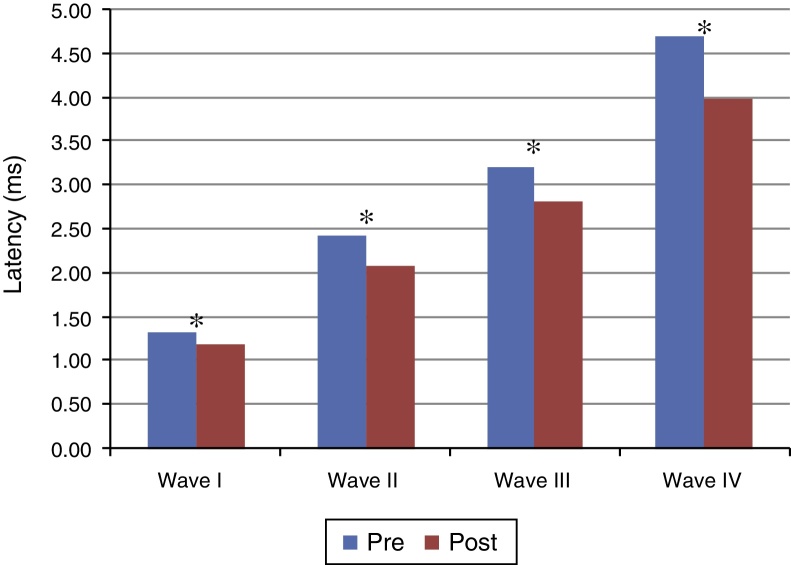
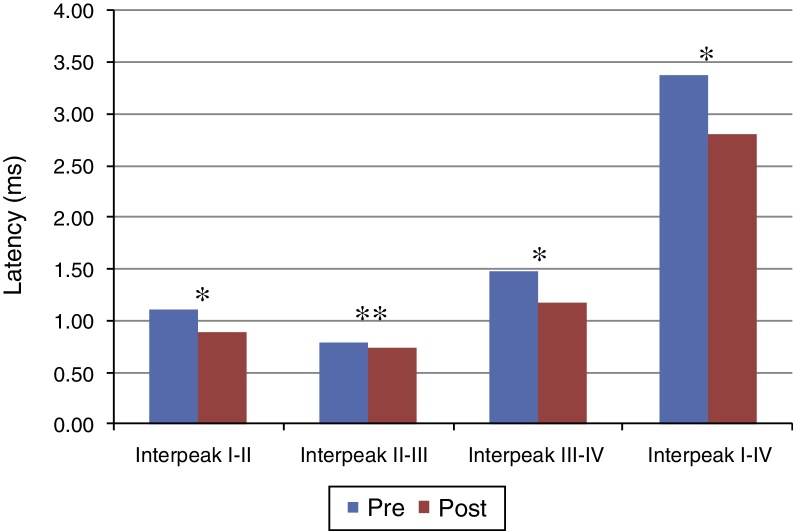
We verified that the concentration of Pb in blood and in brainstem presented a high correlation (r=0.951; p<0.0001). Both concentrations of lead acetate affected the maturation state of the auditory system, being the maturation slower in the regions corresponding to portion of the auditory nerve (wave I) and cochlear nuclei (wave II). The ferrous sulfate supplementation reduced significantly the concentration of lead in blood and brainstem for the group exposed to the lowest concentration of lead (100mg/L), but not for the group exposed to the higher concentration (400mg/L).
This study indicate that the lead acetate can have deleterious effects on the maturation of the auditory nerve and brainstem (cochlear nucleus region), as detected by the Brainstem Auditory Evoked Potentials, and the ferrous sulphate can partially amend this effect.
基于临床和实验研究,文献报道了铅与听觉效应之间的关联。然而,关于铅在听觉系统中的作用及其与血液中金属浓度的相关性,尚无共识。
研究暴露于醋酸铅并补充硫酸亚铁的大鼠听觉系统的成熟状态,特别是听神经和脑干。
将30只断奶雄性大鼠(挪威大鼠,Wistar)分成六组,每组五只动物,分别暴露于两种浓度的醋酸铅(100或400mg/L)之一,并补充硫酸亚铁(20mg/kg)。在铅暴露前后,使用脑干听觉诱发电位分析听神经和脑干的成熟状态。使用电感耦合等离子体质谱法分析血液和脑干中的铅浓度。
我们证实血液和脑干中的铅浓度呈现高度相关性(r = 0.951;p < 0.0001)。两种浓度的醋酸铅均影响听觉系统的成熟状态,在对应于听神经部分(波I)和耳蜗核(波II)的区域成熟较慢。补充硫酸亚铁显著降低了暴露于最低铅浓度(100mg/L)组的血液和脑干中的铅浓度,但对暴露于较高浓度(400mg/L)组没有影响。
本研究表明,如脑干听觉诱发电位所检测到的,醋酸铅可对听神经和脑干(耳蜗核区域)的成熟产生有害影响,而硫酸亚铁可部分改善这种影响。